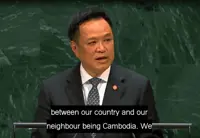
BANGKOK: Thailand and its prime minister, Anutin Charnvirakul (pic), avoided renewed political upheaval after a ruling by one of the country’s top courts removed the threat that the recent election would need to be rerun.
The Constitutional Court decided Monday (Sept 28) on a case over the use of barcodes and QR codes on ballots in the February national election, which critics alleged violated constitutional guarantees for direct and secret elections because they could allow votes to be traceable to individuals.
The court, however, determined that there were enough security measures in place for it to be "difficult” to match votes to voters using the three key components - voter rolls, ballots and voting stubs.
It ultimately decided that the use of the markings - intended to counter fraud - didn’t violate the constitutional principles, aimed at protecting the right of political expression without threat or interference.
The decision allows Anutin’s Bhumjaithai Party-led government to continue with the decisive mandate it won earlier this year, removing the prospect of another nationwide election just seven months after voters last went to the polls.
It also reduces the risk of disruption to economic policy at a difficult time for the Southeast Asian economy. Thailand is projected to grow only about 2.5% this year, constrained by high household debt, weak domestic demand and elevated energy costs.
Investors had also faced the possibility that a new election would interrupt a sharp recovery in Thai assets. The benchmark SET Index has gained more than 25% this year.
At the centre of the case were unique barcodes and QR codes printed on ballots and corresponding stubs containing voter information. The Election Commission has said the identifiers were designed to prevent fraud and properly account for ballots.
The agency acknowledged that ballots could theoretically be matched with their stubs but argued that ballots, stubs and voter-registration records were stored separately, making it impractical to determine how an individual voted.
The court said Monday that QR codes, used on constituency ballots, couldn’t help identify voters, but that the barcodes, used on party ballots, could potentially lead to voter identification.
It said the process had fuelled public mistrust and urged the Election Commission to consider using ballots without identifying markings in future elections.
Anutin is under growing pressure to deliver on campaign promises to lift investment, strengthen competitiveness and revive an economy that has underperformed many of its South-East Asian peers for more than a decade.
Public frustration over living costs and higher energy prices remains a political vulnerability. Veteran protest leader Sondhi Limthongkul has also already begun mobilising supporters against the administration over alleged corruption and political interference.
Only 13.8% of people polled this month backed Anutin as prime minister, compared with 21.7% in June, according to a Sept 18-23 nationwide survey released Sunday by the National Institute of Development Administration. Bhumjaithai’s rating declined to 12.1% from 17% over the same period, pushing it into third place behind the opposition People’s Party and coalition partner Pheu Thai.
Thailand’s courts have overturned national elections before. In 2006, the Constitutional Court annulled an election partly over ballot-secrecy concerns and other irregularities. The military ousted then-Prime Minister Thaksin Shinawatra four months later, ushering in another period of political upheaval.- Bloomberg