VIENTIANE: The government has agreed in principle to adopt 10-year strategies concerning artificial intelligence and satellite technology as Laos seeks to make greater use of advanced technologies to support national development.
The decision is centred around the draft National Artificial Intelligence Strategy for 2026-2035 and a draft Strategy on the Development and Use of Satellites in Laos for 2026-2035.
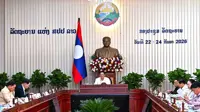
The two documents were among the key items considered at the government’s monthly meeting for September, chaired by Prime Minister Sonexay Siphandone at the Office of the Prime Minister on September 22-23.
Speaking about the move at a press conference, Deputy Head of the Office of the Prime Minister’s Office, Dr Kherngkham Keonouchanh, said the government had instructed the Ministry of Technology and Communications, together with relevant sectors, to revise both drafts based on comments from government members.
With regard to the artificial intelligence strategy, the government called for a greater focus on infrastructure, databases and personnel.
It also wants the strategy to set clear priorities for the use of artificial intelligence and identify areas where the technology can deliver the greatest benefits to Laos.
The government highlighted the need to clarify investment and cooperation conditions, as well as maintain a policy of neutrality in technological cooperation.
Concerning the satellite strategy, the government called for clearer priorities around the scope of use, investment and cooperation in the development of technology.
As digital technologies continue to advance rapidly, satellite systems and artificial intelligence are becoming increasingly useful for development purposes. These technologies could support agriculture, weather and flood monitoring, environmental protection, transport and public services.
Satellite data can provide information for planning and monitoring, while artificial intelligence can help process large amounts of data and enable faster and more informed decisions.
Upgrading skills and infrastructure in these fields could create additional opportunities for research, technology-based businesses and digital services.
The push for these technologies also aligns with the government’s investment agenda for 2026-2030.
According to a report presented by the Investment Promotion and Management Committee at an investment promotion and management conference in August, the government is seeking investment in data centres, artificial intelligence and other digital industries as it strives to diversify the economy and attract higher-value projects.
The investment plan identifies the digital and technology sector, data centres, artificial intelligence, information technology and financial technology as areas with investment potential.
The new focus is part of the government’s bid to attract quality investment and reduce reliance on development projects based mainly on natural resources.
Under this investment agenda, the government is looking to attract projects that bring modern technology to Laos, create a skilled workforce, and connect Lao businesses with regional and international production chains.
Beyond strategies centred around technology, the meeting addressed several legislative and economic matters. The government approved draft action plans concerning gender equality and the protection of women and children, while also agreeing to revise or consolidate laws relating to electricity, mining and social security.
On the economic front, officials reported that budget revenue had reached 78 per cent of the annual target by September, with the average inflation rate recorded at 7.7 per cent.
To maintain economic stability, ministries were instructed to maximise budget collection, encourage wider use of electric vehicles, and strengthen productivity with the aim of curbing price rises while also reducing imports of luxury goods.
Amid the African swine fever outbreak, the government ordered strict surveillance and is evaluating support policies for affected pig farmers, alongside promoting the cultivation of rainy-season and import-substitution crops.
Furthermore, the government is preparing comprehensive reports on the 2026 National Socio-Economic Development Plan, the State Budget Plan and the Monetary Plan. These documents, along with strategic directions for 2027, will be presented at the second ordinary session of the 10th National Assembly in October.
Closing the meeting, Prime Minister Sonexay urged all government members and local leaders to incorporate the agreed priorities into their work plans, ensuring clear responsibilities and strict deadlines based on actual conditions. - Vientiane Times/ANN