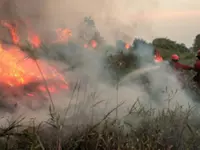
JAKARTA: The burning forests and peatlands in Kalimantan are threatening the region’s endemic orangutans, prompting conservation groups and authorities to step up rescue efforts from the blaze spreading through their natural habitats.
At least 57,000 hectares of land had been burned across Kalimantan, according to the Forestry Ministry’s record as of late July. Some of the burning forests were homes for the endangered Bornean orangutans, which is already fragmented and reduced by deforestation in the region.
Around 57,350 Bornean orangutans live in forests fragmented by industrial concessions across Kalimantan, with 20 per cent of their habitat located within protected forest.
With their homes already fragmented by the forest loss, the fires put the primates at higher risk of not having enough food to survive, forcing them to enter villages and farms that put them into conflict with humans, according to International Animal Rescue (IAR) Indonesia CEO Karmele Llano Sanchez.
One such case took place in Ketapang, West Kalimantan, where IAR Indonesia and local authorities rescued three orangutans on Aug 19 previously found in a community plantation after fires swept through nearby forest that serves as their home range.
The orangutans were translocated to the Gunung Palung National Park in the province. But the three orangutans were not the only ones affected by the fire, with the rescue group having since saved another individual and continued monitoring several others near burned areas.
“We need to be really cautious and aware that more orangutans might need to be rescued in the weeks or months to come,” Sanchez told The Jakarta Post on Aug 27.
Another conservation group Borneo Orangutan Survival Foundation (BOSF) has been standing on guard since January by monitoring fires and preparing water sources in its conservation areas as mitigation measures in facing the El Nino-induced dry season.
No wild or rehabilitated orangutans have needed to be rescued by the foundation so far. None of its rehabilitation centres were also directly affected by fire, but about 48 ha of forest in its Mawas restoration area in Central Kalimantan have burned.
The 309,000-ha peatland area is home to more than 2,500 wild orangutans.
“But an equally serious impact is the smoke, which can reach the rehabilitation centres, BOSF CEO Jamartin Sihite said on Saturday.
As a preventive measure, BOSF provided orangutans at their facilities with multivitamins to help boost their immune systems. But wild orangutans exposed to smoke from wildfires are at higher risk of respiratory infections, Jamartin added.
The disease may disrupt their ability to navigate their habitat, potentially driving them out of the forest. Wildfire could also make it harder for orangutans to survive in the long-term.
“Thick smoke blocks sunlight from penetrating the forest canopy, disrupting the production of fruit trees in the forest, which are a major food source for orangutans,” ecologist Didik Prasetyo of Jakarta-based National University (UNAS) on Aug 27, citing such a condition had impacted orangutans after the 2015 wildfire in Kalimantan.
He added that limited food supply forces orangutans to delay reproduction. They already mate slower than any other primates. Female orangutans typically give birth once every seven to eight years.
Forest and land fires could eventually push already vulnerable orangutan populations closer to extinction, according to World Wildlife Fund (WWF) Indonesia forest and wildlife program director Muhammad Ali Imron.
“The government, communities, land users, businesses and conservationists need to work together to protect orangutan habitats, maintain their connectivity and capacity and ensure long-term survival of the species,” Ali said.
The best strategy is to prevent fires before they happen through stronger land use management and law enforcement to prevent intentional burning to clear land for farming, said Sanchez of IAR Indonesia.
Orangutan conservation was closely tied to the Forestry Ministry’s work in containing the wildfire, with its officials continuing to launch patrols, extinguish fires in key orangutan habitats, secure wildlife corridors and move animals from high-risk regions, said ministry spokesperson Ristianto Pribadi on Aug 27.
On Aug 26, Forestry Ministry Raja Juli Antoni visited Berau, East Kalimantan, to ensure fires did not threaten orangutan habitats in the area. He said wildfire responses were aimed not only at protecting humans, but also wildlife. - The Jakarta Post/ANN
*Gembong Hanung contributed to the story.