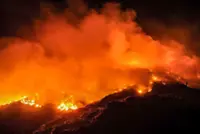
JAKARTA: The number of fire hotspots across Indonesia has surged to the highest level in more than a decade, raising the prospect of severe wildfires and choking haze as El Niño leads to drier conditions in the region.
Over 3,500 hotspots have been recorded so far this month, more than quadruple the July total and the highest August count since 2015, according to the Forestry Ministry’s fire-monitoring platform SiPongi. A hotspot is characterised as a location where satellites detect an elevated surface temperature, indicating a potential fire.
Wildfires and the haze they cause are a near-annual problem across South-East Asia, costing local economies billions of dollars. This year’s intensifying El Niño, a climate pattern that tends to trigger hotter and drier conditions across the region, threatens to heighten fire risks as higher temperatures and parched vegetation turn landscapes into tinderboxes.
Indonesia has been baked by unseasonably dry weather over recent weeks, with significantly lower rainfall and average temperatures around 1.2C above normal since July, data from Atmospheric G2 shows. Arid conditions are set to persist, with climate models seeing a high chance of below-normal rainfall through October, according to the Asean Specialised Meteorological Centre.
There are heightened fire weather conditions in regions including much of Kalimantan, Sumatra, and Java, according to Indonesia’s meteorological agency. A high fire weather index means any blazes that break out are more difficult to control.
The agency pointed to a very strong El Niño and a positive phase of another climate pattern in the Indian Ocean in its latest wildfire bulletin.
In 2015, widespread fires across South-East Asia triggered a regional haze emergency and cost Indonesia US$16 billion, and led to elevated diplomatic tensions between neighbouring countries. That year also saw a strong El Niño event that brought significantly below-normal rainfall to Indonesia.
Globally, dry spells caused by heat waves and amplified by the strengthening El Niño have already caused major fires in North America and Europe. Australia is forecast to see a more dangerous wildfire season from September through November, driven by dry fuel loads, low soil moisture and scant rainfall, according to an official outlook published this week. - Bloomberg