
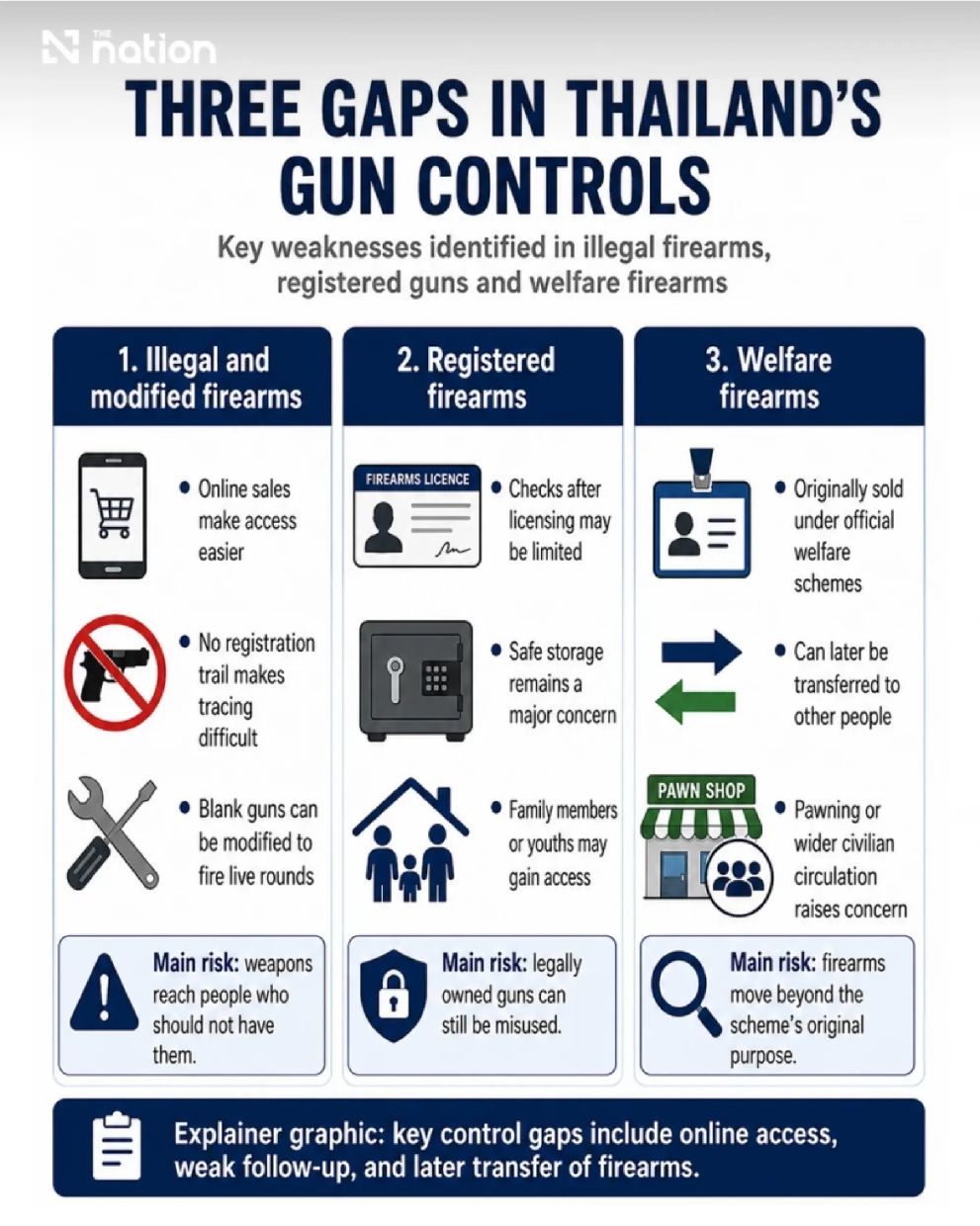
BANGKOK: Thailand’s firearm controls face three persistent gaps involving illegal and modified guns sold outside the registration system, insufficient oversight of legally owned weapons after licences are issued, and the transfer of firearms bought through government welfare schemes.
The weaknesses have returned to attention following the shooting at Debsirin Nonthaburi School on Aug 7 and the shooting of the chairman of the Nonthaburi Provincial Administrative Organisation three days later.
Since 2020, Thailand has experienced at least 13 serious firearm incidents, underscoring problems ranging from legal and illegal access to online sales and the use of weapons belonging to officials or family members.
Small Arms Survey estimates put the number of civilian-held firearms in Thailand at about 10.34 million, comprising approximately 6.22 million registered weapons and more than 4 million unregistered firearms.
Earlier Small Arms Survey figures cited by Nation Thailand similarly put civilian holdings at more than 10.3 million, including about 4 million illegal weapons.
The figures indicate that tackling illegal guns alone would leave substantial questions over registered firearms and weapons acquired through government welfare schemes.
Illegal and modified guns move online
Unregistered firearms remain difficult for authorities to trace because there is no official record linking a weapon to its owner or documenting subsequent transfers.
Growing concern also surrounds blank-firing or imitation firearms, commonly referred to as blank guns. Although designed to fire blank ammunition, some can be modified to fire live rounds.
The issue came into sharp focus after the 2023 Siam Paragon shooting, in which a 14-year-old used what police identified as a modified blank gun.
Investigators subsequently examined its online purchase trail and arrested suspects allegedly connected with the sale of firearms and ammunition.
The case exposed two related problems: the treatment of imitation firearms under existing rules and their availability through online sales channels. Following the Siam Paragon shooting, the Interior Ministry announced measures targeting illegal online firearm sales and tighter controls on imitation weapons.
The illegal market has therefore expanded beyond conventional face-to-face transactions to include online sales, modification and onward distribution, creating another route through which people who should not have access to firearms can obtain them.
Registered guns raise storage and ownership questions
The second gap concerns firearms that are legally registered.
With more than 6.2 million registered firearms, the policy question extends beyond deciding who qualifies for a licence to how owners are monitored afterwards and whether weapons and ammunition are stored securely.
The Aug 7 shooting at Debsirin Nonthaburi School illustrated that risk. Police said the handgun used by the 14-year-old was legally registered to his grandfather, but the boy was able to take the firearm and ammunition from the family home.
The case has brought firearm storage and access within households into the debate, particularly how authorities can prevent children or other family members from gaining access to legally owned weapons.
The government had already tightened firearm controls earlier in 2026, including closer scrutiny of purchase applications and continued monitoring of existing licence holders.
Following the Nonthaburi school shooting, attention has also turned to tougher checks on firearm storage, reviews of existing owners and measures to prevent young people from accessing adults’ weapons.
Welfare firearms can move into civilian hands
A third concern involves firearms sold under government welfare schemes for civil servants and certain groups of state officials.
The programmes allow eligible officials to purchase firearms at prices below normal market levels for purposes including personal and property protection and duties associated with their work.
Research by Assoc Prof Sumet Jarnpradub and colleagues identified several legal problems involving firearm licensing, including government welfare firearms, the number of guns an individual may possess and the modification of imitation firearms. The research was published in the Ramkhamhaeng Law Journal in 2025.
Among the problems cited were welfare firearms being transferred or pawned in ways that depart from the original purpose of the scheme.
The so-called Kamnan Nok case was cited as an example in which a firearm discovered during the investigation was identified as a weapon originally obtained through a government welfare programme.
The researchers also pointed to Interior Ministry letter No. MOI 0307.4/W1479, which allows a welfare firearm to be transferred into another person’s name after the original holder has possessed it for five years, with inheritance treated separately. The paper itself lists the March 12, 2021, directive among its references.
They viewed the transfer provision as a gap that can allow firearms originally supplied under a civil-service welfare scheme to move into the hands of members of the general public.
Another concern identified was the absence of a sufficiently clear limit on the number of welfare firearms an individual official may purchase.
Taken together, the three areas broaden Thailand’s firearm-control challenge beyond seizures of illegal weapons. They cover how guns are bought online, who retains access after a licence has been granted, how weapons are stored inside homes and how firearms acquired through government welfare schemes can later change hands. - The Nation/ANN
[Source: Thansettakij]