
PHNOM PENH: Prime Minister Hun Manet has reaffirmed plans to build a road through Cambodian territory to the remote 'Dragon’s Tail' area at the Cambodia-Laos-Vietnam tri-border point. He noted that difficult terrain should not prevent the government from connecting the area directly with the rest of the kingdom.
Speaking in Stung Treng province on Wednesday (Aug 12), Manet framed road development in Cambodia’s northeast as serving several purposes at once — improving livelihoods and investment opportunities, opening remote areas and strengthening the country’s ability to protect and manage its territory.
He singled out the planned Route 78½, which is intended to extend from the Banlung area in Ratanakiri province towards the remote northeastern tip of Cambodia where the borders of Cambodia, Laos and Vietnam meet.
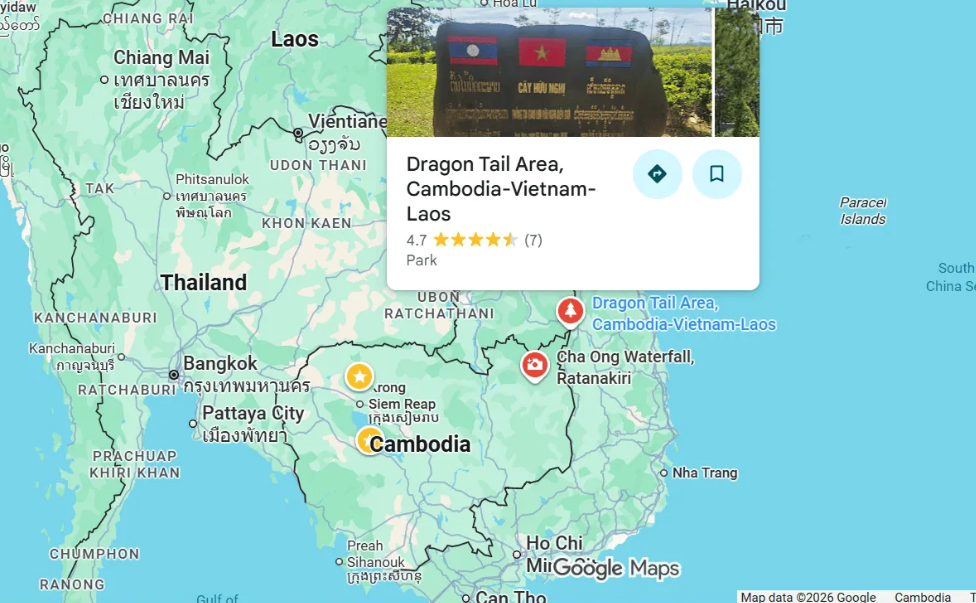
Manet said access from the Cambodian side remains difficult because of the terrain, with some travel to the area currently requiring access through Vietnamese territory.
He insisted that Cambodia should establish its own direct connection.
“We must do it, regardless of how difficult or how far it is. We must complete it, entering from Cambodian territory all the way to the Dragon’s Tail,” he said.
The prime minister explained that the objective was to enable Cambodians to travel through their own country to see the tri-border point, rather than having to enter the area via a neighbouring country.
His remarks formed part of a wider speech on the development of Cambodia’s northeastern provinces — Stung Treng, Ratanakiri, Mondulkiri and Kratie — in which he repeatedly linked transport infrastructure with economic opportunities, population settlement and territorial protection.
Manet compared roads to the blood vessels of the human body, arguing that connectivity allows economic and social activity to develop in previously isolated areas.
“Roads are like blood vessels. Wherever blood vessels reach, they nourish that part of the body,” he said, adding that where there are roads, “there is hope”.
He said better roads could encourage people to settle and develop livelihoods in remote areas, helping turn previously isolated locations into economically active communities.
The infrastructure push comes as the government seeks to accelerate development in the northeast following Cambodia’s withdrawal from the Cambodia-Laos-Vietnam Development Triangle Area (CLV-DTA) in September 2024.
The CLV-DTA was launched in 1999 as a trilateral cooperation framework intended to improve infrastructure, trade, investment and living conditions in remote border areas. It eventually covered 13 provinces — four in Cambodia, four in Laos and five in Vietnam.
Cambodia’s participating provinces were Kratie, Stung Treng, Mondulkiri and Ratanakiri.
Cambodia formally withdrew from the initiative in September 2024, following intense public debate and protests.
Critics had raised concerns about territorial sovereignty and Cambodia’s relationship with Vietnam, while the government repeatedly rejected allegations that participation in the framework could result in the loss of Cambodian territory.
Manet revisited the controversy during his Aug 12 speech, saying the development framework had been portrayed by some as a plan under which Cambodia would lose its four northeastern provinces.
He rejected that interpretation and said the initiative had originally been intended to accelerate development in a region that remained particularly isolated following the end of Cambodia’s civil war in 1998.
Regardless of whether the CLV-DTA still existed, he said, developing the four northeastern provinces remained a government priority. - The Phnom Penh Post/ANN