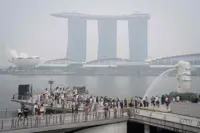
SINGAPORE: Dry conditions that have worsened fires in the region are expected to persist this week, raising the risk of haze over Singapore.
On Aug 9, the Republic’s haze task force announced its readiness to roll out plans after the 24-hour Pollutant Standards Index (PSI) entered the moderate range in central Singapore in the afternoon.
Following the recent warning of the possible return of hazy weather, The Straits Times looks at what residents need to know to protect themselves.
How worrying is the recent haze outlook for Singapore?
Singapore is among the southern South-east Asian countries at high risk of severe haze affecting the region for the rest of 2026. These conditions are expected to peak from August to September, according to think-tank Singapore Institute of International Affairs.
This is due to unusually hot and dry weather, fuelled by an intensifying El Nino climate phenomenon.
El Nino occurs when the atmosphere reacts to a sustained warming of the Pacific Ocean’s surface temperatures above average levels, bringing less rain, longer dry spells and higher temperatures to South-East Asia.
Scientists have warned that the 2026/2027 El Nino could become a “Godzilla” or Super El Nino, with temperatures in the tropical Pacific warming rapidly.
El Nino events tend to have the greatest bearing on Singapore’s rainfall during the dry south-west monsoon season from June to September.
Past moderate-to-strong El Nino events over the last 30 years have resulted in 40 per cent to 80 per cent less rainfall in parts of Singapore for some months.
These drier and warmer conditions worsen the region’s peatland and forest fires, which are the main drivers for transboundary haze experienced in Singapore.
The National Environment Agency (NEA) on Aug 9 said the dry conditions that escalated hot spots in Indonesia’s Sumatra and Kalimantan are expected to persist in the coming week, increasing the risk of haze if the fires persist.
Under prevailing southeasterly winds, smoke haze could be carried to Singapore, especially from the hot spots in the southern parts of Sumatra.
For 2026, the confluence of El Nino and the potential development of another climate phenomenon called the positive Indian Ocean Dipole could prolong the dry season and extend it into October. A positive Indian Ocean Dipole is similar to El Nino, but develops in the equatorial Indian Ocean.
To manage the impact of haze, Singapore set up a task force in 1994 chaired by NEA.
The task force, which typically convenes yearly before the dry season starts in June, has already met twice in 2026.
What happens when air quality goes into the unhealthy range?
The task force will roll out its plans. Air quality enters the unhealthy range when the 24-hour PSI, derived from the 24-hour average concentration levels of six pollutants, exceeds 100.
Once the PSI enters the unhealthy zone between 101 and 200, NEA will issue daily haze advisories to help the public plan their activities for the following day.
In such conditions, the elderly, pregnant women and children are advised to minimise prolonged or strenuous outdoor physical activities. People with chronic lung and heart diseases should avoid such activities entirely.
Should air quality exceed certain thresholds, outdoor events can be cancelled and schools closed.
For example, when the PSI soared to the very unhealthy range in 2015, primary and secondary schools, special education schools and kindergartens run by the Ministry of Education were closed for a day.
Is smell or visibility a good indicator of air quality?
An acrid burning smell often accompanies transboundary haze, due to a mixture of gases from forest and peat fires. These pungent gases are different from the air pollutants monitored for air quality.
The smell tends to be worse at night when winds are weaker, slowing the dilution and dispersal of pollutants. Cooler temperatures also restrict their upward dispersal.
Poor visibility does not necessarily mean the air is more polluted.
Lower visibility can be due to the amount of water vapour in the air, as water droplets scatter light. Certain air pollutant particles attract water molecules, creating larger particles that scatter even more light. This means visibility can be much lower on hazy days with high humidity or rain.
Occasionally, the smell of burning can be due to localised burning, rather than transboundary haze.
How can I be prepared for haze?
Monitor the one-hour PM2.5 readings, which are a key indicator of current air quality during transboundary haze periods. These readings reflect the average concentration of fine particulate matter over the past hour and can fluctuate throughout the day based on weather conditions.
There are four bands on the PM2.5 concentration scale: zero to 55 for normal, 56 to 150 for elevated, 151 to 250 for high, and very high for any higher reading.
When these readings are at elevated levels, vulnerable individuals – including the elderly, pregnant women and those with chronic lung or heart disease – should avoid all outdoor activities for the next hour. The public can view a personal guide for planning outdoor activities using these readings at this website.
N95 masks are not needed for short periods of exposure, such as commuting to work or walking from a bus stop to a shopping centre. These masks are recommended under certain conditions, such as if a healthy person must be outdoors for several hours when the air quality is in the hazardous range, with a PSI reading of over 300.
Surgical masks can reduce discomfort caused by haze by acting as a barrier against larger irritant particles, but unlike N95 masks, they are not effective in filtering fine particles.
To stay updated, check the NEA website (nea.gov.sg), the haze microsite (haze.gov.sg), the myENV app, and the NEA’s social media channels for the latest information.
How can I reduce exposure to haze at home?
Residents can protect their indoor environment by closing doors and windows to limit haze particles entering the home.
Wet-cleaning methods such as mopping and wiping can be used to remove settled dust.
Those with air-conditioners that draw unfiltered air from the outside should ensure outdoor air intake openings are closed.
Portable air purifiers can help cut indoor particle levels. Opt for purifiers equipped with highly efficient air filters to remove fine particles.
Will there be enough masks for everyone?
The authorities said national N95 mask stockpiles are sufficient.
During one of Singapore’s worst episodes of haze pollution in 2015, vulnerable and needy Singaporeans were able to collect N95 masks from community clubs islandwide. - The Straits Times/ANN