THE parliament tweaked the imperial succession law but maintained the bar on women emperors – despite surveys suggesting wide public support for the idea.
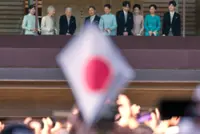
The future of the imperial household – mythically descended from the Shinto sun goddess Amaterasu – depends currently on Prince Hisahito, the 19-year-old nephew of Emperor Naruhito, 66.
If Hisahito – a fan of dragonflies, who is currently studying biology and is not married – has no son, then under the rules, as they stand, he will have no heir and the bloodline will end.
There have been eight female emperors on the Chrysanthemum Throne in Japan’s imperial family, whose divine status was renounced after World War II.
But an 1889 imperial house law stipulated that only men could become emperor, and only through the paternal line.
This was carried over in 1947 into the current Imperial Household Law.
This rules out the popular Princess Aiko, 24, daughter of Naruhito, or any other royal woman ever becoming emperor.
The Bill, passed by the upper house yesterday, allows the adoption of male distant relatives aged over 15 back into the imperial family – as long as they are single – and for their future sons to become eligible to ascend the throne.
They are members of 11 families that left the imperial register after Japan’s defeat in World War II.
The new rules also end the practice of women having to lose their royal status after marrying a commoner, although because of their gender, their children still cannot become emperor.
The legislation passed after wrangling within the ruling Liberal Democratic Party (LDP) led by Japan’s first woman prime minister, Sanae Takaichi, who opposes female succession.
Seiichiro Murakami, a veteran of the conservative LDP, said after the Bill passed the lower house on July 10 that it was “utterly outrageous” to rule out Aiko becoming emperor.
A poll conducted by the Mainichi Shimbun last month found only 23% of people in favour of the sons of re-adopted imperial family members becoming emperor, and 34% against.
By contrast, more than 70% supported a woman emperor, and 40% a matrilineal one.
An Asahi Shimbun poll in May also showed 72% of respondents in favour of changing the rules to allow women to ascend the throne.
The imperial family now has 16 members in total, including five men – retired emperor Akihito, 92, his brother, 90, the emperor, his brother, and Hisahito.
Hideya Kawanishi, a professor at Nagoya University and expert in Japan’s emperor system, said that the new Bill “fails to reflect public opinion”.
“For the conservative camp of the ruling Liberal Democratic Party and the likes, the overriding goal is to preserve the male-line, male-only succession to the throne, and that is precisely why they do not want to listen to the voices of the people,” Kawanishi said.
“Maybe it would have been good if they talked more about the possibility of female emperors and other stuff reflecting modern society,” office worker Yoshiki Yaguchi, 66, said while walking in the Yurakcho area of Tokyo. — AFP