
PHNOM PENH: Chen Theung grips a hammer tightly before striking a hollow metal pipe beneath his stilted wooden house in Mondulkiri province, sending a sharp metallic echo across nearby rice fields.
The sound is deliberate — a warning aimed at one of Cambodia’s largest remaining herds of wild Asian elephants.
For the 43-year-old farmer from Koh Myer Krom village in Koh Nhek district ’s Nong Khlek commune, the nightly ritual has become essential to protecting the crops that feed his family.
As darkness falls during harvest season, villagers take turns watching the fields, armed with flashlights, fires and improvised noise-making devices in an effort to drive elephants away before the animals flatten entire plots within minutes.
“If I don’t guard the crops, we won’t have any rice left because the elephants destroy everything,” Theung says.
“They pick, eat and trample the fields. In just half an hour, if we don’t come, everything can be gone,” he adds.
Across eastern Mondulkiri, communities living near forested areas are increasingly adapting to life alongside elephants as encounters between humans and wildlife become more frequent.
What was once an uncommon occurrence has, over the past four to five years, evolved into a seasonal struggle between subsistence farmers and one of the country’s most endangered species.
Theung said elephant raids were rare in the past, when villagers were more concerned about wild boars and smaller animals damaging crops.
“I don’t know why elephants have been destroying villagers’ crops over the past few years,” he said.
Community discussions organised by conservation organisation WWF-Cambodia suggest the problem began emerging around 2018 and 2019, with villagers and researchers linking the growing movement of elephants into farmland to food shortages and disturbances inside forest habitats.
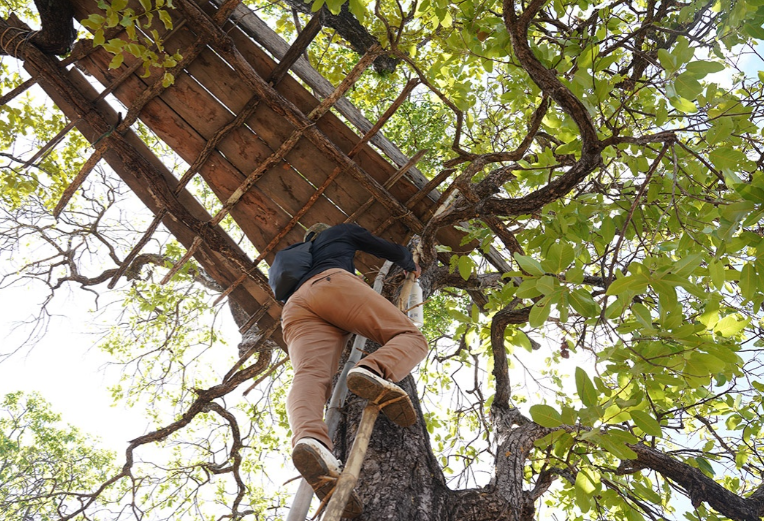
Chen Theung guards his farm from a ten-metre-high platform, ready to scare elephants away should they come to close. Hong Raksmey
According to information shared during the meetings, elephants are now entering agricultural areas irregularly — sometimes once every month or two — making it difficult for communities to predict their movements or prepare protective measures.
Villagers say the elephants particularly target crops such as rice, casava and sugarcane, although they continue appearing even outside harvesting periods.
Theung estimated that around 68 elephants, excluding calves, move through the area between August and October each year.
“During harvest season, the herds come down to eat the farmers’ crops,” he said.
To avoid direct confrontation, villagers have increasingly turned to non-lethal deterrent methods.
Metal pipes are hammered repeatedly through the night, loudspeakers and microphones broadcast noise across fields, while fires are lit around farmland boundaries.
“The elephants are not really afraid of fire though,” Theung says, “Sometimes they just kick the burning wood away.”
During the rainy season, some farmers construct temporary shelters high in large trees to monitor farmland overnight. The work requires constant alertness, particularly when elephants move in small groups.
“If they come in a large herd, the baby elephants usually make a lot of noise, trumpeting and that serves as an advance alarm for villagers,” explains Theung.
“But if only one or two elephants come, we often don’t hear them coming and are not prepared to chase them away,” he continues.
While fear remains, many villagers say their relationship with elephants has gradually shifted from panic to cautious coexistence.
Chan Kimsay, a community leader who works with biodiversity researchers, said the greatest risks often arise when villagers attempt to chase elephants away at night.
A view of the farmers’ fields, which are sometimes disturbed by herds of wild elephants. Hong Raksmey
“We created this human-elephant coexistence project using elephant deterrent equipment to stop them from coming too close to people,” he says.
The programme encourages communities to maintain safe distances from elephants while using lights, loudspeaker systems, banging on metal and other methods to redirect the animals away from homes and crops.
“Once villagers have access to elephant repellent equipment, the risks of confronting elephants directly have been reduced because people no longer need to go close to them,” Kimsay notes.
He warned, however, that accidents remain possible if villagers become careless around the animals, even though no serious incidents have yet been reported in the community.
Kimsay believes habitat disturbance, forest loss and human activity are likely contributing to the increased movement of elephants into populated areas.
“I want there to be a proper habitat for wild elephants where they are not disturbed by humans,” he says.
WWF-Cambodia recently established volunteer response teams in affected villages across Koh Nhek district as part of a broader initiative aimed at transforming conflict into coexistence between humans and elephants.
Chen Theung stands ready to repel the big animals from destroying his farm with a megaphone. Hong Raksmey
During a meeting held in March 2025 with communities in Koh Myer Leu and Koh Myer Krom villages, residents discussed the roles and responsibilities of local volunteer groups, including the use of technical support and field equipment to provide rapid responses to elephant incidents.
WWF said the teams are intended to improve communication between villagers and conservation workers while helping reduce crop losses and safety risks.
“The development of this response team is an opportunity to strengthen teamwork and planning with impacted communities,” the organisation said in a statement.
According to a 2020 report by the Ministry of Environment and wildlife conservation groups, Cambodia’s wild Asian elephant population is estimated at between 400 and 600 animals, primarily living in the Cardamom Mountains, northern plains and eastern highlands of Mondulkiri province.
These landscapes remain among the country’s most important biodiversity strongholds, but conservationists warn that pressures from human activity continue to threaten wildlife habitats.
For villagers in Nong Khlek commune, however, the issue is immediate and deeply personal.
Commune chief Phay Kimphut explains that eight families in the area have been heavily affected by elephant raids, with herds regularly entering farmland between August and November.
“They come to trample and eat the farmers’ rice,” he says. “When villagers report it, local authorities help chase the elephants away.”
Despite growing encounters, Kimphut notes that elephants have not yet entered residential village areas, remaining largely within agricultural zones.
As another evening settles over Koh Myer Krom village, Theung prepares once again for a sleepless night.
Beside him lies the long rusted pipe that has become both alarm bell and lifeline — a simple tool in an increasingly fragile balance between people struggling to protect their harvests and elephants searching for food beyond the forest. - The Phnom Penh Post/ANN