US President Donald Trump departed the country touting business deals that gave markets little to cheer, while Beijing warned Washington about mishandling Taiwan and said its conflict with Iran should never have started.
Trump’s visit to the United States’ main strategic and economic rival, the first by a US president since his last trip in 2017, had aimed for tangible results to beef up his dented approval ratings ahead of crucial midterm elections.
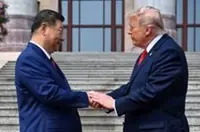
The summit was filled with pageantry, from grand receptions with goose-stepping soldiers to lavish banquets and private tours of a secret garden, while Trump repeatedly heaped praise on his host, commenting on his warmth and stature.
“It’s been an incredible visit. I think a lot of good has come of it,” Trump told Xi at their final meeting at the Zhongnanhai complex, a former imperial garden housing the offices of Chinese leaders, before they dined on a menu of lobster balls and Kung Pao scallops.
But just before yesterday’s meeting, China’s foreign ministry issued a blunt statement outlining its frustration with the United States’ and Israel’s conflict with Iran.
“This conflict, which should never have happened, has no reason to continue,” the ministry said, adding that China was supporting efforts to reach a peace deal in a conflict that had severely affected energy supplies and the global economy.
At Zhongnanhai, Trump said the leaders had discussed Iran and felt “very similar”, though Xi did not comment.
Trump had been expected to urge China to use its leverage with Iran to make a deal.
But analysts doubt Xi will be willing to push Teheran hard or end support for its military, given Iran’s value to Beijing as a strategic counterweight to the United States.
A brief US summary of Thursday’s talks highlighted what the White House called the leaders’ shared desire to reopen the Strait of Hormuz off Iran, through which a fifth of global oil and gas once flowed, and Xi’s apparent interest in American oil purchases to pare its dependence on the Middle East.
“What’s notable is that there’s no Chinese commitment to do anything specific with regard to Iran,” said Patricia Kim, a foreign policy fellow at the Brookings Institution.
US officials said they had also agreed to deals to sell farm goods and made progress on setting up mechanisms to manage future trade, with both sides expected to identify US$30bil (RM117.8bil) of non-sensitive goods.
There were scant details of the deals, however, and no signs of a breakthrough on selling Nvidia’s advanced H200 AI chips to China, despite CEO Jensen Huang’s dramatic last-minute addition to the trip.
Trump told Fox News that China had agreed to order 200 Boeing jets, its first purchase of US-made commercial jets in nearly a decade, but that was far short of the roughly 500 expected by markets, and Boeing shares fell more than 4%.
“For the market, the summit can be strategically reassuring while underwhelming in substance,” said Chim Lee, senior China analyst at the Economist Intelligence Unit.
The summit’s main achievement may be maintaining a fragile trade truce struck when the leaders last met in October and Trump suspended triple-digit tariffs on Chinese goods while Xi backed away from choking off supplies of vital rare earths.
It has not yet been decided whether to extend the truce beyond its expiry later this year, US Trade Rep Jamieson Greer, accompanying Trump, told Bloomberg TV yesterday.
Such an extension would be “the most basic benchmark” for the summit, said the Brookings’ Kim. — Reuters