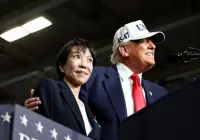
TOKYO: Just four hours after US President Donald Trump departed Beijing aboard Air Force One on May 15, capping a high-stakes summit with his Chinese counterpart Xi Jinping, he made a phone call.
On the line was Japanese Prime Minister Sanae Takaichi, who later noted in a post on X that Trump provided a “detailed explanation” of his talks with Xi.
They also exchanged views, she wrote, “primarily on issues related to China, including economic security, as well as security affairs”.
Though they spoke for only 15 minutes, the gesture went a long way towards soothing Japanese anxieties.
There were fears that its sole security ally – who resurrected the concept of a “G-2” world dominated by two superpowers – might make concessions at Tokyo’s expense.
These nerves are raw in Japan, where relations with Beijing are in a tailspin after Takaichi made blunt, impromptu comments that Tokyo might intervene militarily should China invade Taiwan.
Speaking to reporters after the call, Takaichi expressed immense gratitude for the “tremendous support to Japan” that Trump extended, implying he had spoken up for Japan while in Beijing.
“We agreed to maintain close communication on the Indo-Pacific situation,” she said. “I was able to confirm with President Trump that the Japan-US alliance is unwavering.”
Still, a “G-2” worldview threatens to leave Japan sidelined in its own neighbourhood, particularly if Trump – an unpredictable and transactional leader – decides to reduce the US military footprint in East Asia or curtail arms sales to Taiwan to win concessions from China.
Fuelling these concerns was Japan’s reported failed attempt to convince Trump to stop over in Tokyo en route to Beijing in a bid to ensure they were on the same page, even as Takaichi had visited Washington for a summit in March 2026.
The apparent snub reignited fears of “Japan Passing”, a phrase to invoke the nation feeling overlooked in global statecraft.
While institutional frameworks between the US and Japan are robust, Professor Heng Yee Kuang of the University of Tokyo’s Graduate School of Public Policy told The Straits Times: “President Trump’s self-image as a master deal-maker means Japan must remain hyper-alert.”
This is all the more so, he said, given Trump’s hot-cold relationships with other “Trump whisperers” such as Italian PM Giorgia Meloni and British PM Keir Starmer.
Such sensitivity has been heightened since Japan and China have effectively stopped talking to each other. Beijing’s retaliation for Takaichi’s Taiwan comments was swift and multifaceted.
Chinese visitor numbers have plunged, and students are being urged to avoid Japanese universities. China has also tightened export controls on rare earths and dual-use products.
Japan, meanwhile, stripped away any attempt at diplomatic politesse by demoting China in its annual Diplomatic Bluebook in April, from describing it as a “most vital bilateral relationship” to an “important neighbouring country”.
The semantic demotion speaks volumes in the world of Asian statecraft, with China’s Foreign Ministry protesting against the rewording as a “breach of faith” that undermines the very foundation of their ties.
Dr Rumi Aoyama, who heads the Waseda Institute of Contemporary Chinese Studies at Waseda University, told ST that Sino-Japanese relations are at their “worst state” since the normalisation of ties in 1972.
She characterised the rewording in the Bluebook as a pragmatic effort to “more accurately reflect the current state” of relations, rather than a rhetorical shift.
Likewise, Prof Heng said it was “more telling to assess concrete policy developments”, pointing to Japan’s recent decision to lift restrictions on lethal weapon exports.
Tokyo is currently in talks to send destroyers and surface-to-ship missiles to the Philippines, a neighbouring country to Taiwan.
Japanese forces conducted live-fire drills with Type 88 anti-ship missiles alongside Philippine and US forces in early May, successfully striking a decommissioned minesweeper.
An editorial in the Yomiuri newspaper argued that Japan is merely reacting to China: “The more China tries to intimidate Japan, the more wariness towards China spreads in Japan, bolstering support for the push... to strengthen defence capabilities.”
As tensions flared, Japanese Maritime Self-Defence Force vessels moved through the Taiwan Strait in April for the first time in 10 months.
The Yomiuri newspaper cited an official as saying that Beijing’s maritime expansion could be emboldened without such passage.
The friction is also evident in the East China Sea, where there are overlapping claims to the Exclusive Economic Zones.
Despite a 2008 pact for joint gas exploration in the East China Sea, China has unilaterally constructed 23 “gas platforms” near the median line between the two countries. Two of them were built since January, Japan’s Foreign Ministry has said.
Experts warn that these structures could create a fait accompli, allowing Beijing to dominate maritime corridors essential for any potential military operation against Taiwan.
Professor Shin Kawashima, a Sino-Japan expert at The University of Tokyo, observed that China is attempting to transform the East China Sea into an “inland sea” via blockading drills and structural expansion.
But beyond military developments, he also saw a battle to control the narratives. “The narrative of ‘Japan Passing’ is what China desires most,” he said.
“Japan must prevent such a narrative from spreading... and explain developments to third countries to prevent them from believing Chinese propaganda.” - The Straits Times/ANN