




US President Donald Trump’s landmark visit to China comes as the US-Iran war disrupts global energy supplies, fuels economic uncertainty and adds fresh strain to Washington-Beijing ties. In the latest instalment of a series examining how rivalry, interdependence and geopolitical crises are reshaping the relationship between the two powers, we look at the likely outcomes from Trump’s trip.
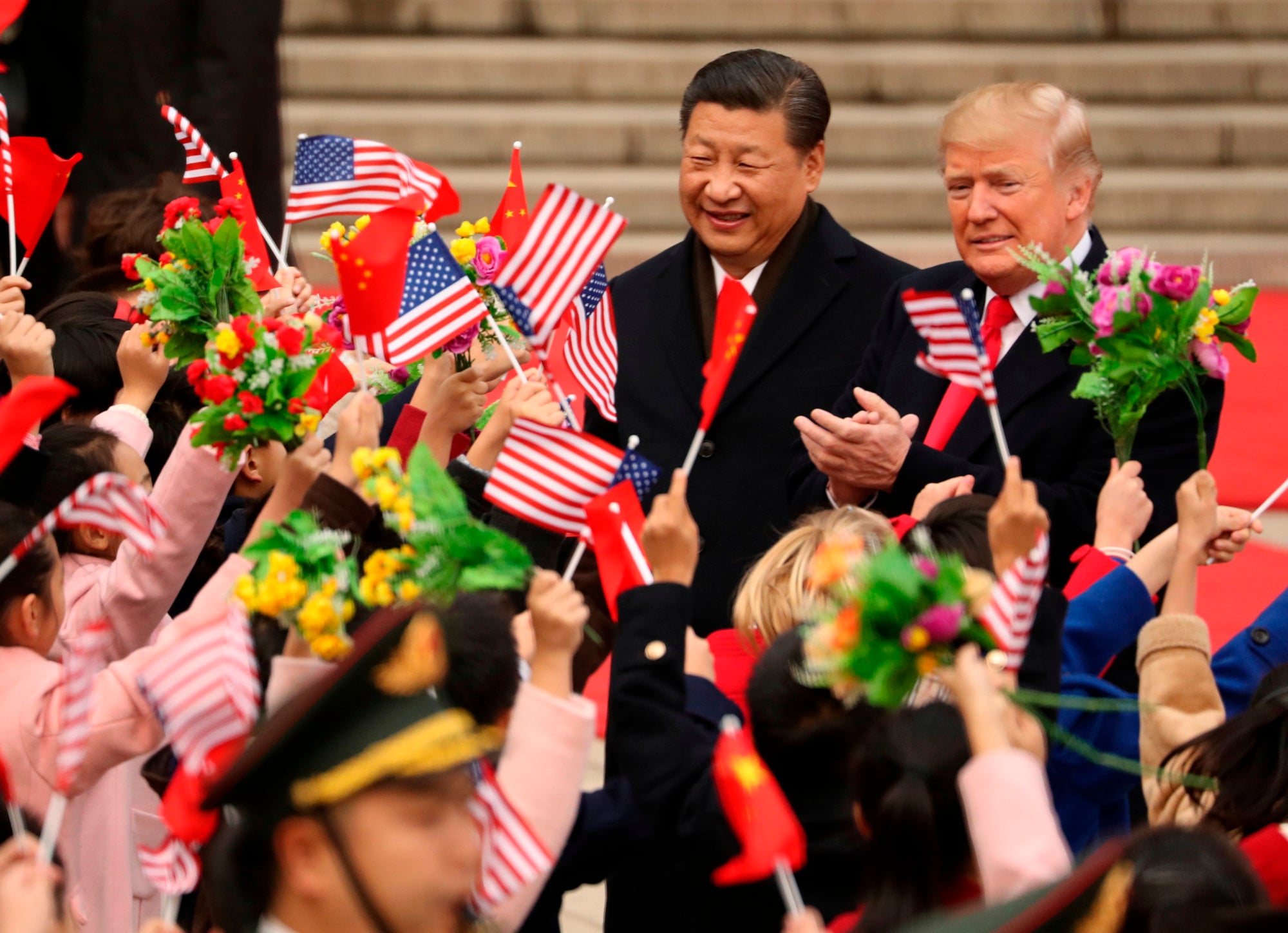
As Donald Trump arrived in Beijing on Wednesday night for the first US presidential visit in nearly a decade, the world’s most consequential bilateral relationship faced a pivotal test.
Trump will hold talks with Chinese leader Xi Jinping against the backdrop of a fragile trade truce, intense strategic rivalry and global turmoil from the US-Iran war.
The US president wants to rebalance the relationship and focus on “reciprocity and fairness” to restore American economic independence, according to White House officials. They said the discussion was expected to cover trade, artificial intelligence, Iran, Taiwan and other security issues.
Observers expect the summit to focus on practical, transactional outcomes rather than breakthroughs.
But the key question is whether Xi and Trump can prevent the relationship from going backwards.
For Beijing it will be a test to see if Washington can refrain from any further escalation on tariffs, export controls and Taiwan. It will also be a test of whether US policy on China has become too ideologically hardened to be influenced by leader-level diplomacy.
For Washington, it will be about whether Trump – whose entourage includes Tesla chief executive Elon Musk and Apple CEO Tim Cook – can secure enough tangible wins to present the trip as a success ahead of midterm elections.
Zhiqun Zhu, a professor of international relations at Bucknell University in Pennsylvania, said Beijing saw Trump as more pragmatic in his second term.
“The Chinese side appreciates Trump’s policy adjustment from a confrontational approach during much of his first term and during the Biden administration to a more realistic and moderate approach now,” Zhu said.
He added that Trump “understands the importance of getting along well with China in this turbulent and fragmented world”.
Zhu noted that a stable relationship with China “could help Trump both at home and abroad when he is bogged down with the Iran crisis and faces growing discontent among Americans with rising gas prices”.
The visit follows weeks of preparation, including talks in Seoul on Wednesday between US Treasury Secretary Scott Bessent and Chinese Vice-Premier He Lifeng.
In a goodwill gesture, Beijing announced last month that it would send two giant pandas to Atlanta ahead of Trump’s arrival.
US officials have said potential summit deliverables could include deals in aerospace, agriculture and energy, with China expected to announce increased purchases of American goods ranging from Boeing aircraft to soybeans and natural gas.
Proposals for a “Board of Trade” to expand non‑sensitive commerce and a “Board of Investment” to manage cross‑border investment disputes may also be announced during Trump’s visit, US officials said on Sunday.
Establishing a dedicated channel for AI safety issues is also on the agenda amid growing US concerns about technology competition and conflict.
In addition, joint law enforcement cooperation on fentanyl precursors and cross‑border narcotics networks is likely to be discussed. Yuyuan Tantian – a social media account linked to state broadcaster CCTV – said the two powers could work together on transnational threats where their interests converged, citing Monday’s joint US-China announcement on an international drugs bust.
Stephen Olson, a visiting senior fellow at the ISEAS-Yusof Ishak Institute and a former US trade negotiator, said: “The easiest thing to do – and the one thing they must do – is to extend the trade truce and signal that a greater degree of stability has been injected into the relationship.”
Ker Gibbs, former president of the American Chamber of Commerce in Shanghai, said an agreement on US agriculture products was achievable.
“China needs soybeans and pork. American farmers need the revenue. Trump needs to deliver something to his rural base. A purchase commitment costs Beijing relatively little politically and gives Trump a number he can announce,” he said.
In addition, Gibbs said fentanyl cooperation was “politically useful” for both sides, while limited, category-specific tariff adjustments could ease the pain for US importers facing volatility.
“The goal is going to be stability, and a return to some measure of predictability,” he said.
Rare earth export controls will also be on the agenda given China’s leverage and America’s needs in defence and technology.
“Beijing demonstrated with the rare earth restrictions that it has cards to play. Trading that card for tariff relief or technology concessions is a natural negotiating exchange,” Gibbs said.
The summit is expected to lay the groundwork for future engagements, with plans for up to four meetings between the two leaders in what Chinese Foreign Minister Wang Yi called “a landmark year”.
Observers said Beijing had adjusted its approach to Trump after a first term where the Chinese leadership put more stock in the personal chemistry between Trump and Xi.
They said that in his second term Trump was more firmly in control of China policy, with a more coherent posture.
“His approach is still largely transactional, focusing on ‘deals’ he can make,” Zhu said.
He added that the bilateral relationship – while aided by the leaders’ good personal ties – “remains fragile, and there is a risk that an unpredictable Trump may make an about-face without warning”.
Frans-Paul van der Putten, an independent China expert based in the Netherlands, noted the subtle policy shift on China under Trump.
“It has probably become easier for China to understand the overall direction of US foreign policy,” he said. “Despite Trump’s changeable behaviour, the basics of US foreign policy during his second presidency are more coherent and focused than when he was president for the first time.”
He said while Trump was unpredictable, he was “very likely to keep coming back to the US-China relationship as a key issue during his presidency”.
According to van der Putten, summits between the two leaders were crucial since “exchanges between the two governments below the leadership level are limited, and often linked to upcoming meetings between Xi and Trump”.
He said that while the summit might ease tensions – and extend the trade truce – much depended on structural rivalry and economic interdependence.
“The US depends on China’s supply of rare earths, while China is faced with a strong military presence of the US in East Asia and on the world’s seas,” he said.
Iran is expected to feature prominently during the summit, with Trump set to press Xi on Beijing’s purchases of Iranian oil and potential weapons-related support, according to US officials.
Taiwan – which Beijing regards as “the very core of China’s core interests” – remains the most sensitive issue. There has been speculation that a key goal for Beijing this week is to push Washington to change its position on Taiwan – that it could be seeking US restraint on arms sales and high-level visits to the island and on rhetoric that could embolden independence forces.
US Secretary of State Marco Rubio told reporters last week that Taiwan would be discussed by Trump and Xi. But a senior US official said in a briefing on Sunday that there had been no change in US policy on Taiwan.
Beijing sees Taiwan as part of China to be reunited by force if necessary. Most countries, including the United States, do not recognise Taiwan as an independent state. But Washington is opposed to any attempt to take the self-governed island by force and is committed to supplying it with weapons.
Van der Putten said Trump may prefer to keep cross-strait relations unchanged “at least for as long as he is in office”.
“Xi may want assurance that the US under Trump will do nothing to encourage pro-independence sentiments or activities in Taiwan, and ideally that it signals that Taiwanese independence is not an option under any circumstance,” he said.
On US arms sales, he said there could be a trade-off between increased Chinese purchases of American civilian aircraft and reduced weapons exports to Taiwan.
“Trump needs China’s help to find a way out with the US-Iran conflict, and some of the weapons that Taiwan needs – such as air defence missiles – are currently in short supply as they are urgently needed also by the US military,” he said.
“China could agree to buy more American goods, such as airplanes, to compensate for fewer US exports of weapons to Taiwan,” he said. “However, it seems unlikely that the US will substantially reduce arms exports to the island.”
Sourabh Gupta, a senior policy specialist with the Institute for China-America Studies, said Beijing should treat Trump as “a very different political animal vis-a-vis China compared to his first term”.
“He is much more firmly in charge of China policy in ways that were not possible during his first term,” Gupta said, adding that Beijing needed to appeal directly to Trump’s “transactional and unsentimental instincts”.
“Beijing must highlight the potential role that China can play in advancing the interests of American workers, farmers and families, as well as the role that Chinese firms could play in building out America’s industrial expansion,” he said.
On Taiwan, Gupta described Beijing’s view of US policy as “deeply unsatisfactory”.
He argued that in recent years, Washington’s “one China” rhetoric had been reduced to non‑support for unilateral changes to the status quo, while acknowledgement of Beijing’s position and non‑support for independence had “mostly been swept under the rug”.
Gupta proposed reviving dialogue mechanisms on diplomacy and security that were set up during Xi’s 2017 visit to Trump’s Mar‑a‑Lago resort and halted when the trade war erupted. He also suggested a framework for exchanges on strategic stability and arms control be established.
“It’s a Trump priority and would be well‑timed with the ongoing Nuclear Non‑Proliferation Treaty Review Conference in New York,” he said.
Gupta also called for talks to lay the groundwork for a possible Xi state visit to Washington later this year, ideally culminating in a joint statement.
“There has not been a leaders‑led joint statement in more than a decade,” he noted.
At the same time, he pointed out that Trump’s promises were not “sacrosanct” and that any failure to deliver on his China “asks” would embolden hawkish voices in Washington.
Shi Yinhong, a professor of international affairs at Renmin University of China, cautioned against high expectations for the summit, noting the broader deterioration of relations.
“Many in China have long anticipated such summits, but they often overlook a recurring pattern: within weeks – or at most a few months – after every meeting between the two leaders, relations sour once again,” he said.
Zhu offered a similar assessment.
“Trump’s visit to China will help to stabilise the bilateral relationship, but no breakthroughs are likely out of the visit on critical issues such as Taiwan,” he said.
“The visit will not fundamentally change the competitive nature of the US-China relationship or the security structure in the Indo-Pacific region.” -- SOUTH CHINA MORNING POST


