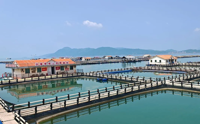
PHNOM PENH: There are no roads here. Instead, brightly painted boats glide between houses, fishermen stand waist-deep in the water and entire villages appear to float on stilts several metres high.
A boat trip on Tonle Sap Lake in Cambodia feels like entering another world - one where water dictates daily life and sets the rhythm of the community.
South-East Asia's largest freshwater lake lies about an hour's drive from Siem Reap.
The small city, home to an international airport, is best known as the gateway to the temples of Angkor - but it also serves as the starting point for excursions to Tonle Sap.
In the heart of Cambodia, visitors encounter a way of life that feels timeless. Yet Tonle Sap keeps up with modern life with several floating villages geared towards tourists.
The communities of Kampong Phluk and Kampong Khleang are among the most popular for day trips, with itineraries typically including boat rides past homes, schools and pagodas.
By boat to school
The children here learn to handle boats from an early age - and usually paddle to school on their own in the morning.
Most of their fathers are fishermen. Depending on the water level, they cast their nets from boats or while standing in the water.
Tonle Sap is one of the world's most fish-rich inland waters and a vital lifeline for the whole of Cambodia.
Meanwhile, the boat chugs steadily on across the brown water, past mangroves and rice fields.
After about an hour, the view opens up to the vast lake, which stretches like a sea to the horizon.
A lake that changes size
During the rainy season from May to October, the lake multiplies in size. It can become up to 250 kilometres long and 100 kilometres wide.
This is because the Tonle Sap River, which connects the lake to the Mekong River, changes its flow direction twice a year - a very special phenomenon.
"During the rainy season, the Mekong carries so much water that it pushes back the Tonle Sap River - so it flows into the lake instead of out of it," says tour guide Sin Peng.
In the dry season, the opposite happens: the water level of the Mekong drops, and the Tonle Sap River flows out of the lake again.
A roadside delicacy
On the return journey, you can watch fish being processed by the roadside using an old technique: after being caught, the fish are gutted, marinated in brine and later slowly smoked over open wood fires.
A spicy-sweet, smoky scent wafts through the humid air. Smoking serves not only to enhance the flavour but, above all, to preserve the fish.
Fish is the most important source of protein and forms a key part of the population’s diet. In local restaurants, tourists can sample the smoked fish in soups or salads - a fitting end to any trip to Tonle Sap.
Tips and practical information
Getting there: There are direct flights to Siem Reap from various major cities in South-East Asia, such as Bangkok, Singapore or Kuala Lumpur.
Tonle Sap Lake is an hour's drive from the small town.
Tours: The easiest option is to ask your hotel about tours, which can be quickly organised from there - including private tours. Alternatively, there are numerous tour operators online. A day trip can be combined with a visit to the impressive 12th-century Khmer temple of Beng Mealea.
Best time to visit: A trip is particularly worthwhile during the rainy season between May and October, when the lake reaches its maximum level and the stilt houses stand deep in the water. - dpa