
HANOI: Nestled among the limestone mountains of Tuyen Phu Commune in central Quang Tri Province, a network of small suspension bridges is quietly helping white-necked langurs cross fragmented forest areas safely each day, offering a simple but effective solution to a growing conservation challenge.
Behind the initiative is the persistence of Nguyen Thanh Tu, a border guard veteran who has contributed to preserving the rich biodiversity of the sun-drenched, wind-swept central region.
After leaving the military, Tu returned to his homeland and resumed farming like many local residents. A chance encounter with a troop of white-necked langurs changed his life.
In Tuyen Phu Commune, where steep limestone mountains are interspersed with residential areas, troops of white-necked langurs live as a vivid example of biodiversity.
However, this close overlap between human activity and wildlife habitat has made their survival increasingly precarious.
Roads cutting across the mountains have inadvertently become dangerous barriers. In search of food or mates, the langurs must cross busy roads each day, exposing them to traffic. Many have been injured or killed, while some local residents have also been involved in accidents when encountering the animals.
These incidents prompted concern among locals, including Tu. How could the langurs move safely without risking their lives? How could humans and nature coexist without harm?
From these questions came a simple idea: build narrow suspension bridges for the langurs. Made of steel wire and about 50cm wide, the structures span roads and serve as safe crossing routes.
The first two bridges were installed in Thiet Son and Thuan Hoan villages.
Volunteers not only built the bridges but also planted trees at both ends, creating natural corridors to help guide the animals and support their movement.
Funding for the bridges came not from the State budget but largely from community contributions and support from conservation experts.
Each bridge costs just over VNĐ40 million (US$1,700), but their impact is significant, helping to protect the lives of hundreds of langurs.
Tu is the driving force behind the initiative.
Recognising that the langurs are rare primates listed in the Vietnamese Red Book, Tú decided to embark on a journey to protect them.
At the time, however, it was not an easy task.
The langurs live near residential areas, and false rumours about their medicinal value have made them targets for hunting.
Words alone were not enough to protect them, so Tu began by raising community awareness.
In 2013, he campaigned to establish a volunteer group to protect the langurs, with only four initial members, including former hunters.
Step by step, through perseverance, they persuaded people to abandon hunting, limit deforestation and protect the langurs’ habitat.
Without salaries or benefits, the langur protection group led by Tu has voluntarily maintained its activities for more than 13 years.
Today, the group has 18 members and has become a key force in protecting the langurs.
More importantly, they did not act alone. Through information dissemination and mobilisation, people in the commune gradually changed their perceptions.
Previously exploited rocky areas are now preserved. Logging and deforestation have significantly decreased. Trees have recovered, creating an abundant food source for the langurs.
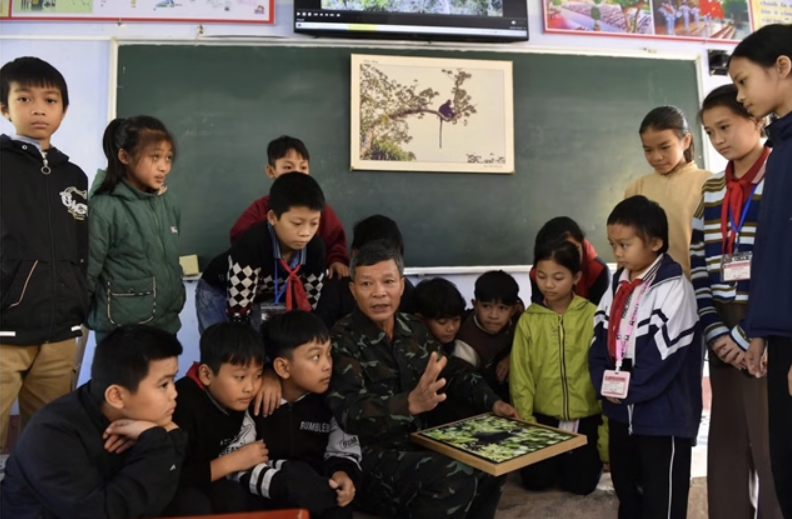
In addition, Tu is frequently invited to schools to speak and share his knowledge about langurs and the importance of environmental protection. His lessons go beyond simply imparting knowledge as they also inspire a love of nature among students.
As a result, the langur population has increased significantly. From just a few individuals initially, the Thiet Son mountain region now has approximately 22 troops with nearly 200 individuals, a significant number for this rare primate species.
Tu’s home is not only his family’s accommodation but has also become a destination for international scientists, photographers and visitors who come to conduct research, capture images and share conservation experiences.
Through these exchanges, knowledge about langurs and nature conservation has been disseminated. Tu has not only learned but also become a communicator to the community, especially the younger generation.
The Thiet Son mountain region has also become well known for langur protection.
In 2018, the limestone mountain area in Tuyen Phu Commune was included in special-use forest planning, covering more than 500ha and creating a legal framework for conservation work.
By 2023, the volunteer group had been upgraded to a cooperative, opening up a sustainable development direction linked to livelihoods.
The white-necked langur population, a rare primate species, continues to survive and thrive in Tuyen Phu, not thanks to multi-million dollar projects but to the collective efforts of the community and the perseverance of ordinary people. — Vietnam News/ANN