SINGAPORE: Fainting and high body temperatures are usually tell-tale signs of a person suffering from heat exhaustion, but a new tool developed in Singapore aims to detect signs of heat injury by tracking a person’s gait.
The Home Team Science and Technology Agency (HTX) has been tracking the walking patterns of more than 150 police officers since October 2025, as part of an ongoing trial for an early warning system that can identify personnel who are on the verge of heat illness. The system also monitors the officers’ heart rates.
When the system flags an officer as being at risk of heat illness, he will be closely monitored.
Early interventions – which can include prescribed rest or an ice bath – help to prevent the officer from suffering from severe heat illnesses, such as exertional heat stroke. This can result in fainting, collapse or seizures, and can cause rapid organ damage requiring emergency treatment.
No officer has been flagged as at risk of heat illness so far.
The Home Team comprises seven departments including the Singapore Police Force (SPF), Singapore Civil Defence Force (SCDF) and Central Narcotics Bureau.
“Exertional heat illness is a challenge for our Home Team units because of the different kinds of high-tempo activities they have to go through – like search-and-rescue operations, counter-terrorism and also patrolling,” said Dr Seng Kok Yong, deputy director of the HTX Human Factors and Simulation Centre of Expertise.
“All these can increase heat strain, and this is not helped by the worsening climate,” he added.
Singapore has entered one of the hottest periods of the year, which usually stretches from March to June. The maximum temperature in the second half of March was 35.4 deg C, recorded at Sembawang.
The Straits Times has contacted SPF and SCDF for the number of heat illness cases recorded in recent years.
Associate Professor Jason Lee, director of the Heat Resilience and Performance Centre at the National University of Singapore, noted that firefighters face greater heat stressors because of the blazes they have to fight, and their full protective gear limits heat from dissipating.
He also worries that the heat might impair police officers’ decision-making under time pressure.
“When you feel hot, your risk-taking behaviour will be affected. You perceive the same risks lower... and may take the wrong action,” added Prof Lee, who is based at the NUS Yong Loo Lin School of Medicine.
SCDF told ST that it began in 2023 to progressively equip firefighters with new protective gear that includes breathable fabric layers and a lightweight, stretchable outer shell that is more conducive for prolonged usage.
How the system works
The first-of-its-kind tool by HTX involves two wearable components – a heart rate monitor attached to an officer’s upper arm and shoe padding laden with sensors to detect unsteady walking.
The insole is fitted with 14 pressure sensors and other devices to measure 30 different gait parameters. These factors include speed, number of steps, and how long a foot is on and off the ground.
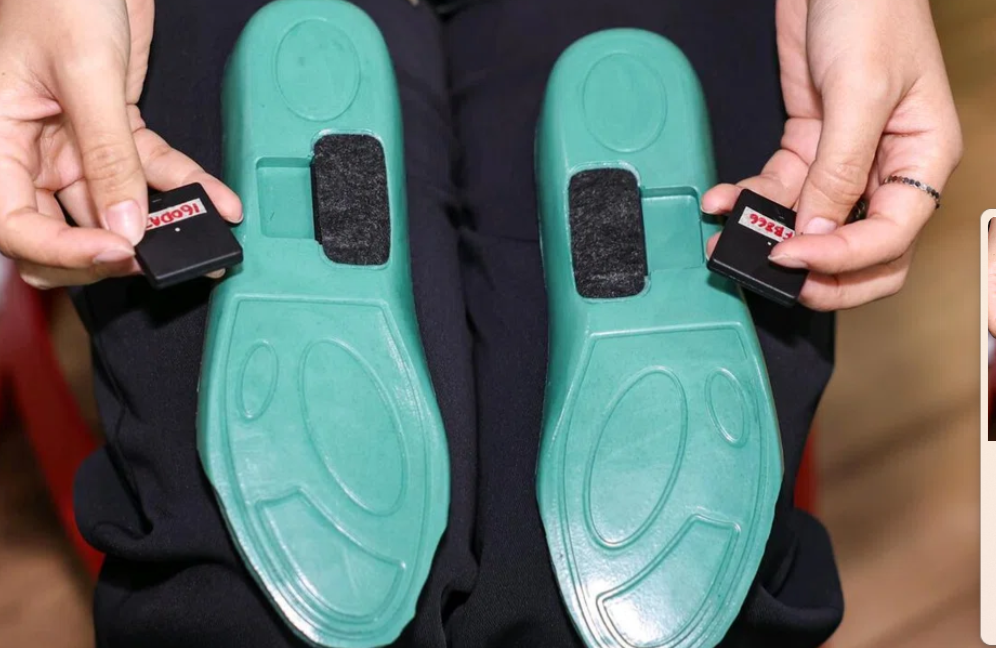
The system uses a combination of heat strain and gait indicators to reduce false alarms caused by accidental falls and uneven terrain, said Dr Seng.
During the trial, which will continue until the end of 2026, each police officer wears the heart rate monitor and insole for up to six hours a day while doing physical training and exercise. The tool has not been used in actual operations.
Dr Seng said the heart rate and gait measurements will detect the two leading signs of heat illness caused by exertion – neurological dysfunction and the body under duress.
Severe heat illness can significantly disturb neurological function, causing unsteady or wobbly movement, said Dr Seng.
A racing heart rate can be used to estimate a person’s core body temperature. A spike in temperature to 39.5 deg C or 40 deg C is a sign that the body is strained.
The heart rate and gait measurements are fed into an algorithm built by the HTX team, which decides whether the officer is safe or at risk of exertional heat illness.
The measurements and results are shown on a computer dashboard fitted with a map indicating where the officers are located.
When an officer’s profile on the dashboard flashes an amber alert, indicating that the system has flagged him as a potential heat casualty, help will be sent.
The need for tailored systems
While HTX has been looking into heat stress measures for a long time, it is only in the past four years that the team has been developing solutions and alerts tailored to each officer’s heat risk level, said Dr Seng.
In the past, a “blanket approach” was taken, in which the same warnings were issued to all officers.
These warnings were based on environmental markers such as the wet bulb globe temperature – which is a measure of heat stress that accounts for air temperature, humidity levels, wind speed and solar radiation. Broad-based measures include dressing lightly and taking longer breaks between strenuous work when heat stress levels are high.
SCDF, for example, has since 2018 allowed front-liners to wear their light corporate polo T-shirts instead of the uniform as standard attire when they are at the fire stations, deployed within emergency ambulances or attending to routine operations.
But a person’s heat stress risk is not just based on weather conditions alone, said Dr Seng.
“We’re looking into more individualised solutions because we know the risk for every officer differs based on his clothing, whether he is aerobically fit, heat-acclimatised, hydrated, well rested, or has health conditions,” added Dr Seng.
The early warning tool and an app called xHEAT are among the first targeted inventions by the team. The xHEAT app is a questionnaire that Home Team officers and their supervisors can use to simulate their heat stress risk before embarking on a task.
The questions range from their weight and clothing to the intensity and duration of their tasks, and how much water they plan to drink.
The xHEAT app can be used to simulate officers’ heat stress risk before embarking on a task.
If an officer is assessed to be at moderate or high risk of heat stress, the commander can choose to assign him to less strenuous work or plan cooling measures ahead of the task.
Dr Seng’s team, which hopes to start trials for the app soon, also plans to look into optimal ways to help Home Team officers recover faster between intense operations.
They are exploring cold compression therapy – a cold wrap around the limb – as well as fluid and nutritional aids. - The Straits Times/ANN