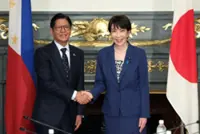
HOUSTON: Japanese Prime Minister Sanae Takaichi salved a diplomatic wound left by Washington’s European allies after US President Donald Trump bitterly reprimanded them for refusing to send their navies to end Iran’s blockade of the Strait of Hormuz.
Striking bonhomie was on display during the Thursday (March 19) visit of the first Asian leader and the first US ally to the White House after the Iran war began.
Takaichi was greeted by Trump with a hug upon arrival and with a light kiss on the cheek at their dinner at the White House.
Trump called her spectacular, popular and powerful, and declared Japan was “stepping up to the plate” on the Iran war. He reminded everyone that he had endorsed her before her “landslide win” in the Feb 8 elections in Japan.
But it was Takaichi who stole the show with her determined effort to keep the vibes positive.
“I firmly believe that it is only you, Donald, who can achieve peace across the world,” she said in her opening remarks that set the tone for the meeting, which was telecast live from the White House.
She maintained the good cheer at dinner. Dressed in a sparkly dark grey skirt suit with a double strand of pearls, a white handbag in the crook of her arm, she drew comparisons with the “Iron Lady” of British politics, former premier Margaret Thatcher. Albeit with a relaxed smile.
She wished Trump’s son Barron an early happy birthday, saying he took after his parents and was very “ikemen”, or good-looking in Japanese slang.
Applause rang out when she said “Donald and I are best buddies” to realise shared goals for a stronger Japan and a stronger America.
The claps were louder still when she channelled her mentor, assassinated former prime minister Shinzo Abe, famous for his rapport with Trump, as she signed off her dinner speech with a phrase associated with him: “Japan is back.”
The one awkward moment of the day, when she appeared caught off guard, was when Trump brought up the Japanese attack on Pearl Harbor during World War II while replying to a Japanese reporter who asked why he had not warned allies about the US attack on Iran.
“We didn’t tell anybody about it because we wanted surprise. Who knows better about surprises than Japan? Why didn’t you tell me about Pearl Harbor?” Trump said.
Takaichi reacted viscerally, reported Yomiuri Shimbun’s Mineko Tokito Abe, who was covering the event, “her eyes widening and her smile disappearing as she leaned back, drawing her hands in, clearly taken aback”.
But the Prime Minister made no comment.
The 20-day-old Iran war stalked the visit, with Trump sending mixed messages on what he expected. He said he did not need help from Japan, but it would be “appropriate” for the country to help since 90 per cent of its oil imports transit the Strait of Hormuz.
“I expect Japan to step up because we have that kind of relationship and we step up for Japan. We have 45,000 soldiers in Japan. We spend a lot of money on Japan,” he said.
Takaichi stressed Japan’s diplomatic efforts, saying it had held talks with Tehran, urged it to stop regional attacks, condemned its closure of the Strait of Hormuz and called its nuclear weapons programme unacceptable. She also said she would present a plan to calm energy markets.
Briefing the Japanese press after the meeting, she described her conversation with Trump as “sensitive”.
“The consensus was that ensuring the safety of the Strait of Hormuz is of the utmost importance. However, there are certain actions we can and cannot take within the scope of Japanese law, so I provided a detailed and thorough explanation,” she said.
Japanese Deputy Cabinet Secretary Masanao Ozaki, in another briefing, confirmed that Trump had requested that Japan and other countries contribute to ensuring the safety of navigation in the strait.
Nicholas Szechenyi, an expert in Japanese politics, foreign policy and US-Japan relations at the Center for Strategic and International Studies, said he was struck by her reference to what Japan can and cannot do.
“She probably addressed the constraints but my sense is that in order to maintain momentum in the US-Japan relationship, the Japanese government will find some way to support the security agenda in the Strait of Hormuz,” he said.
That would not mean sending vessels directly into the war zone, given that Japan can get directly involved militarily only in a situation that threatens the survival of the nation.
But it could include sending military vessels to the region for intelligence gathering. And once the bombing stops, there is the possibility of deploying Japan’s minesweepers and contributing surveillance assets now stationed in Djibouti on anti-piracy missions.
“It’s more likely that Japan’s other contributions, diplomatic, energy, economic, will be impactful in the near term, and that whatever military contribution they offer might follow a little later,” said Szechenyi.
Takaichi also met her core objective, which was to talk about the China threat candidly with the President, he said.
What exactly was discussed has not been revealed. Tensions between Japan and China escalated in November 2025 after Takaichi described a potential Chinese attack on Taiwan as an “existential crisis” for Japan, justifying military involvement.
Beijing, which claims self-ruled Taiwan as its own, retaliated with economic curbs, naval incursions and warnings. And Japan began plans for missile deployments near Taiwan, heightening the risk of a regional conflict.
Pressed on the issue, Ozaki was tight-lipped. “We discussed various issues concerning Taiwan and China, and confirmed that Japan and the US will continue to cooperate closely,” he said. On Taiwan, he declined to provide details.
Szechenyi noted that Takaichi had adroitly seized on the chance to talk about China even amid the angst over Iran.
When a reporter asked Trump whether he planned to “broker a relationship between Japan and China”, she spoke up.
Japan had been consistently open to dialogue with China, she said, adding: “And also speaking of the US-China relationship, my sincere hope is that the relationship will be conducive for regional security and also ensuring a global supply chain in the world.”
“That was a subtle reminder to the Trump administration that security dynamics in Asia are deteriorating, and that the US should not take its eye off the ball,” said Szechenyi.
It likely presented Japan the opportunity to counter, in private discussions, what Trump might be hearing from Beijing. Tokyo could also air its desire that Trump not endorse the so-called G2 dynamic with China because it might not reflect the interests of Japan and other regional allies, he said.
In his reply to the reporter, Trump said he wanted to hear Takaichi’s views. “I’d really like to have the Prime Minister talk about China, because I know they have a little bit of an edgy relationship, and I just like to know where it stands and how you’re doing with China,” he said.
He also said he would “be singing Japanese praises in Beijing” when he travels to China for a summit with President Xi Jinping that has been postponed.
Trump had not offered such backing to Takaichi earlier, while she was under attack by Beijing.
Emma Chanlett-Avery, an expert on US-Japan relations at the Washington-based Asia Society Policy Institute, said it was unlikely that Takaichi got the assurances she was seeking from Trump.
“The circumstances denied her that opportunity,” she said, noting the boilerplate mention of security issues in the statement issued by the White House.
“The Iran war was a fog over the whole summit or she would have been able to press concerns to Trump a little more directly. And because the Trump-Xi summit has now been postponed, I don’t think that she got in Trump’s ear to press her priorities as effectively as she may have if the summit was proximate,” she added.
“In the Trump administration, any number of things can happen in six weeks.”
Szechenyi said the fact that China featured as a theme was a plus from Japan’s perspective because there was a concern that they would not get to regional security issues at all.
The value of a personal connect with Trump could not be overstated, said Szechenyi.
“He is running a top-down administration; he doesn’t care for strategic coordination and strategic planning. So the fact that Japan has a direct line to him to engage on bilateral issues, as well as regional and global dynamics, is extremely significant.”
He said Trump saw Takaichi’s election success as a sign of her political savviness.
“And so there’s potential to invest in that personal relationship and get things done with Japan.”
“Takaichi has found a way to penetrate the Trump circle and I suspect that other US allies are envious of that right now.”
“She will take advantage of that to not only shape a positive agenda for US-Japan relations, but if necessary, get on the phone and remind the US President of Japan’s equities as he engages in other diplomatic initiatives. And that’s really significant.”
Chanlett-Avery at the Asia Society was less convinced. “I think their summit avoided being a disaster, if you can call that a success,” she said. “It didn’t really cement Japan’s status as any sort of special ally.”
After the meeting, the two countries announced a US$40 billion (S$51.2 billion) project to build nuclear reactors in Tennessee and Alabama, and a US$33 billion investment in natural gas power generation facilities in Pennsylvania and Texas.
Japan has promised to invest US$550 billion in the US in a 2025 deal that lowered threatened tariffs by Washington to 15 per cent from 25 per cent.
Like other nations under Section 301 trade investigations, it is wary of new tariffs on “overproduced” goods flooding US markets.
“The Takaichi government has been pressing the administration to maintain the current agreement and not reopen that conversation,” said Szechenyi.
“And in the interim, Japan’s strategic play is to keep demonstrating that it’s committed to the investment agreement.” - The Straits Times/ANN