JAKARTA: Declining freedom of expression and weakening the country’s judiciary system have contributed to the drop of Indonesia’s score in the global graft index in the first full year of President Prabowo Subianto ’s administration.
Indonesia scored 34 at the 2025 Corruption Perception Index (CPI) that was published by Berlin-based Transparency International on Tuesday (Feb 10)
The index is based on perceived levels of public sector corruption on a scale of 0 to 100, with 100 indicating the cleanest governance.
This year’s score indicated a three-point drop from 2024 and is below the global average of 42, putting Indonesia at 109th position of 182 countries surveyed, on par with countries such as Nepal which experienced political instability following a youth-led protests in September 2025 that led to the toppling of its prime minister.
Indonesia also lagged behind several neighbours, including Timor-Leste, Malaysia and Vietnam, which scored 52, 44 and 41, respectively. Singapore ranked the highest among South-East Asian countries, sitting at third position globally with a score of 84.
To calculate each country’s score, the antigraft watchdog compiled data from nine surveys and assessments on perceptions of public sector corruption, such as bribery, nepotism, the adequacy of anti-corruption laws as well as protections for whistleblowers, journalists and investigators.
In this year’s report, the group highlighted a “worrying pattern” of restrictions on freedom of expression in several countries, including Indonesia, citing political interference in nongovernmental organisations through funding limitations and intimidations.
“It is becoming harder for independent journalists, civil society organizations and whistleblowers to speak out against corruption freely. It is also more likely that corrupt officials can continue misusing their power,” Transparency International wrote in the report.
In Indonesia’s case, anti-corruption efforts had weakened due to declining leadership quality, weakening oversight institutions and shrinking civic freedoms, Transparency International Indonesia (TII) programme manager Ferdian Yazid said during the report launch on Tuesday.
Declining judicial independence had further contributed to Indonesia regression, said TII secretary-general Danang Widoyoko, tracing the trend back to the revision of the Corruption Eradication Commission (KPK) Law in 2019 that stripped the agency of its independence.
He also pointed to a recent controversial selection of Golkar Party lawmaker Adies Kadir as a Constitutional Court justice by the House of Representatives, which he said lacked meaningful public participation.
“This is an extraordinary setback. It poses a serious threat to judicial independence,” Danang said.
“Without an independent judiciary and law enforcement system, corruption cases investigation can easily be used to serve certain interests
Jakarta-based Indonesia Corruption Watch (ICW) largely linked the CPI decline to the leadership of Prabowo and Vice President Gibran Rakabuming Raka, whom the group saw as only showing insincere antigraft commitments.
The President has repeatedly reasserted his pledge to fight against corruption, a crime he called harming national priorities, and making meaningful progress impossible.
But “over the past year, the Prabowo-Gibran administration has used its authority to build an ecosystem that normalizes conflicts of interest, nepotism and political patronage,” ICW said in a statement on Tuesday.
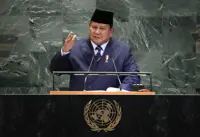
President Prabowo Subianto delivers a speech on Dec 24, 2025, during a ceremony for the handover of funds collected from forestry administrative fines and recovered state assets from corruption cases at the Attorney General’s Office (AGO) complex in Jakarta.
The group noted that conflicts of interests were being sustained through the appointment of family members, cronies and individuals within the President’s inner circle for strategic government positions and concessions in major projects.
Some examples highlighted by ICW were deputy ministers holding leadership roles in state-owned and private firms as well as alleged strong political and military affiliations linked to Prabowo’s flagship free nutritious meal programme.
It also pointed to the recent appointment of Prabowo’s nephew Thomas “Tommy” Djiwandono as a deputy governor of Bank Indonesia (BI).
The appointment was seen problematic by some experts, as it eliminated two other nominees who had built their careers at the monetary authority, while Tommy had only started working as deputy finance minister in July 2024.
Responding to Transparency’s report, KPK spokesperson Budi Prasetyo said the drop on Indonesia’s score, which reflects public trust towards national antigraft pledge, should serve as a call for collective introspection and acceleration of corruption eradication efforts.
Acknowledging the persistent widespread corruption in the country, he reasserted KPK’s commitment to support an “integrity-driven democratic and political ecosystem” through education, prevention and law enforcement measures, while underlining the need to strengthen its preventive efforts.
“To increase public trust in the corruption eradication efforts,” Budi said, “we hope every progressive law enforcement taken by the KPK will be followed by concrete commitments and actions from all stakeholders to ensure corruption doesn’t recur.” - The Jakarta Post/ANN