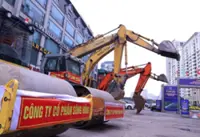
A sanitation worker collecting rubbish at an informal dumping site in Vietnam's capital city, Hanoi. -- PHOTO: VIETNAM NEWS/ASIA NEWS NETWORK
HANOI (Vietnam News/ANN): Hanoi will require households to sort their rubbish into three categories from Jan 8, under new rules that allow waste collectors to refuse unseparated rubbish and could pave the way for higher, volume-based disposal fees.
The regulations, issued under Decision 87 signed by the city’s Vice-Chairman Nguyen Manh Quyen, represent the capital’s most sweeping overhaul of household waste management in more than a decade.

Under the new rules, household waste must be separated at source into recyclable materials, food waste and hazardous waste.
Collection companies will be authorised to reject rubbish that is not properly sorted or not placed in approved containers, and to report violations to local authorities for inspection and penalties.
The first category covers recyclable materials such as paper, plastic, wood, rubber and electrical equipment. Food waste, including leftovers, expired food and kitchen scraps, forms the second category.
The third includes bulky items such as broken furniture and door frames, as well as hazardous household waste like pesticide containers, paint, used batteries and accumulators.
The city has also standardised waste containers by colour. Food waste must be placed in green containers designed to prevent leaks and odours, while other household waste must go in grey containers.
Hazardous waste must be stored separately in corrosion-resistant, waterproof packaging that prevents leakage into the environment.
Households will be responsible for providing their own containers.
Recyclables may be handed directly to recycling operators, stored at home for periodic delivery to designated collection points or collected by municipal waste services.
Food waste may be composted, used as animal feed or collected by authorised operators. Bulky waste must be transferred to licensed collectors for a fee or taken by residents themselves to approved collection points, where no charge applies.
Hazardous household waste may be stored at home or brought to collection points on schedules set by local authorities.
The decision applies not only to households and individuals, but also to organisations that generate less than 300kg of domestic waste per day, which may opt to follow household waste management rules.
City authorities say the new system is intended to reduce landfill use and improve recycling rates in a city that produces around 7,500 tonnes of household waste daily.
The Department of Agriculture and Environment has been tasked with developing a new pricing framework for waste collection, transport and treatment.
Currently, waste fees in Hanoi are flat and modest: residents in urban wards pay about VND24,000 (S$1.15) per household per month, while those in rural communes pay roughly half of that. VIETNAM NEWS/ASIA NEWS NETWORK