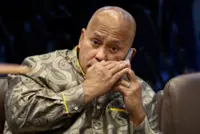
MANILA: The blind soldier who was previously ordered to end his service prematurely due to his disability thanked President Ferdinand Marcos Jr. for allowing him and other wounded officers to continue serving the country.
In a Facebook post on Tuesday, Army Captain Jerome Jacuba said his return to the Armed Forces of the Philippines (AFP) and his surprise promotion were the most beautiful gifts that he and his family received this Christmas.
“Thank you for boosting the morale of our troops, especially the wounded soldiers and the PWD (persons with disability) sector as a whole. Thank you for the opportunity to be heard and show that our ability is stronger than our disability,” he added.
Jacuba was more than eager to return to his post, saying he could not defy the orders of President Ferdinand Marcos Jr.
“Thank you very much for your trust in me to continue my service despite my disability. So who am I to refuse or disobey my commander-in-chief?” he said.
Marcos ordered the review of the current policy of the AFP, ordering the compulsory separation from service of officers who incur total permanent physical disability while in the line of duty.
In a video statement on Monday, the president said the current complete disability discharge (CDD) policy was “unjust and unfair,” citing the experience of the 38-year-old Jacuba.
“Because even if he has lost his sight, there are still many duties a soldier can perform — especially a soldier with 15 years of experience. He can still contribute and help us in many ways,” the president said.
Jacuba, along with his wife and three daughters, all cheered when they watched the president’s message.
Before receiving the good news, Jacuba posted a video on his Facebook telling his followers that his more than 15 years in service ended on Nov. 30 after he became totally blind.
He lost his sight when an improvised explosive device went off during an operation in Maguindanao against the Bangsamoro Islamic Freedom Fighters in March 2016.
“I entered the military whole and complete. But now, I’m left without my sight. However, I say that my sight was not taken from me — I gave it to our country,” he said.
“It is an honour to be blind for our country,” he added.
Jacuba’s video became viral. It was shared more than 55,000 times and garnered more than 35,000 comments, with many expressing their appreciation and adoration for Jacuba’s service to the country.
It was viewed by more than 12 million people, including Marcos.
Jacuba was the same soldier whom former President Rodrigo Duterte had an emotional encounter with during his visit to the AFP Medical Centre in Quezon City in August 2016.
Duterte was moved to tears and even hugged Jacuba, who also turned emotional during their meeting. The blind officer has gained attention since then.
As part of his reforms, Marcos also directed Defence Secretary Gilberto Teodoro to review the CDD policy, so other soldiers would not need to suffer the same experience that Jacuba did.
“So that this does not happen again — that one of our soldiers, who was hurt because of his sacrifice and because he was doing his duty to defend the Philippines, would simply be released or let go once he is injured. That is not right,” Marcos said.
“So we will create a new policy on CDD as soon as possible,” he added. “This is for all our soldiers who, because of their duty, were hurt or injured. We must continue to honour their courage and their sacrifice.”
According to Marcos, with the new CDD policy, soldiers would no longer have to worry about the security of their tenure should they become permanently disabled while defending the country.
“I assure you that opportunities will be fair and that you will have a true home within the AFP,” he said.
The CDD policy of the AFP was based on Presidential Decree No. 1044, issued by Marcos’ father and namesake, then-President Ferdinand Marcos Sr., in 1976 during martial law.
Under the law, any officer or enlisted person who incurs total permanent physical disability in line of duty before completing 20 years of active service shall be compulsorily separated from the service in the next higher grade than the permanent grade last held.
Total permanent physical disability refers to the permanent loss of use of the one hand or both hands, or of one hand or both hands, or of one foot or loss of both feet or both legs, or of one eye or both eyes having only light perception, or mental faculties.
The degree of physical disability shall be determined by a medical board of the military hospital that provided medical treatment to the military personnel concerned. - Philippine Daily Inquirer/ANN