

China sends its youngest astronaut to 'Heavenly Palace' space station


Chinese astronaut for the Shenzhou 21 mission, from left, Zhang Hongzhang, Wu Fei, and Zhang Lu wave as they attend a see-off ceremony for their manned space mission at the Jiuquan Satellite Launch Center in northwestern China, Friday, Oct. 31, 2025. -- AP Photo/Andy Wong

BEIJING (Reuters): China's Shenzhou-21 space rocket and its crew, including the youngest member of its astronaut corps, blasted off on Friday atop a Long March-2F rocket from the Jiuquan Satellite Launch Centre in northwest China, Chinese state media reported.

It was the seventh mission to the permanently inhabited Chinese space station since it was completed in 2022.
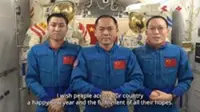
Missions on China's Shenzhou-21 spacecraft involve trios of astronauts on six-month stays in space, with veteran astronauts increasingly replaced by younger faces. First-timers Zhang Hongzhang, 39, and Wu Fei, 32 - China's youngest astronaut to be sent to space - were picked to participate in the programme in 2020.

Commander Zhang Lu, 48, flew on the 2022 Shenzhou-15 mission.

FIRST SMALL MAMMALS ON SPACE STATION

The Shenzhou-21 astronauts will take over from the Shenzhou-20 crew who had lived and worked on board Tiangong, or "Heavenly Palace", for more than six months. The Shenzhou-20 astronauts will return to Earth in the coming days.

The Shenzhou-21 crew were also joined by four black mice, the first small mammals to be taken to the Chinese space station. The mice will be used in experiments on reproduction in low Earth orbit.

Biannual launches have become the norm for the Shenzhou programme, which has in the past year reached new milestones with the deployment of Chinese astronauts born in the 1990s, a world-record spacewalk, and plans to train and send the first foreign astronaut, from Pakistan, to Tiangong next year.

The rapid advances have raised alarm bells in Washington, which is now racing to put a U.S. astronaut on the moon again before China does.

Both countries are also competing in nascent institution-building efforts, with the U.S.-led Artemis Accords on lunar exploration matched up against the Chinese and Russian-led International Lunar Research Station.

(Reporting by Ryan Woo and Eduardo Baptista; Editing by David Holmes) - Reuters


Follow us on our official WhatsApp channel for breaking news alerts and key updates!

Next In Aseanplus News

Myanmar declares a 'zero tolerance' policy for cyberscams. But the fraud goes on
Cambodia says Thai military bombs Poipet casino hub on border
Hotels and stores in Japan suffer amid cancellations by Chinese tourists
Australian firm to invest A$100mil in Laos berry farming project
Alleged Bondi shooters holed up in hotel for most of Philippines visit
Thai navy troops uncover cache of 16 landmines at Ban Sam Lang area
Manila teacher probed for forcing student to eat cockroach
Japan releases first sakura forecast for 2026; Tokyo to see blooms from mid-March
Brunei arrests nine in Belait drug crackdown
Air India finds missing plane 13 years after it ‘vanished’

Others Also Read