SINGAPORE: Three blocks of the former Kandang Kerbau Hospital in Hampshire Road were on Wednesday (Oct 1) collectively gazetted as Singapore’s 76th national monument, with a special public exhibition launched to mark the occasion.
It was on Oct 1, 1924, that Kandang Kerbau Hospital – which has a history that dates back to 1858 – opened as a free maternity hospital specialising in gynaecology and childbirth.
Acting Minister for Culture, Community and Youth David Neo, who officiated the gazette at the former hospital on Oct 1, said the facility stands as a physical reminder for many first entering parenthood.
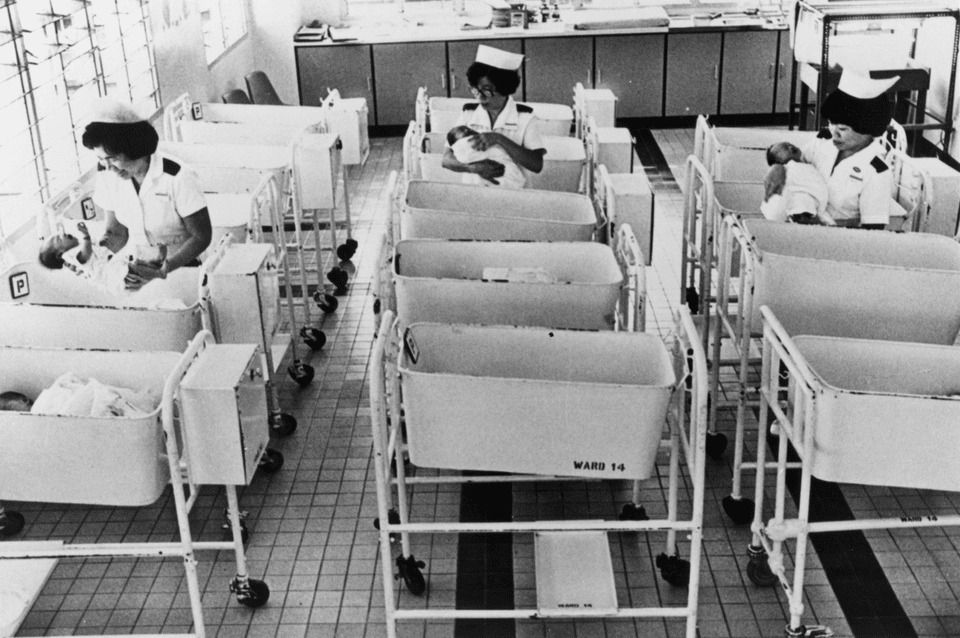
“It also honours the dedication and professionalism of our healthcare professionals across the ages,” said Neo, who also launched the special exhibition called The Architecture Of Care.
In a statement, the National Heritage Board (NHB) noted that the former hospital holds an important place in Singaporeans’ social memory as the birthplace of more than 1.2 million babies from 1924 until the hospital moved across the road in March 1997 to its present location.
It was also in 1997 that the hospital took its current name, KK Women’s and Children’s Hospital.
In 2004, the Land Transport Authority (LTA) took over the old hospital premises, which the agency has used as its headquarters till today.
The three blocks forming the monument occupy roughly half of a plot of land that has been earmarked for housing and is about 3.5ha in size – equivalent to the area of about five football fields.
Responding to queries from The Straits Times, an LTA spokesperson said that the agency will continue to occupy the former hospital site until around 2030.
Noting that the old hospital grounds have been zoned for housing since 1998, a spokesperson for the Urban Redevelopment Authority said that given the national-monument status of Blocks 1, 2 and 3, “agencies will review the plans and identify ways to sensitively integrate them with future developments”.
In Singapore, gazetting a building or site as a national monument gives it the highest level of protection under local laws.
Monuments have to be of national importance and historic, cultural, traditional, archaeological, architectural, artistic or symbolic significance to be gazetted under the Preservation of Monuments Act 2009.
Each national monument is issued a set of preservation guidelines prepared by NHB, which spell out the exact features of the property that must be preserved.
NHB’s monument inspectors also carry out inspections on the monuments once every two years.
Of the three blocks that form the monument, Block 2 was built first, and is the oldest remaining building from the former hospital. It housed the hospital’s third-class wards.
Nicholas Phoon, manager for built heritage and archaeology at the NHB, said the four-storey block, which was completed in 1933, was at that point the tallest in the hospital compound as the other buildings were no more than two storeys tall.
Block 3, which was completed in 1940, was originally three storeys tall but later had a fourth added.
It housed antenatal and labour wards, and was also used partially as a midwifery school. Antenatal care refers to medical care given to pregnant women before they give birth.
Facing Bukit Timah Road, Block 3 was the hospital’s main facade until Block 1, which faces Hampshire Road, was completed in 1955.
Block 1 was designed by Dr Benjamin Henry Sheares – the first local-born Professor of Obstetrics and Gynaecology at the hospital, and later Singapore’s second president – who was assisted by then chief government architect K. A. Bundle.
It housed air-conditioned wards, a students’ hostel and an operating theatre.
The special exhibition is located on the first storey of Block 1 and will run until Dec 31.
The public may visit the exhibition from Mondays to Fridays, between 9.30am and 5pm. Visitors must register at the LTA headquarters’ security posts.
The exhibition spotlights the hospital’s role as the birthplace of generations of Singaporeans, especially in the post-independence years, when the hospital struggled to keep up with demand, and some mothers reportedly delivered in its corridors.
Of note is 1966 – referred to by the exhibition as the “birthquake” year – when 39,835 babies were born, or on average, one every 13 minutes and 11 seconds.
The NHB said that the figure set a world record that entered the hospital in the Guinness Book of Records, for delivering the most babies in a single maternity facility in a year.
Also on display are items that tell of the hospital’s contributions towards midwifery, such as a certificate issued by the hospital’s school of midwifery – the nation’s first when it opened in 1952.
Another highlight is a book of handwritten notes by the late Dr Yvonne Marjorie Salmon – who in 1975 became the hospital’s first female head of obstetrics and gynaecology – taken at a 1953 lecture by Dr Sheares. - The Straits Times/ANN