

The Himalayan nation’s president and army sought to find a consensus interim leader to fill a political vacuum after deadly anti-corruption protests toppled the government and left parliament in flames.
The Himalayan nation of 30 million people was plunged into chaos this week after security forces tried to crush rallies by young anti-corruption protesters, culminating in widespread violence on Tuesday.
At least 51 people were killed in the worst violence since the end of a Maoist civil war and abolition of the monarchy in 2008.
The military took back control of the streets on Wednesday, enforcing a curfew, as army chief General Ashok Raj Sigdel and President Ramchandra Paudel held talks yesterday with key figures and representatives from “Gen Z”, the loose umbrella title of the youth protest movement.
Disagreements between rival factions remain, although Sushila Karki, 73, Nepal’s first woman chief justice, is a leading candidate.
“A meeting has been scheduled for this afternoon with the president, the army chief, former chief justice Sushila Karki, our representative Sudan Gurung and one legal expert,” Nimesh Shrestha, who was part of the Gen Z protest, said.
Karki has said that “experts need to come together to figure out the way forward”, and that “the parliament still stands”.
Gurung, the youth activist, told reporters on Thursday that their “first demand is the dissolution of parliament”.
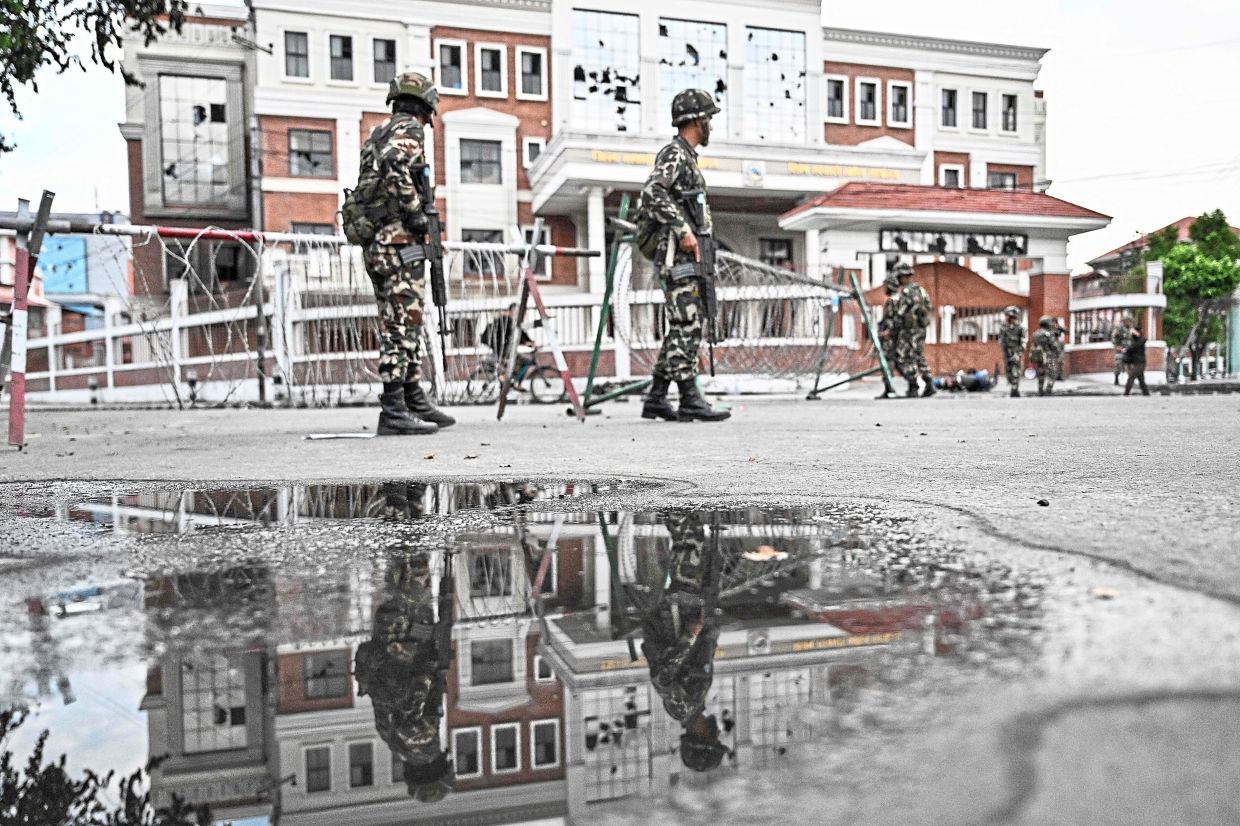
The army patrolled the largely quiet streets of the capital Kathmandu for a third day yesterday, after the protests and nationwide chaos that included a mass breakout of prisoners.
“I was very afraid and stayed locked inside my home with family and didn’t leave,” said Naveen Kumar Das, a painter-decorator in his mid-40s.
He was among many ordinary residents of Kathmandu who took advantage of a brief lifting of the curfew in the morning to stock up on supplies.
“It was a really tense time and we just stayed indoors,” said Laxmi Thapa, 32, on a motorbike as her husband filled its fuel tank.
“We came out as things have improved.”
The army said yesterday that it had recovered more than 100 guns looted in the uprising, during which protesters were seen brandishing rifles.
More than 12,500 prisoners who escaped from jails across the country during the chaos “are still at large”, police spokesman Binod Ghimire said.
Protests fed into long-standing economic woes in Nepal, where more than two-fifths of people are aged between 16 and 40.
A fifth of people aged 15-24 are unemployed, according to the World Bank, with GDP per capita just US$1,447 (RM6,100). — AFP
