SINGAPORE: The blood moon played hide-and-seek with stargazers in Singapore but made a splashy appearance across parts of Asia, Africa and Europe on Sept 7.
On Facebook, several members of enthusiast group CloudSpotting & SkySpotting Singapore posted images of what they had caught on their cameras, often lamenting about the clouds that obstructed their view.
Some caught partial glimpses from neighbourhood areas, while others took to rooftops and prime stargazing spots like Marina Barrage to secure their shots.
In a Facebook post in the wee hours of Sept 8, members of the Astronomical Society of Singapore said they were at Passion Wave in the Marina Bay area but “unfortunately, the moon was never out of the clouds”.
The blood moon was sparked by a total lunar eclipse. September’s full moon, known as the Corn Moon, took on the reddish hue during the eclipse. The phenomenon was last seen in Singapore on Nov 8, 2022.
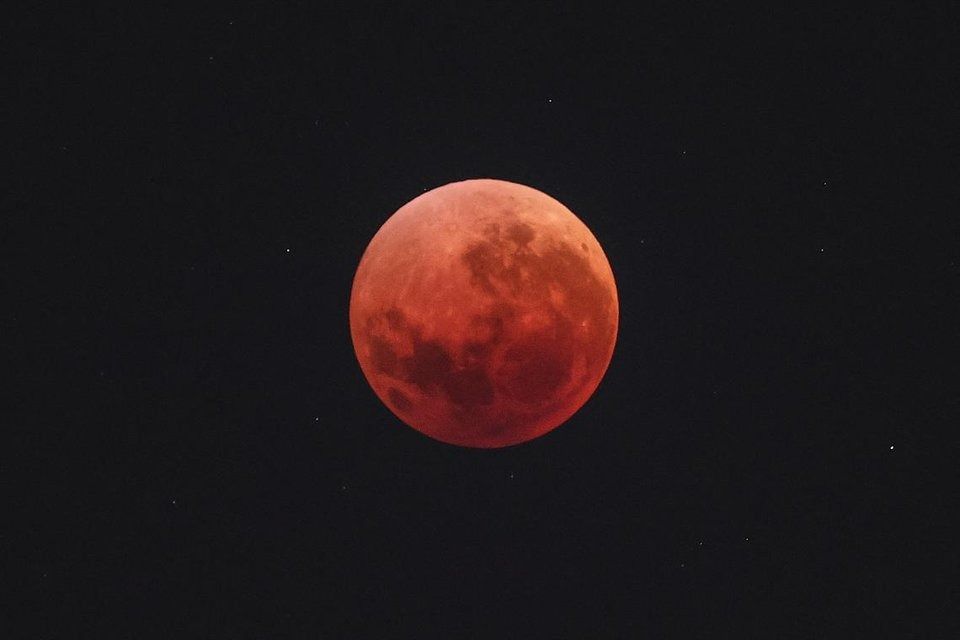
The eclipse began at 11.28pm in Singapore, reaching its maximum at 2.11am on Sept 8. It ended at 4.55am, according to global astronomy website timeanddate.com’s latest data.
Total lunar eclipses are visible about once every three to four years, said the Science Centre Singapore observatory in response to queries.
According to AFP, when the Sun, Earth and Moon line up, the shadow cast by the planet on its satellite makes it appear a deep red colour.
The Moon appears red during lunar eclipses because the only sunlight reaching it is “reflected and scattered through the Earth’s atmosphere”, said Dr Ryan Milligan, an astrophysicist at Queen’s University Belfast, Northern Ireland, told AFP.
Chai Jurn Wei shared on Facebook photos taken at Jurong Lake Gardens in the early hours of Sept 8.
He said that although clouds frequently obscured the view, he managed to capture the moon during brief clear spells, noting that its dimmer glow revealed faint stars – tiny white specks in his images – that are normally concealed by the brightness of a full moon.
Blue wavelengths of light are shorter than red ones, so are more easily dispersed as they travel through Earth’s atmosphere, he said, adding that “that’s what gives the moon its red, bloody colour”.
Those living in Asia were best placed to see the total eclipse, with wire agencies filing photos from the Philippines, Myanmar, Sri Lanka, Turkey and Iran.
Parts of Australia enjoyed the view of a red-hued moon on the night of Sept 7 too. Reader Kannan A, who was holidaying in Sydney, shared with The Straits Times photow he had taken of the blood moon.
Set against the backdrops of the Sydney Opera House, Shangri-La Hotel and the famous Sydney Harbour Bridge, the moon glowed orange against the night sky in the photos Kannan shared.
When a total lunar eclipse does occur, it is not unusual for a few to follow in close succession. After this, the next is expected to fall on March 3, 2026. - The Straits Times/ANN