
Global powers converge in Tianjin


In this photo provided by Indian Prime Minister's Office, Indian Prime Minister Narendra Modi, left, and Chinese President Xi Jinping, right, hold a meeting on the sidelines of the Shanghai Cooperation Organization (SCO) summit in Tianjin, China Sunday, Aug. 31, 2025. (Indian Prime Minister's Office via AP)

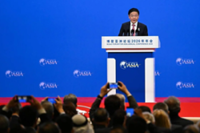
President Xi Jinping gathered the leaders of Russia and India among dignitaries from around 20 Eurasian countries for a showpiece summit aimed at putting China front and centre of regional relations.

Security was tight in the northern port city of Tianjin, where the Shanghai Cooperation Organi­sation (SCO) summit is being held until today, days before a massive military parade in the capital Beijing to mark 80 years since the end of World War II.
The SCO comprises China, India, Russia, Pakistan, Iran, Kazakhstan, Kyrgyzstan, Tajikistan, Uzbekistan and Belarus – with 16 more countries affiliated as observers or “dialogue partners”.

Russian President Vladimir Putin touched down in Tianjin yesterday with an entourage of senior politicians and business representatives.

Meanwhile, Xi held a flurry of bilateral meetings with leaders from the Maldives, Azerbaijan, Kyrgyzstan and one of Putin’s staunch allies, Belarusian President Alexander Lukashenko.

He also met India’s Prime Minister Narendra Modi, Xinhua news agency reported.

China and Russia have sometimes touted the SCO as an alternative to the Nato military alliance. This year’s summit is the first since US President Donald Trump returned to the White House.

In an interview published by Xinhua on Saturday, Putin said the summit will “strengthen the SCO’s capacity to respond to contemporary challenges and threats, and consolidate solidarity across the shared Eurasian space”.

“All this will help shape a fairer multipolar world order,” Putin said.

As China’s claim over Taiwan and Russia’s invasion of Ukraine have seen them clash with the United States and Europe, experts say that Beijing and Moscow are eager to use platforms such as the SCO to curry favour.

“China has long sought to present the SCO as a non-Western-led power bloc that promotes a new type of international relations, which, it claims, is more democratic,” said Dylan Loh, an assistant professor at Singapore’s Nanyang Technological University.

More than 20 leaders including Iranian President Masoud Pezeshkian and his Turkish counterpart Recep Tayyip Erdogan are attending the bloc’s largest meeting since its founding in 2001.

“The large-scale participation indicates China’s growing influence and the SCO’s appeal as a platform for non-Western countries,” Loh added.

Beijing, through the SCO, will try to “project influence and signal that Eurasia has its own institutions and rules of the game”, said Lizzi Lee from the Asia Society Policy Institute.

“It is framed as something different, built around sovereignty, non-interference, and multipolarity, which the Chinese tout as a model,” Lee said.

Putin needs “all the benefits of SCO as a player on the world stage”, said Lim Tai Wei, a professor and East Asia expert at Japan’s Soka University. — AFP

Follow us on our official WhatsApp channel for breaking news alerts and key updates!

Next In Aseanplus News

Jakarta’s minimum wage bump faces disappointed labourers
'Grey grub nest' and 'rat nest': Thai parliament press corps hands out 2025 nicknames
Ceasefire does not mean Cambodia has abandoned right to self-defence: Hun Manet
Myanmar pro-military party 'winning' junta-run poll first phase: Source
Dam safety tops agenda at Lao Dam Association’s annual conference
Domestic tourism in Vietnam sees strong uptick ahead of New Year holiday
Perlis MB and exco team to take pay cuts to ease state’s financial burden
Cops bust 17 gang members linked to robberies and at least two murders
Labuan Customs seizes 55 vehicles worth RM7.12mil
More than 1,100 Bruneians meet Brunei royal couple in London

Others Also Read