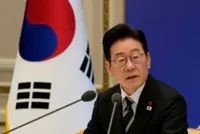
The nation’s President Lee Jae-myung and Japan’s Prime Minister Shigeru Ishiba agreed to step up cooperation in their first in-person talks, in an early indication of the direction of future relations between the two countries after Lee took office.
The two leaders met on the sidelines of the Group of Seven (G-7) summit in the Canadian Rockies on Tuesday, just days before the 60th anniversary of the normalisation of diplomatic ties between South Korea and Japan.
“We are inseparable, like neighbours sharing a front yard. We may have small differences and disagreements, but I hope that we can overcome them and develop a more cooperative and mutually beneficial relationship in many ways,” Lee said to Ishiba.
The meeting builds on a dialogue that began with a phone call about a week ago. Left-leaning Lee, who has been critical of Japan in the past, became president after winning a June 3 vote triggered by the ouster of his conservative predecessor.
The two leaders agreed to beef up trilateral cooperation with the United States to respond to geopolitical risks including North Korean issues, and reaffirmed their commitment to shuttle diplomacy between the neighbours, a statement from the South Korean president’s office said.
“The two leaders affirmed that they will continue to work closely together, as well as within the trilateral framework with the United States, on responding to North Korea on issues that include nuclear, missiles, and abductees,” according to a separate statement from the Japanese government.
Lee had also planned to meet with President Donald Trump on the sidelines of the G-7 summit but the talks were cancelled after Trump cut short his trip amid the Israel-Iran conflict.
The possibility of a three-way meeting among the leaders in Canada had also been floated in South Korean local media reports.
The relationship between Japan and South Korea, as well as their trilateral ties with the United States, is under scrutiny given a tendency for new leaders in Seoul to walk back on progress made by predecessors, as well as interest in how the United States will engage in the Indo-Pacific under Trump.
Despite his past criticism of the United States and Japan, Lee is likely wanting to emphasise continuity in relations with both countries at least at the start of his administration. — Bloomberg