
BEIJING: China’s humanoid robots will not replace human workers and cause mass unemployment, according to a Chinese official who oversees a tech hub in Beijing, amid a rapid expansion of the sector and state funding for it.
Liang Liang, a deputy director at the Beijing Economic-Technological Development Area, which hosts one of China’s largest tech hubs, said in an interview on Friday (May 16) with foreign media that he does not believe that humanoid robots will replace their human creators, but will boost productivity and operate in hazardous environments.
“We don’t believe robots will make people unemployed, but rather they’ll boost efficiency or take on tasks humans are unwilling to do, like exploring the vast universe or the ocean depths where people can’t go. Machines can assist us in that exploration,” Liang said.
“When it’s nighttime and humans need rest, machines could keep working, giving us better, cheaper and more user-friendly products. So, we see this as the direction for our future development,” he added.
Liang explained that the world’s first robot half-marathon held in April in Beijing was deliberately set up in a way that would highlight his and other officials’ hopes that these humanoids will support and assist humans, rather than replace them.
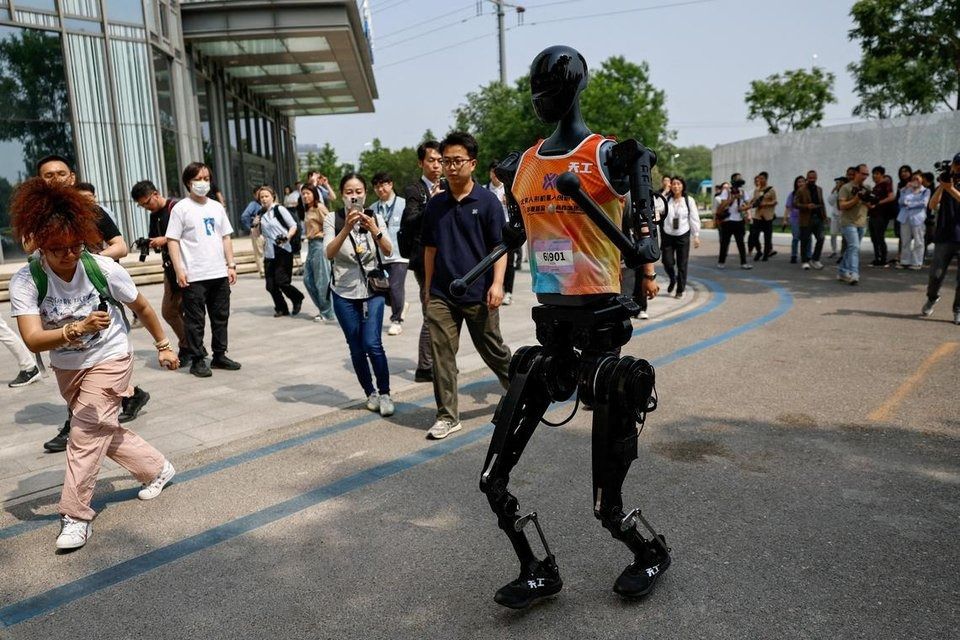
The half-marathon featured two tracks separated by a railing, with humans competing against each other on one side while on the other side 20 teams each operated a robot, varying wildly in size and ability.
“You see, in the marathon, humans have their track where they push their physical limits, and the machines have their own track where they jointly challenge their limits, but they aren’t trying to take over the human course to sprint to the finish line. The future will be like this too,” Liang said.
Liang spoke to reporters at the headquarters of state-backed X-Humanoid, also known as the Beijing Humanoid Robotics Innovation Centre, whose robot Tiangong Ultra won the inaugural robot half-marathon.
Besides the sports-focused Ultra model, which can reach a top speed of 12kmh, the centre also displayed other prototypes that showed it was working on robots that can complete mundane tasks in the face of obstructions and changing environments.
In one demonstration, an employee repeatedly moved the position of a piece of litter or snatched it from the robot’s hand, which would then relocate the object and carry out the task until it was completed, a self-corrective ability the centre says will be key in turning the humanoids into productive workers. - Reuters