All that’s left: A local resident inspecting the debris of his house that was destroyed by Pakistani artillery shelling at the Lagama village in Uri, about 100km from Srinagar. — AFP
The death toll from India and Pakistan’s biggest clashes in decades passed 50 with each country accusing the other of sending waves of drone attacks.
The escalation between the nuclear-armed rivals follows an attack on tourists in the Indian-run part of disputed Kashmir that killed 26 people on April 22 and Indian airstrikes on “terrorist camps” on Wednesday.
In the third day of tit-for-tat exchanges since, the Indian army said on X that it “repulsed” Pakistani attacks using drones and other munitions overnight and “a befitting reply was given”.
India also accused Pakistani forces on Thursday of targeting three military stations – two in Kashmir and one in the neighbouring state of Punjab.
Pakistan’s Information Minister Ataullah Tarar said Pakistan has “not targeted any locations in Indian Illegally Occupied Jammu & Kashmir, or across international border, so far”.
Five civilians were killed including a two-year-old girl by Indian shelling overnight in areas along the heavily militarised Line of Control, Pakistani security and governments officials said.
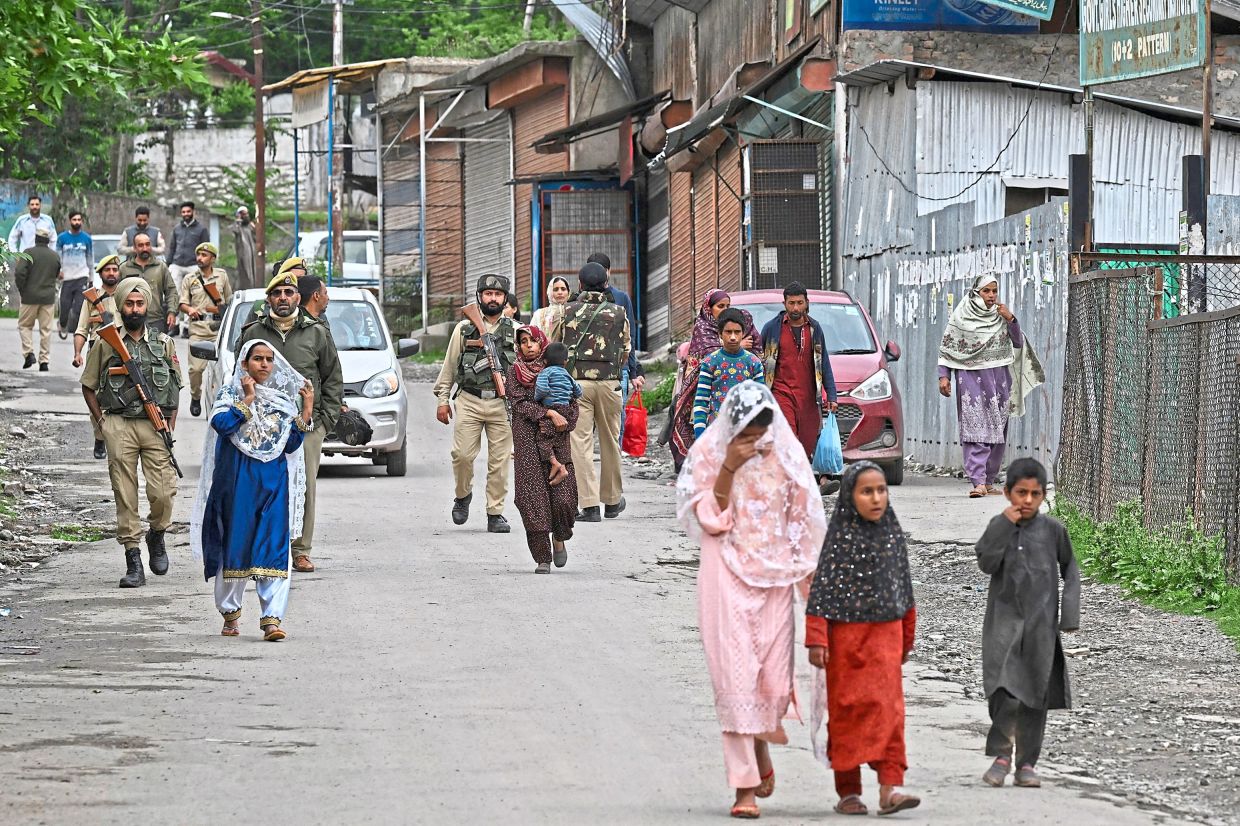 Seeking shelter: Indian villagers evacuating following overnight Pakistani artillery shelling in Uri. — AFP
“In response, the Pakistan Army carried out a strong counter-attack, targeting three Indian posts across the Line of Control (LoC),” police official Adeel Khan, based in Kotli district where four of the deaths occurred, said.
Pakistani military sources said that its military had shot down 77 Indian drones in the last two days, claiming they were Israeli-made.
In Indian-administered Kashmir, a police official said one woman died after heavy overnight shelling in Uri, some 100km from the state capital Srinagar, and two men were wounded.
“The youth of Kashmir will never forget this act of brutality by India,” said 15-year-old Muhammad Bilal in Muzaffarabad, the main city in Pakistan-administered Kashmir where a mosque was hit in Wednesday’s strikes.
In Indian-administered Jammu, Piyush Singh, a 21-year-old student, said: “Our (attack) is justified because we are doing it for whatever happened to our civilians.”
India and Pakistan have fought several wars over Kashmir which has been split since 1947 when British colonial rule ended and which both countries claim in full.
Pakistan has rejected claims by India’s government that it was behind last month’s attack, calling for an independent investigation.
Pakistani authorities insist they have the right to retaliate to India’s initial strikes.
In a late Wednesday TV address to the nation, Pakistan Prime Minister Shehbaz Sharif warned they would “avenge” those killed by Indian airstrikes.
Yesterday schools were closed on both sides of the Pakistan and Indian border in Kashmir and Punjab, affecting tens of millions of children.
India has also closed 24 airports, but according to local media the suspension on civilian flights may be lifted today.
The Indian Premier League cricket mega tournament was also suspended for a week, the Indian cricket board announced.
India has ordered X to block more than 8,000 accounts, the platform said, adding that it was reluctantly complying with what it described as government-imposed “censorship”.
The move appears to be part of India’s sweeping crackdown targeting social media accounts of Pakistani politicians, celebrities and media organisations.
Several countries have offered to mediate, and Iranian Foreign Minister Abbas Araghchi met his Indian counterpart Subrahmanyam Jaishankar in New Delhi on Thursday, days after visiting Pakistan.
Diplomats and world leaders have pressured both countries for restraint.
However, the International Crisis Group said “foreign powers appear to have been somewhat indifferent” to the prospect of war, despite warnings of possible escalation.
“A combination of bellicose rhetoric, domestic agitation and the remorseless logic of military one-upmanship have heightened the risks of escalation, particularly because for some time there was no diplomatic communication between the sides,” it said.
Amnesty said the warring sides “must take all necessary measures to protect civilians and minimise any suffering and casualties”. — AFP