Aid groups in the worst-hit areas of Myanmar said there was an urgent need for shelter, food and water after an earthquake that killed more than 2,700 people, but said the country’s civil war could prevent help reaching those in need.
The death toll had reached 2,719 and is expected to rise to more than 3,000, Myanmar’s military leader Min Aung Hlaing said in a televised address yesterday.
He said 4,521 people were injured, and 441 were missing.
Myanmar held a minute’s silence yesterday in tribute to the victims.
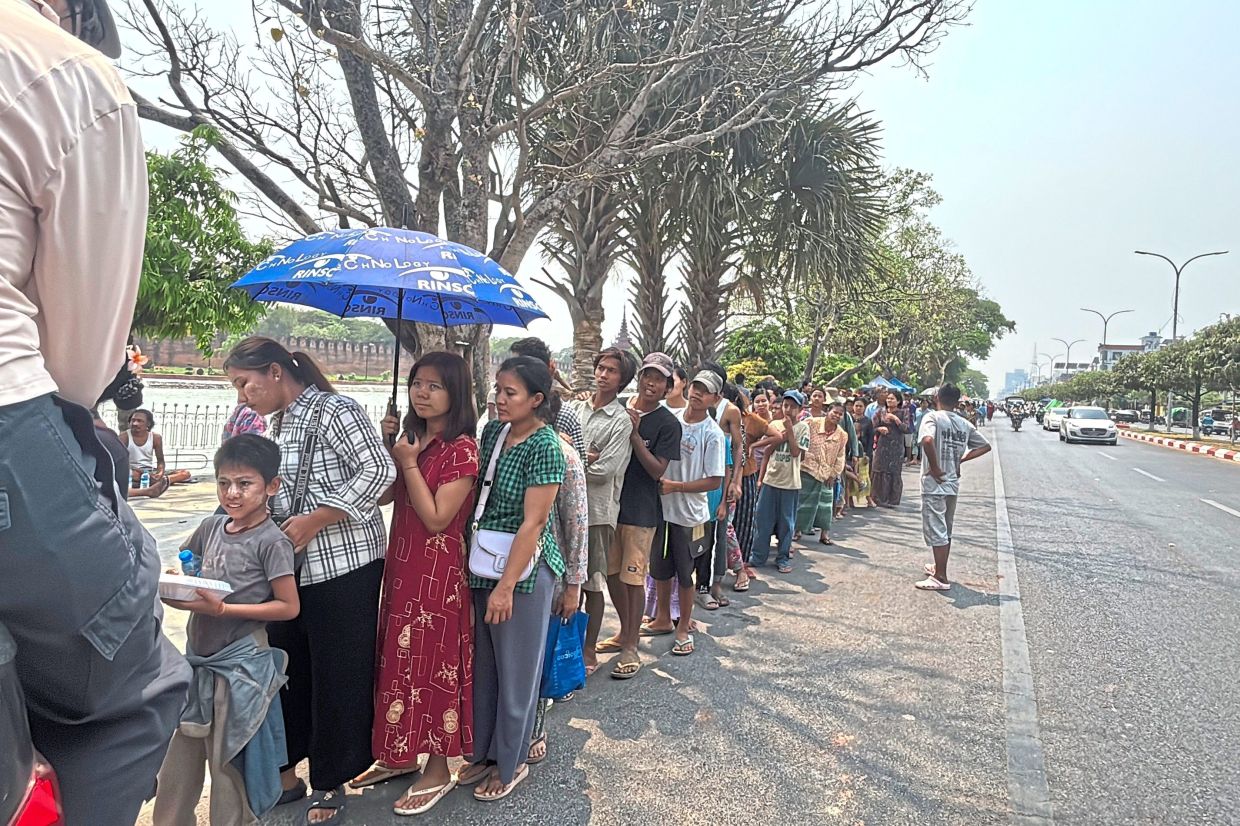
Four days after the earthquake struck, many people in Myanmar are still sleeping outdoors, either unable to return to ruined homes or afraid of further aftershocks.
Sirens rang out at 12.51pm – the time the quake struck on Friday – bringing the country to a standstill to remember those lost.
Mandalay, the country’s second-biggest city with 1.7 million inhabitants, suffered some of the worst destruction.
Outside the Sky Villa apartment complex, one of the city’s worst-hit disaster sites, rescue workers stopped and lined up with hands clasped behind their backs to pay their respects.
Officials and attendants stood behind a cordon, watching relatives further back, as the sirens wailed and a Myanmar flag flew at half-mast from a bamboo pole tied to a rescue tent.
The moment of remembrance is part of a week of national mourning declared by the ruling junta, with flags to fly at half-mast on official buildings until April 6 “in sympathy for the loss of life and damages”.
The 7.7-magnitude quake, which hit around lunchtime on Friday, was the strongest to hit the South-East Asian country in more than a century, toppling ancient pagodas and modern buildings alike.
In neighbouring Thailand, rescuers pressed on searching for life in the rubble of a collapsed skyscraper in the capital Bangkok, but acknowledged time was against them.
In Myanmar’s Mandalay area, 50 children and two teachers were killed when their preschool collapsed, the United Nations Office for the Coordination of Humanitarian Affairs said.
“In the hardest-hit areas ... communities struggle to meet their basic needs, such as access to clean water and sanitation, while emergency teams work tirelessly to locate survivors and provide life-saving aid,” the UN body said in a report.
The International Rescue Committee said shelter, food, water and medical help were all needed in places such as Mandalay, near the epicentre of the earthquake.
“Having lived through the terror of the earthquake, people now fear aftershocks and are sleeping outside on roads or in open fields,” an IRC worker in Mandalay said in a report.
The civil war in Myanmar, where the junta seized power in a coup in 2021, has complicated efforts to reach those injured and made homeless by the South-East Asian nation’s biggest quake in a century.
Amnesty International said the junta needed to allow aid to reach areas of the country not under its control. Rebel groups say the junta has conducted airstrikes after the quake.
“Myanmar’s military has a longstanding practice of denying aid to areas where groups who resist it are active,” Amnesty’s Myanmar researcher Joe Freeman said.
“It must immediately allow unimpeded access to all humanitarian organisations and remove administrative barriers delaying needs assessments.”
The junta’s tight control over communication networks and the damage to roads, bridges and other infrastructure caused by the quakes have intensified the challenges for aid workers.
Thai officials said a meeting of regional leaders in Bangkok later this week would go ahead as planned, although the junta’s Min Aung Hlaing may attend by teleconference.
Before the quake struck, sources said the junta chief had been expected to make a rare foreign trip to attend the summit in Bangkok on April 3-4. — Agencies