
HANOI: If you are looking for a place to have peace, poetry, live closer to nature and experience the simple life of farmers, then the Miet Thu region in the southern province of Kien Giang is a perfect choice.
Coming to Miet Thu covering two districts of An Minh and An Bien, you will first notice that many houses are made of trees and leaves.
Thatched houses in Miet Thu are very typical, carrying the ancient tradition to suit the terrain, climate and weather conditions of the region.
The leaves used for roofing are from nipa palms. This plant is strong, and adapts to both fresh and brackish water environments.
These nipa palm leaves are relatively durable against changes in weather and climate typically seen in the tropical monsoon region in the South.
In the dry season, a layer of nipa leaves covers the house, providing very good insulation.
On hot sunny days, when you step into these houses, you will immediately feel a cool breeze as if cooled by an air conditioner.
“I have heard many stories about nipa-leave-roofed houses from my grandmother and mother. However, when I came to Miet Thu, I was still surprised by the excellent insulation of these houses thatched with nipa leaves," Tran My Lan, a tourist from HCM City, said.
"When I returned to HCM City, the question kept ringing in my mind as to why such a rustic house could have such magical qualities. I plan to build a similar house in the city."
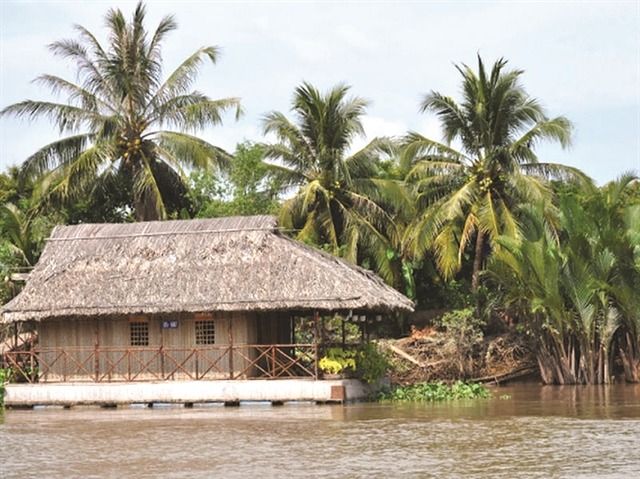
Perhaps because of the benefits these houses bring in, even when life improves and many houses are made of new materials in the Miet Thu area, people still build an additional thatched roof for afternoon naps as a kind of cool house.
If the leaves used to build the house are carefully selected, on average, new leaves will only need to be replaced every five years.
When travelling in Miet Thu, tourists can choose to stay in these houses instead of staying in motels or hotels.
The people here are very hospitable. They are very willing to welcome you and usually they will not charge any fees.
In addition to the thatched houses, the means of transport of the people here is also very special.
Because this place is crisscrossed with canals, the main means of transport for the locals is a small wooden sampan.
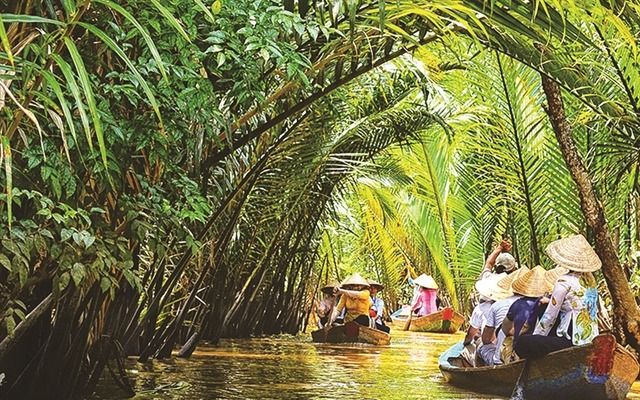
Even after more than three centuries of development and improved transport infrastructure, the boat is still considered a creation of the ancient Miet Thu people and is still popular.
The experience of sitting on a sampan and gliding on the cool water and enjoying the fresh air in the nipa and cajuput forests of Miet Thu will be an unforgettable experience for visitors.
“When I first got on this boat, I was a little scared because the boat was moving on the water at a fairly fast speed and the boat seemed quite small for an American like me," Jack Tomson, from the US, said.
"But then the fear turned to excitement as the boat moved quickly on the water, making cool drops of water fall on my face, a very refreshing feeling.”
In addition to experiencing the daily life of the locals, visitors should not miss exploring U Minh Thượng National Park.
U Minh Thuong National Park
Trịnh Minh Chau, a 52-year-old tourist from Binh Duong Province, loves the park so much that he and his family come here once a month. "My family and I can fish, breathe fresh air and listen to the songs of hundreds of species of birds," he said.
“Living and working in a busy province like Bình Duong makes me and my family face air pollution, noise and stress. To reduce stress and be able to live closer to nature, my family and I often come here to relax and recharge."
The park’s name U Minh means darkness and is a mystery to some. It is so called because of the lack of sunlight due to the dense vegetation. Even locals sometimes find the park difficult to navigate.
Separated by the Trem and Cai Tau rivers, the park has two main areas called U Minh Thuong (Upper Park) in An Minh District of Kien Giang Province, and U Minh Ha (Lower Park) in Ca Mau City of Ca Mau Province.
U Minh Thuong, covering an area of 21,000 hectares, has a core area of 8,000 hectares. It is home to many rare and endangered bird species. There are a total of 187 bird species, 39 amphibian species, and 34 fish species.
Considered the richest region in the Mekong Delta in terms of flora and fauna, with more than 243 plant species, U Minh Thuong has 32 mammal species, including hairy-nosed otter.
Currently, to attract tourists to experience nature, the U Minh Thuong management board has started to provide services for tourists, including fishing, nature exploration and sightseeing.
Now, all accommodation services and boat tours, as well as souvenirs for tourists are available.
The experience of sitting on a boat on the intricate canals of the park is a popular choice for many tourists.
Meanwhile, for others who are passionate about fishing, the experience of fishing in the forest is an experience that is difficult to find elsewhere.
The park has around 60 kinds of freshwater and brackish-water fish, as well as wild boars, monkeys, weasels, snakes, turtles and pangolins, many of which are listed in the Red Book.
Visitors are also allowed to cook food themselves or order ready-made food at the edge of the forest. The most popular dishes are grilled fish, grilled snake with water lily, grilled field rats, and young lotus leaves.
However, when visitors enter the forest, all cooking is prohibited. Visitors are also prohibited from bringing fire-making tools into the park.
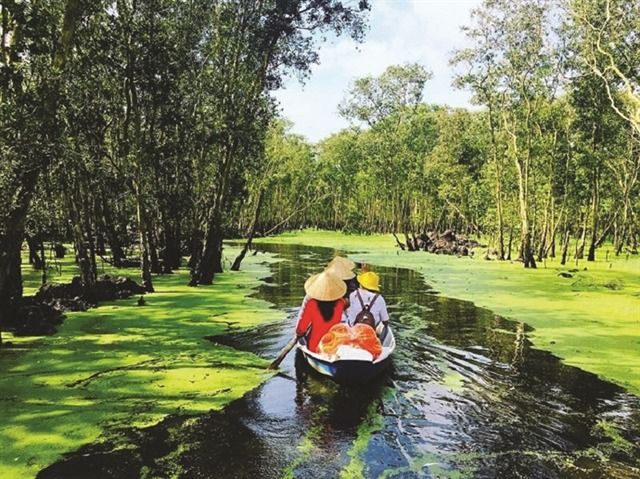
In addition, visitors can also take part in more adventurous activities including exploring flooded cajuput forests where people can fish or hike to the former barracks of the South Vietnam Liberation Front armed forces.
Besides activities associated with nature, visitors should not miss the culinary experience with the typical characteristics of the Miet Thu region as well as the Mekong Delta in general.
Delicious dishes
Miet Thu has a dense canal system and vast rice fields, so the cuisine here is also closely linked to rivers and rice fields.
Snakehead fish smoked inside a burning mound of rice straw, grilled field rat or coconut worms are dishes that tourists should try when coming to Miet Thu.
Most dishes in Miet Thu are not seasoned with too many spices and the preparation is very simple but extremely unique.
Smoked snakehead fish is one of those dishes that is almost unseasoned but is prepared very uniquely.
The fish is first prepared and washed with unrefined salt and rinsed, and is then pierced with a stalk of lemongrass which removes odour and adds a wonderful aroma.
The fish is placed upright on the ground and covered with straw, then lit on fire for about 20-30 minutes. After removing the straw, the black skin of the fish is scraped off.
Then, the fish is sprinkled with scallion oil, rolled in lotus leaves with crushed peanuts, vegetables and aromatic herbs. The whole fish roll is then wrapped in rice paper.
Because the fish is not cooked with conventional utensils but is cooked directly with burning straw, the cook needs to have experience to know how much straw to use to make the fish done properly. This requires an experienced cook.
Dipping sauce made of sweet and sour tamarind and fish sauce is served with the dish, which is said to represent the soul of the Miet Thu countryside as well as the Mekong Delta.
Another specialty is field rats grilled in clay pots. Rats live in rice fields and eat only herbs and rice, so their meat is firm and fragrant. Diners say the dish tastes like wild deer meat.
After removing the intestines, skin and claws, the rats are marinated with lemongrass and chili for 15 minutes and placed on a special hook in a clay pot and grilled for an hour under burning straw.
The meat is served with a mixture of salt, pepper and lime juice as well as green bananas, tomatoes, cucumbers and Vietnamese mint.
This dish may seem a bit intimidating to first-timers. But if you can take the first bite, you won't be able to stop.
Miet Thu is about 280km from HCM City and about 50km from central Rach Gia City in Kien Giang Province.
You can take a bus for only VND250,000-450,000 (US$10-15), drive a motorbike or take a flight.
As for accommodation, if you want to learn about agricultural life in Miet Thu, choose a homestay where the host will show you how to harvest rice, catch fish with nets, tend vegetables and catch ducks. - Vietnam News/ANN