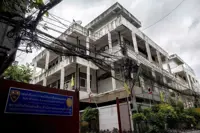
KHAO LAK, Thailand (dpa): With the sound of the jungle close by some of the world's best beaches, the coastal region of Khao Lak is quintessentially Thai - and yet hardly touched by mass tourism.
The smell of coffee fills the warm, humid tropical air. Before a cave in the rainforest, some men have heated water in a bamboo tube over an open fire and then prepared a jet-black brew. This isn't only for the tourists, but is a tradition in southern Thailand. The drink is served likewise from cups made of bamboo.
Sipping their coffee, the visitors look out on the Sok River, where the rafts on which they came are bobbing peacefully. Cherry-red dragonflies buzz above the water, an army of ants marches across the sandy soil, and high up in the tree is the sound of exotic birds singing away.
Welcome to the Khao Sok National Park in southern Thailand. Its 739 square kilometres are among the most scenic places in the kingdom. "The rainforest in this region is one of the oldest in the world and probably older than the Amazon," says the park's website.
Those who explore it by bamboo raft or by canoe can hardly cease to be amazed. Towering limestone cliffs and waterfalls, wild nature and the sound of the jungle - you get the feeling that you are far away from civilisation.
"Mangrove snake!" suddenly shouts the raftsman as he points to a yellow-and-black snake that has wrapped itself around a branch. The park is home to almost 50 mammal species, over 300 bird species and countless bats, reptiles and insects.

Khao Lak is Thailand from a picture-book. And yet, the beaches have not yet been taken over by mass tourism. Above all it is couples who seek - and find - what they want: Relaxation and quiet. One such place is Bang Niang Beach with its towering coconut palms. Then there's White Sands Beach, whose name says it all.
"We call Khao Lak 'Little Thailand' because you can find everything here that embodies Thailand's tradition and culture. It is simply authentic," says Samer Alhaj, manager of the JW Marriott Khao Lak Resort & Spa.
The resort offers a unique attraction: Guests can swim in what is billed as the longest pool in Southeast Asia - stretching over a total length of 2.4 kilometres.
"Khao Lak is for those who really wish to relax," says Thing, a travel guide for the tourism company Khaolak Vista and who, as is often the case here, identifies himself with just his first name. "There is just one nightclub in the area and it is always empty."
The name Khao Lak is also linked with one of the darkest moments of recent human history: The catastrophic tsunami of December 26, 2004 which struck the littoral states of the Indian Ocean. There was scarcely a region in Thailand that was more heavily hit than Khao Lak. Thousands of people - locals and tourists alike - were killed. Virtually the entire area was devastated.
Today, the Ban Nam Khem Tsunami Memorial Park recalls the tragic loss of life, the grief of the bereaved. Photos and floral decorations, reminders of the dead, are on blue and white tiles everywhere.

"Everyone here helped so that Khao Lak could be resurrected," says Thing. Today, there is no sign of the devastation and destruction. But to assure that such a catastrophe can not repeat itself, authorities set up alarm systems, signposted evacuation routes and high concrete tsunami shelters all along the coast.
Thing has driven the group to the historic centre of Takua Pa, 30 kilometres north-east of Khao Lak. In the 19th Century, tin mining flourished here, and lured merchants from China, England and Portugal. Pastel-coloured buildings in Sino-Portuguese architecture as well as shrines and small temples, Chinese lanterns and arcades recall that period.
Khao Lak is also the gateway to its own world of islands. From here, there are day excursions and diving safaris to the Similan Islands and the more remote Surin Islands. But to help protect the natural environment, both archipelagos are off-limits to visitors during the May-October rainy period. And, only a few of the Similan Islands are open to visitors, which during the high season can often mean that the white sand beaches are a magnet for dozens of excursion boats.
That's when a visitor is not alone - but for what little amount of other tourists you see with you, the spectacular granite formations and the bays can barely be topped for their beauty. - dpa
Already a subscriber? Log in
Get 20% OFF The Star Digital Access
Cancel anytime. Ad-free. Unlimited access with perks.