



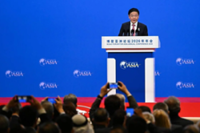
BOAO, Hainan (The Straits Times/ANN): The continued delay in finalising a code of conduct (COC) in the South China Sea, a result of the Covid-19 pandemic, will lead to prolonged uncertainty in the area, former diplomats and academics said at a panel discussion on Tuesday (April 20).
With no other dependable platform at the moment to resolve issues, this could very easily escalate into military competition if near misses continue around disputed territories.
Beijing claims nearly all of the sea but there are competing claims from Brunei, Malaysia, the Philippines and Vietnam.
In the past year, there have been several incidents in the area, including the West Capella standoff involving coast guard and military vessels from multiple claimant states after Malaysia sent an oil and gas survey ship into the area.
China and the Asean member states have been negotiating the COC, aiming to finalise it by the end of 2021. But talks have stalled since last year after the pandemic forced countries to impose travel restrictions, putting an end to in-person meetings.
"For negotiations like that, you need to be in the same room because there are things that need to be argued about, to be ironed out. These things cannot be done online because how do you have an argument over video call?" said Professor Wu Shicun, head of the Hainan-based National Institute of South China Sea Studies.
While the pandemic is gradually coming under control in parts of the region, much time has been lost and it is unlikely the COC can be agreed upon this year, Prof Wu added.
But there are concerns that the continued delay could lead to prolonged uncertainties that add to the tension in the waterway, said Dino Patti Djalal, former Indonesian ambassador to the United States.
"The COC is one area that claimants can hold each other accountable to mutually agreed rules which we are setting up now," he said at the session.
"My concern is that there will be more uncertainties than certainties (because of the delay). There are mainly some competitive strategic relationships that are constantly evolving and developing in the South China Sea," he said, referring to the United States, which under the Trump administration had conducted multiple freedom of navigation exercises in the waterway, angering Beijing.
Also speaking at the session were former Philippine president Gloria Arroyo and Professor Zheng Yongnian of the Advanced Institute of Global and Contemporary China Studies at the Chinese University of Hong Kong, Shenzhen.
Both Arroyo and Dino pointed out that while their respective countries are still willing to work with Beijing on areas like vaccine accessibility, the sentiment is different on issues relating to the South China Sea.
China's nine-dash line, meant to demarcate its territory in the southern sea, enroaches into Indonesia's exclusive economic zone near the Natuna Islands.
Philippine President Rodrigo Duterte said on Tuesday he would send military vessels to "stake a claim" over resources in the disputed waterway after critics complained that he had gone soft on China.
The Philippines had won a landmark arbitration case over China in 2016, confirming that it has rights to the disputed area but Beijing has refused to recognise the ruling.
Amid tension between Beijing and Washington, some of which plays out by proxy in the waterway, both sides need to realise that claimant states play a role as a sort of buffer to prevent relations between the superpowers from completely disintegrating, said panel moderator and former vice-foreign minister Fu Ying.
"Countries with vested interests should on the one hand see this as their role and take up the responsibility; China and the US could also give credence to that and not force these countries to choose sides, or even to form groupings," she said.
"That is not a good look." - The Straits Times/Asia News Network
Already a subscriber? Log in
Get 20% OFF The Star Digital Access
Cancel anytime. Ad-free. Unlimited access with perks.


