JAKARTA (The Jakarta Post/ANN): President Joko Jokowi' Widodo has instructed the National Police to devise a guideline for the law enforcement body in handling online defamation cases amid rising concerns that the nation’s cyberlaw has been repeatedly abused to silence government critics.
The draconian Electronic Information and Transactions (ITE) Law and its vague provisions on what constitutes defamation on the web have long been criticised by activists for curbing freedom of speech and expression in the country.
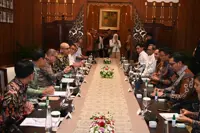
Addressing an annual joint meeting of the police and the military on Monday, Jokowi said he was aware that the implementation of the law had often incurred “a sense of unfairness” among the public and therefore called the police to selectively process cases that violate the law.
“I order National Police chief [Listyo Sigit Prabowo] to ensure that the police are more selective in receiving [and processing] reports of ITE Law violations. [Cases related to] articles that can invite multiple interpretations should be treated carefully, ” the President said.
“[The police must] draft an official interpretation guideline of such cases to make it clearer.”
He also ordered Listyo to ensure that the implementation of the law was more consistent, accountable and just.
“If the ITE Law cannot bring fairness, [the government] will work together with the House of Representatives to revise the law [...] particularly erasing the articles that offer multiple interpretations, ” Jokowi said.
His remarks came a week after his previous statement encouraging the public to actively exercise their right to criticie his administration provoked widespread reactions, including from former vice president Jusuf Kalla, who, in a public discussion, raised a question about how people could criticise the government without risking being summoned by the police.
Recent trends highlighted the increasing use of problematic articles in the ITE Law, with data compiled by Amnesty International Indonesia showing that there were 119 cases of ITE Law violation in 2020, the highest in six years, with 141 suspects, including 18 activists and four journalists.
In October last year, the police detained eight Save Indonesia Coalition (KAMI) activists for allegedly spreading hate speech against certain groups and inciting protests against the Job Creation Law, sparking concerns that the law was being used to penalise government critics.
The ITE Law penalises any individuals found guilty of distributing, transmitting or making accessible electronic contents containing insults, pornography, hate speech, hoaxes and threats.
Institute for Policy Research and Advocacy (ELSAM) director Wahyudi Djafar said while revising the law was crucial, the planned police guideline would be equally critical to ensure consistent implementation of the law going forward.
"The guideline should clearly define how the police handle cases that constitute violations of the law," he said, hoping that prosecutors and judges would follow in the footsteps of the police or, at least, be on the same page when handling the cases.
Unclear standards of how the law was enforced, coupled with high incarceration rates for people charged under the problematic articles, had caused people to be more hesitant to express their views online, said Southeast Asia Freedom of Expression Network (SAFEnet) executive director Damar Juniarto.
He cited data compiled by a coalition of civil society organizations that showed the conviction rate of people reported for allegedly violating articles related to defamation, hate speech and hoaxes, among other things, between 2016 and February 2020 stood at 96.8 per cent, with an incarceration rate of 88 per cent.
Before Jokowi made the call on Monday, a plan to revise the law was included in the House’s five-year National Legislative Programe (Prolegnas) last year -- listed under the House's initiative.
But its deliberation has yet to start and it has not made it onto the Prolegnas priority list to date. Deputy chairman of the House’s Legislation Body (Baleg), Willy Aditya of the NasDem Party, said the revision could be included on the 2021 priority list if both the government and the House agreed to do so.
The law, introduced in 2008 despite objections from pro-democracy activists, was first revised in 2016 following an initiative by Jokowi's administration.
The revision did not make many changes to the controversial provisions that permit prosecution for online defamation, but reduced their maximum penalty from six to four years in jail and the fine from Rp 1 billion (US$71,388) to Rp 750 million. - The Jakarta Post/Asia News Network
Already a subscriber? Log in
Get 20% OFF The Star Digital Access
Cancel anytime. Ad-free. Unlimited access with perks.