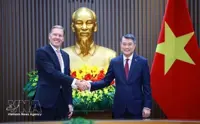
NEW DELHI (The Straits Times/ANN): Indian Prime Minister Narendra Modi and his Vietnamese counterpart, Nguyen Xuan, discussed issues related to the South China Sea as well as defence links between the two countries during a virtual summit on Monday (Dec 21).
The two leaders underscored the importance of "self-restraint" and "non-militarisation" of the South China Sea while drawing up a roadmap for closer defence ties.
The South China Sea featured prominently in the talks at a time when both countries have seen a downturn in ties with China.
Modi stressed that the code of conduct negotiations on the South China Sea should not prejudice the interest of other countries in the region, said Ministry of External Affairs Secretary (East) Riva Ganguly Das.
Asean and China have been seeking to resume talks on a maritime code of conduct.
Separately, the two countries released a document called India-Vietnam Joint Vision for Peace, Prosperity and People, where two paragraphs were dedicated to the South China Sea issue.
"Both leaders underscored the importance of non-militarisation and self-restraint in the conduct of all activities by claimants and all other states, and avoidance of actions that could further complicate the situation or escalate disputes affecting peace and stability," said the document in the context of the territorial disputes.
India is currently embroiled in its worst border troubles with China in over four decades.
It has accused China of changing the status quo on the Ladakh border with negotiations so far failing to resolve all differences.
Vietnam has competing claims with China near the Paracel Islands in the South China Sea.
The country has objected to Chinese military drills in the disputed area, accused Beijing of intimidating its fishermen and of advancing territorial claims during the pandemic.
Analysts noted that there were many areas of convergence between India and Vietnam, which will also take their seats in the United Nations Security Council next month.
"Among Asean member states, convergence with Vietnam is greatest... Other Asean countries have been relatively more circumspect. Vietnam has been much more open and explicit in courting countries like India and trying to diversify the relationship bilaterally," said Professor Harsh Pant, director of studies and head of the Strategic Studies Programme at the Observer Research Foundation in New Delhi.
"India also wants to diversify and make sure the Indo-Pacific strategy is in sync with what important key stakeholders like Vietnam want to do in the region."
Though India is not directly involved in the territorial dispute, China has expressed irritation with its oil exploration activities in the area. One of the oil blocks where India has been involved in partly falls under territory claimed by China.
ONGC Videsh, the overseas arm of the Indian public sector oil and gas company, has sought a two-year extension for exploring the Vietnamese oil block.
Business ties between India and Vietnam have grown over the years with bilateral trade touching US$12.34 billion in 2019-2020.
Vietnam is India's 18th largest trading partner globally and the 4th largest within Asean, after Singapore, Indonesia and Malaysia.
On Monday, Modi also invited Vietnamese companies to invest in India and highlighted the urgent need for a long-overdue review of the Asean-India Trade in Goods Agreement (Aitiga) as a concrete step towards revitalising economic engagement between India and Vietnam as well as the larger Asean region.
He also highlighted the importance of ties in opening remarks at the summit.
"We see our relationship with Vietnam from a long-term and strategic view. Peace, stability and prosperity are our shared purpose in the Indo-Pacific region.
"Our partnership can make a significant contribution in maintaining stability and peace in the region," said Modi. - The Straits Times/Asia News Network
Already a subscriber? Log in
Get 20% OFF The Star Digital Access
Cancel anytime. Ad-free. Unlimited access with perks.