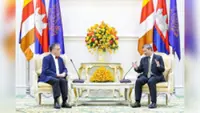
PHNOM PENH: The prime ministers of Cambodia and Thailand, Hun Manet and Anutin Chanvirakul are scheduled to attend the July 17 opening session of the World AI Conference 2026: WAIC in Shanghai, China, at the invitation of Chinese President Xi Jinping.
But will China play a role in pushing for border talks between the two? They have not met around the negotiating table since December.
Manet will be accompanied on his July 15-17 trip by Foreign Minister Prak Sokhonn, Defence Minister Tea Seiha, and Sun Chanthol, first vice-chairman of the Council for the Development of Cambodia (CDC).
Anutin will reportedly be joined by his own foreign minister, Sihasak Phuangketkeow.
The Cambodian and Thai premiers are both scheduled to meet with Xi and Chinese Premier Li Qiang.
“This working visit highlights the shared commitment between Cambodia and China to deepen their long-standing friendship and promote mutually beneficial cooperation,” said a foreign ministry statement.
“The visit also serves as a new driving force to advance the implementation of the Comprehensive Strategic Partnership of Cooperation, enhance the Diamond Cooperation Framework and build an all-weather Cambodia-China Community with a Shared Future in the new era,” it continued.
Thai foreign ministry also issued a release.
“The visit is to further strengthen the Thailand-China Comprehensive Strategic Cooperative Partnership for the mutual benefit of the two peoples,” it said.
Manet and Anutin attended the 3rd ASEAN Future Forum (AFF 2026), held in Hanoi, Vietnam, in early June. Both prime ministers shook hands for the camera, but no discussions took place which addressed the ongoing border dispute.
Analysts suggest that China will use its position as a major trading partner of both nations to push for them to find a solution.
According to the Royal Academy of Cambodia’s Kin Phea, however, the main obstacle to finding a resolution may be those who “actually hold power” in Thailand.
“The Thai military has not implemented the measures that their civilian government agreed with their Cambodian counterparts. They allow the military to arbitrarily carry out their actions, including encroaching on Cambodian sovereign territory,” said Phea, who serves as director of the academy’s International Relations Institute.
“China should push for both countries to meet for talks and solve the issue peacefully, through diplomatic paths or other consultation effort, based on international law. China should play a more active role as arbitrator so that both countries can solve their conflict, end tensions and return to normalcy,” he added.
He noted that these intentions were declared at the Chinese-brokered Fuxian Consensus reached in December 2025.
“Thailand must be forced to respect the consensus. They must withdraw their troops from occupied areas, return to the negotiating table, and work with the Joint Boundary Commission (JBC) without further delay,” he added.
Several parts of Cambodia remain under Thai occupation, with some 20,000 Cambodian civilians unable to return to their homes.- Phnom Penh Post/ANN