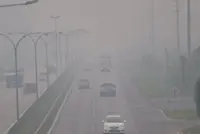
Dreaded annual haze may return


Grey outlook: The skies are grey lately due to heavy clouds and the weather, and visibility will be further reduced if the haze returns.
PETALING JAYA: Just as most Malaysians are heaving a sigh of relief that the country is in the recovery stage of the Covid-19 pandemic, another problem is looming – the annual haze.

The haze which normally occurs between June and October may make a comeback if neighbouring countries and Malaysia fail to control open burning that is the cause of transboundary haze.

Medical experts are concerned that the haze may cause further problems to those already infected with Covid-19.

Malaysian Public Health Physicians’ Association president Datuk Dr Zainal Ariffin Omar said risk groups such as children and the elderly who are Covid-19 positive will face enhanced respiratory problems if the haze occurs.

Dr Zainal said as Covid-19 spreads through droplets and is not an airborne virus, people could protect themselves by continuing to mask up whether or not haze occurs this year.

“There has been no evidence or study that the haze situation will increase the spread of Covid-19, so technically it’s a very remote possibility.

“But because the virus spreads through droplets, using a face mask will lessen the possibility of infection.

“I would advise people to continue using a face mask, before, during and after the haze,” he said.

Environment Department air division director Mashitah Darus said Asean countries need to be certain that this does not recur this year.

“This is because polluted air can increase the risk of Covid-19 infection to the general public.

“In this season, the southern part of the South-East Asian region that covers major Indonesian islands such as Sumatra and Kalimantan and Peninsular Malaysia will experience a dry season with surface temperatures above normal levels and rainfall less than other seasons,” Mashitah told The Star.

For this reason, the control of haze-causing forest fires should be monitored more closely for the dry season, she said.

In June, the current state of air quality based on the Air Pollutant Index (API) reading showed that almost all air quality in the country was at a moderate level.

The department also issued a strong warning to all landowners to monitor their land, especially in vulnerable and often burned areas such as peatlands, farms, construction sites, landfills including illegal dumping sites, forests, shrubs and industrial areas.

“Landowners are required to take steps to prevent invasion by irresponsible parties resulting in open burning.

“Strict action will be taken against any irresponsible party causing open burning, including landowners,” said Mashitah.

Under Section 29 (A) of the Environmental Quality Act 1974, those convicted of an open burning offence may be subject to a fine of up to RM500,000 or imprisonment of up to five years or both.

Among others, the department is patrolling and using drones to monitor open burning incidents and fire-prone areas such as peatlands and waste disposal sites; monitoring the current air quality status; and enhancing community participation to help monitor cases.

Quoting media reports, Mashitah said Indonesia had started cloud seeding operations as the country’s first step in overcoming its annual forest fires, believed to be the cause of haze around South-East Asia.

“Indonesia began implementing cloud seeding in the Riau hotspot in Sumatra, with plans to do so in other parts of Borneo.

“This operation will continue throughout the dry season, which is expected to continue until the end of September and the focus is on peatlands that are flammable when dried for agricultural purposes,” she said.

On July 1, Reuters reported that the Central Kalimantan province in Indonesia declared a state of emergency until Sept 28 after identifying over 700 fires.

Meanwhile, the Malaysian Meteorological Department said the API for most places in the country was currently at a normal level, with most places in Sabah and Sarawak registering good air quality while the peninsula had good or moderate readings.

Its director-general Jailan Simon said as of Wednesday night, there was only one hotspot in Sumatra and none in Kalimantan, due to rain.“Rain is expected over the next few days in the areas so we won’t be experiencing transboundary haze for the time being,” he said when contacted.

The Asean Specialised Meteorological Centre also noted that rainy weather prevailed over many parts of the Asean region yesterday and hotspot activities in the region remained generally subdued.

Meanwhile, the Fire and Rescue Department said it recorded a total of 94 open burning cases at forests in May and June as well as 54 cases at farms or orchards in the same period.

For forests, there were 50 open burning cases in May followed by 44 cases in June while at farms or orchards, there were 31 cases in May and 23 incidents the following month.

Get 20% OFF The Star Digital Access

Monthly Plan

RM 13.90/month

RM 11.12/month

Billed as RM 11.12 for the 1st month, RM 13.90 thereafter.

Best Value

Annual Plan

RM 12.33/month

RM 9.87/month

Billed as RM 118.40 for the 1st year, RM 148 thereafter.

Follow us on our official WhatsApp channel for breaking news alerts and key updates!
Haze , environment , Covid-19

Next In Nation

Negri polls: Anwar to campaign at four locations on July 22
Man found dead on Bukit Maras summit
Malaysia's new high commissioner to Singapore presents credentials to president Tharman
Speed testing vehicles on public roads can lead to legal action
KL Education Dept to take legal action over viral student brawl
Foreign worker electrocuted while installing lamp post
PAS-Umno cooperation necessary to reinforce Malay Muslim political power, says Hadi
Independent candidate in Negri polls to be charged over social media post
Kajang murder probe: Cops nab five suspects
MACC arrests Sabah NGO chief over misuse of RM2mil

Others Also Read