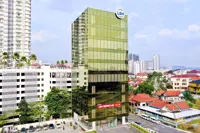
KUALA LUMPUR: Islamic finance has a prominent role in helping to address unmet needs of the world's Muslim population for Shariah-compliant financial services, says Securities Commission Malaysia chairman Datuk Syed Zaid Albar.
Over 46 million individuals from Islamic countries have chosen to exclude themselves from formal financial services due to religious reasons, he said.
Providing access to financial services is a universally shared vision for all nations, including the Islamic countries; in reality, access is neither uniform nor consistent, Syed Zaid said.
“The inability to access the most basic of financial products and services prevents some segments of a country's population from fully participating in its growth and prosperity.
“It translates into costs for the nation as inequalities in terms of opportunities and wealth can hinder economic growth from reaching its optimal potential,” he said in his keynote address at the SC-World Bank- IOSCO Asia Pacific Hub Conference 2019 here on Monday.
He said Islamic products and services for financial inclusion hold the promise for a shared and infinitely better future. The Islamic capital market has long championed innovative approaches to enhance societal returns.
“Shariah-based financial contracts, including risk-sharing financing instruments and social solidarity instruments such as tithe, sadaqah and waqf (endowment), could be utilised for financial inclusion,” he said.
Meanwhile, World Bank Group representative to Malaysia and country manager, Dr Firas Raad, said Islamic finance could play a role in addressing the high levels of poverty in Organisation of Islamic Cooperation (OIC) countries.
The countries, he said, account for over 40 per cent of those living on less than US$1.25 a day and is home to one-third of the global population living in extreme poverty, defined as those living on less than US$1.90 a day.
He expressed hope that the two-day conference would give more insights on how the Islamic instruments could be expanded and innovated to provide more financial inclusion to important segments of society, especially the lower income group.
Meanwhile, touching on the Malaysian bond, ringgit and equity markets, he said the country's economy has strong fundamentals that could cope with any economic shock that might come its way.
“We have emphasised in the past that the deep capital market of Malaysia is diversified economy, with strong demand externally for its products with positive current accounts.
“That would make make the Malaysian economy quite resilient and able to cope with any shock that comes its way, “ he added. - Bernama
Already a subscriber? Log in
Get 20% OFF The Star Digital Access
Cancel anytime. Ad-free. Unlimited access with perks.