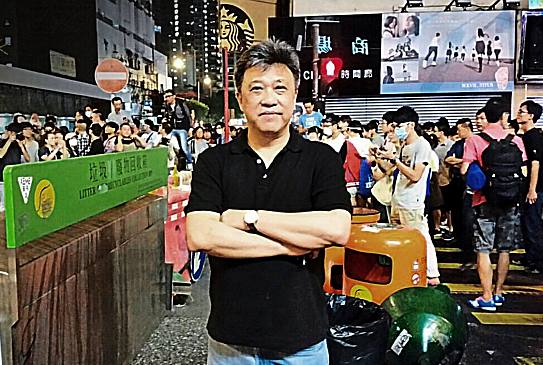
IT’S already 2.30am Saturday in Mongkok in Hong Kong but tension is still very much in the air. A typical Friday evening in the world’s busiest district, with its myriad of bars, brothels and mahjong parlours, would have been bustling with life.
But businesses have been hit badly. The entire area seems to have been taken over by thousands of protesters. Outnumbered by the protesters, the police are seemingly restrained and unwilling to use too much force.
Scuffles had broken out between the police and the predominantly young and angry demonstrators just hours earlier.
At the junction of Sai Yee Street, I saw protesters provoking policemen into a fight, with the hope of getting arrested. But the cops looked the other way, even when cursed and abused right in front of their faces.
Taking advantage of this, the protesters soon put up barricades at numerous road junctions in the area to bar traffic from entering the district.
Taxis and buses were stopped and tempers flared between passengers and the protesters.
Mongkok has emerged as the hotspot of the so-called Umbrella Revolution, so named because the protesters used umbrellas to shield themselves against the pepper spray used by the cops to disperse crowds.
Fights have broken out between the residents of Mongkok and the protesters as businesses are affected. Fingers have been pointed at the triads but listening to the taxi and bus drivers, they’ll tell you that patience is wearing thin.
The youngsters have accused the counter-democracy protesters of being linked to the triads. They, in turn, have accused the leaders of the protesters of being agents of the Americans, who have been accused of financing the protests.
But talking to both sides, it boils down to simple livelihood issues in the pressure cooker environment of Hong Kong.
Hong Kongers are angry with the huge number of mainland Chinese moving into the island and the strain exerted on its health and education facilities. Not to forget, the competition for jobs. The resentment against the mainland Chinese has been building up.
Older Hong Kongers have dismissed the protests as youthful idealism, which would not bear fruit as the harsh reality is that Hong Kong is part of China and nothing will change that.
Over endless glasses of beer in Mongkok, I met a group of entertainment outlet operators who wanted their side of the story told.
“Mahjong parlours are down by at least 40% and in some cases, 80%. Rentals here are among the highest in the world,” one operator said.
Rental for a 50 sq ft shop can reach RM70,000 a month.
“There are wages to pay too but we have been hit. We are not interested in politics. We just want the protesters to move away elsewhere.”
I witnessed a shouting match between some students and what looked like triad characters in Mongkok as I tried to catch a taxi back to the hotel at around 3am. One person yelled loudly at the students to “go back and sleep” as he and his fierce-looking friends walked towards the protesters, who smartly backed off.
The passing cops ignored the verbal clash, perhaps too tired after the commotion they had to fend off earlier. They are obviously exhausted, having to work a minimum 18 hours each day, and enduring not only verbal abuse but also having bags of urine thrown at them.
They didn’t blink an eye either at the prostitutes, who looked like mainlanders, standing at the street corners. Business is bad, needless to say.
The business operators seemed reluctant to talk when I brought up the subject of a triad leader named Kwok Wing Hung aka Shanghai Tsai, who heads the Wo Shing Wo gang.
He has been accused of organising attacks on the students but he has remained unreachable.
Another name that has surfaced is Cheung Cyun Hon aka Kiddo or Chai Chai in Cantonese who has stayed in England for many years.
Other triad figures included Ah Me, who is said to be a university graduate from New Zealand with a Caucasian wife, and now regarded as a rising star.
The three largest gangs in Hong Kong are the Wo Shing Wo, 14K and Sun Yee On, all reportedly involved in criminal activities.
Between sips of beer, one of the businessmen pointed out that shops in Mongkok had to pull down the shutters from as early as 7pm.
“This is Hong Kong. We do business late but having to close at 7pm is killing us. I fear that Mongkok will explode soon and no one will benefit. The people of Hong Kong will be the biggest losers,” he said.
He refuted angrily my remarks that businesses in Mongkok were triad-linked or controlled by the gangsters, or that they enjoyed intimate ties with the politicians, saying I had been watching too many “bad Cantonese movies about triads”.
Yet, the media has widely reported about gang personalities enjoying cosy meals with aides of government leaders.
In 2012, the local media reported how Shanghai Tsai and Kiddo met up with aides of chief executive officer Leung Chun Ying. Even his then election challenger Henry Tang had met up with Shanghai Tsai.
Both politicians denied knowing the triad leader when challenged by the nosy Hong Kong media.
The triad leaders were also said to have enjoyed close ties with leaders of the Chinese Communist Party.
“Look, we are businessmen who must know all kinds of people,” the businessman said, making it clear he did not want to talk further about triads in Mongkok.
As the protesters prepared to sleep on the streets of Mongkok, I finally managed to flag down a taxi and was able to head back to my hotel.
The cab driver, in his 60s, complained angrily at how his work has been affected by the protests, saying they were getting out of hand.
The Hong Kong protests have essentially become a generation gap issue as the young fight to have their voices heard while the older ones fight to earn a living in one of the most congested and toughest cities in the world.
Already a subscriber? Log in
Get 20% OFF The Star Digital Access
Cancel anytime. Ad-free. Unlimited access with perks.