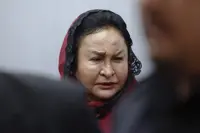
PUTRAJAYA: Intervention must be part of a national plan that ensures every family from every community has access to quality, affordable health care and services across the lifespan of a person with autism, said the prime minister's wife, Datin Seri Rosmah Mansor.
She said a comprehensive strategy must include input from researchers, policymakers, educators, and caregivers to cover a wide range of issues, including training of skilled personnel such as psychiatrists, psychologists, paediatricians, therapists, and early interventionists.
Rosmah said the strategy should also encompass policies on insurance, tax incentives and funding for research and evidence-based treatment.
"Autism knows no racial, ethnic or socio-economic boundaries and no efforts should be spared to reduce disparities in awareness and access to care," she said when delivering a keynote address at the International Seminar on Autism 2014 at the Putrajaya International Convention Centre (PICC) on Tuesday.
Rosmah, who is also patron of the seminar, said research showed that the earlier the intervention, the better the outcome would be, hence reducing the average age of diagnosis must be given a priority.
She said parents and caregivers should also be assisted in developing education and treatment programmes to enable autistic children and adolescents to reach their fullest potential, and every adult with autism should have access to services and supports that maximise independence and secure the best quality of life.
"Parents should be acknowledged as experts on their own children as they are the ones who spend most of the time with them. Empowered parents will be able to plan a better future for their own children. The children will grow up with the best care possible, as parents understand autism better and know where to get assistance.
"In the long run empowering parents means less government spending for autism services," she said.
Rosmah, who is also Permata programme patron, said lack of autism awareness was a serious issue as it had prevented many children from receiving early intervention that would help them develop optimally.
She said as the increase in the prevalence of Autism Spectrum Disorder (ASD), including in the United States from one in 88 children in 2012 to one in 68 children in March 2014, had prompted calls for a national plan of action to address its urgent and long-term public health needs.
"In the United Kingdom the prevalence rate is one case for every 66 births and a 56 per cent increase of children with autism has been reported in the last five years. More worrying is the prevalence rate of one in every 38 children in South Korea," she said.
Rosmah said many children with autism did not receive appropriate public education where only 2,600 of 13,500 children with ASD were enrolled in government special education schools or in integrated and inclusive programmes of the mainstream in primary and secondary schools.
She said majority of them attended community centres for children with special needs operated by the Welfare Services Department of the Ministry of Women, Family and Community Development while others attended centres belonging to non-profit organisations or private enterprises which were beyond the means of ordinary families.
Thus, the Permata Kurnia Centre, set up to provide early intervention for children with ASD to develop their fullest potential and prepare them for the mainstream primary school education, will be extended to other states when proven successful, she said.
The two-day seminar themed 'Autism is not a Tragedy, Ignorance is' is organised by Permata Programme with the cooperation of Universiti Kebangsaan Malaysia and Autism Speaks, a non-governmental organisation.
Focusing on quality intervention for autistic children, the seminar is attended by over 1,000 participants from 35 countries, including first ladies of Sudan, Sri Lanka, Kyrgyz Republic, Albania and Morocco. - Bernama
Already a subscriber? Log in
Get 20% OFF The Star Digital Access
Cancel anytime. Ad-free. Unlimited access with perks.