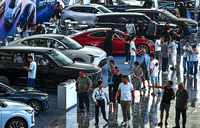
TOKYO: Perusahaan Otomobil Kedua Sdn Bhd (Perodua) has no plans to introduce electric vehicles (EV) in Malaysia in the near future despite Daihatsu Motor Co unveiling a concept EV at Tokyo Motor Show 2017 on Wednesday.
Daihatsu owns a 20% stake in Perodua and a 51% stake in its manufacturing arm, Perodua Auto Corp Sdn Bhd.
Speaking to reporters on the sidelines of Tokyo Motor Show 2017, Perodua Auto vice-president Datuk Zainal Abidin Ahmad said Malaysia does not have sufficient infrastructure for the company to produce EVs.
“Hybrid and EVs require the country to have sufficient infrastructure in terms of charging facilities and range of lithium ion batteries, which are currently not available in full force,” he said.
Zainal pointed out that a study on the impact of EV production and its market requirements in the country will be done if the company is confident there is sufficient infrastructure to support the vehicles.
“EVs are a totally different powertrain. We haven’t done any study yet. We have not come up with any idea on what we want to do with powertrains for future generations,” he said.
Moving forward, Zainal said Perodua Auto would continue to boost the efficiency of its internal combustion engines by improving on their technology.
The manufacturer is currently conducting a study on how to improve fuel consumption for its engines.
“I would rather focus on the bread and butter, which is internal combustion engine capabilities that are energy efficient, maximising the efficiency of fuel consumption, by enhancing technology," said Zainal.
Perodua’s Bezza, its first energy-efficient vehicle, can travel up to 22.8km per litre of petrol for the manual transmission, while the automatic transmission can travel up to 21.3km per litre.
For the country to produce EVs, Malaysia Automotive Institute CEO Datuk Madani Sahari said it is important to own the technology that produces lithium ion batteries as the component makes up 40% of the cost. The cost competitiveness of lithium ion batteries is vital in the production of EVs, he said.
Currently, the automotive sector in the country is moving towards the commercialisation of lithium ion batteries, expected to commence in the first quarter of 2018.
Another key infrastructure needed to produce EVs in the country is the charging stations.
The government aims to have 100,000 EVs on Malaysian roads by 2020.
Madani predicts that EV prices will mature over the next 10 years in Malaysia.
“The national carmakers will start to produce EVs when their business plans make sense in terms of cost competitiveness and there are charging stations widely available,” he said.
“It’s a chicken and egg situation - the government is taking the initiative with a two-pronged strategy (producing lithium ion batteries and EV charging stations), so we can enable the introduction of EVs."
Already a subscriber? Log in
Get 20% OFF The Star Digital Access
Cancel anytime. Ad-free. Unlimited access with perks.