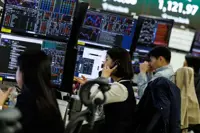
PETALING JAYA: Global investors are increasingly losing their risk appetite for stocks.
Shares on the local bourse took another big hit yesterday, as the sell-off in Asian equities continued. The FTSE Bursa Malaysia KL Composite Index tumbled 22.20 points, or 1.4%, to 1,613.17 points.
Most investors kept to the sidelines, as Bursa Malaysia will be closed for a holiday today.
Washed out by the outflow of foreign funds that has surpassed RM16bil so far this year, few investors are finding the nerve to commit to stocks at current price levels.
While many see the impending injection of an RM20bil boost for the stock market as a positive move, the question remains on whether the funds are ready to be deployed.
“The timing for deployment of the funds is yet to be certain,” said an analyst at MIDF Research.
Elsewhere, investors had to endure sharper losses. Main stock indices in Australia, Japan, China, Taiwan and Indonesia were down by at least 2% from Tuesday. Equity prices in South Korea fell 1.9%, while the benchmark in Singapore was down 0.5%.
The sell-off in Asian equities resumed in earnest this week after a decision by the United States Federal Reserve to keep its interest rate steady last week was interpreted by the market as a signal that policymakers in the US are still concerned about the sluggish state of the global economy.
This has dashed hopes for a quick return of foreign funds into Asian markets.
Souring investors’ already-fragile sentiment yesterday was the latest preliminary factory data from China, which showed slumping output for the past three months.
This further dimmed the outlook for Malaysia’s biggest trading partner. A slowdown in China, analysts said, is bound to drag on the whole of Asia.
Malaysia, however, is also reeling from weaker commodity prices, as the price of crude oil has more than halved from a year ago.
CIMB Research, in a note last week, said Malaysia was unable to deal with the capital outflow that was driven mainly by fears about China’s growth and weaker commodity prices.
The ringgit, already the worst-performing currency in the region so far this year, fell 0.9% yesterday to 4.3435 against the US dollar.
The exchange rate yesterday was the weakest since 1998, when the currency was pegged to the US dollar at the height of the Asian financial crisis.
Already a subscriber? Log in
Get 20% OFF The Star Digital Access
Cancel anytime. Ad-free. Unlimited access with perks.