'Enough silence': Artist honours victims of 1965 Indonesian mass killing


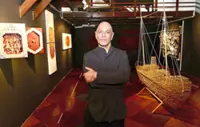
‘My works can be confrontational, they can be stark reminders about dark chapters in a nation’s history, but ultimately, this kind of art is also about finding a certain peace, a more sombre reflection on human suffering and grief, ‘ says Dadang. Photos: Wei-Ling Contemporary

There is a certain bleak and dark atmosphere at Wei-Ling Contemporary’s latest exhibition. The long blackout curtains and a floor-to-ceiling’s worth of exhibits – an array of badly bruised, bloodied and battered portraits – only add to the overwhelming sense of grimness.

This is no ordinary exhibit.

This is Indonesian artist and activist Dadang Christanto’s first solo exhibition in Kuala Lumpur. Missing is a new series of works tied to the Indonesian anti-communist purge in the 1960s which the CIA has described as “one of the worst mass murders of the 20th century”.

“There is no need to lower your voice, or speak in hushed tones when you come to view this show,” says Dadang, 61, during a recent interview at the gallery.

“There has been enough silence. I know some people will be not be comfortable with the works, but this is my art, which is closely related to the history, circumstances and aftermath of the Indonesian massacres of 1965-66.

When we talk about genocides since WWII, the 1965-66 massacres in Indonesia stand out as the most under-reported by the media.

“Even 53 years later, it remains an unfamiliar piece of history to many, like it has been swept under the carpet,” he says.

dadang
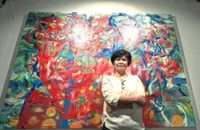
Dadang's Ciduk, Siksa, Bunuh, Buang IV (arcylic and charcoal on canvas, 2018).

The campaign of mass violence by the General Suharto-led Indonesian Army took place during the transition to the three-decade-long Suharto dictatorship and the “New Order” in Indonesia.

“In the space of a few horrific months, the Indonesian army – and its death squads – saw to the killings of an estimated 500,000 civilians, who were ‘linked’ with the Indonesian Communist Party (PKI) and other leftist groups.

“Farmers murdered, shopkeepers butchered, teachers killed, no lives were spared. It was a bloodbath.

“More sadly, those who were brutally murdered had no idea of what was going on in Jakarta at the time. The actual death toll has been reported to be far higher, as high as one million dead,” says Dadang.

In the late 1990s, the artist, who is from an Indonesian family of Chinese descent, moved to Australia, where he continues to create powerful, thought-provoking and confrontational works.

This chapter of Indonesian history has haunted him since he was a child. Dadang was barely eight years old when he lost his father. A mob of soldiers dragged him from the family home in the village of Tegal, Central Java, one night in 1965. He was never seen or heard from again.

dadang
Part of Dadang's Missing series (acrylic, charcoal on canvas, 2018), a work featuring 110 portraits lined up from floor to ceiling at KL's Wei-Ling Contemporary.

Throughout his career, Dadang’s art has become inseparable from this tragedy.

Since the late 1990s, he has produced a body of works that honour countless victims of political violence and crimes against humanity from around the world. However, references to the year 1965 appear again and again.

Visitors who have seen the exhibition at Wei-Ling Contemporary and understand the reasons behind it have greeted it in awe.

“There is definitely a darkness about the work but when you dig deeper and understand its starting point, you are able to empathise with the artist and his reasons for making these pieces.

“You can find strength and beauty in this darkness,” says Lim Wei-Ling, gallery founder.

“This is the type of artist that Dadang is ... an artist who, through his art, hopes to jolt our senses into doing something to help.

“To not let us forget those who never came back. His work confronts because it needs us to take notice and not turn our backs.”

Missing, featuring new works and installations, is a continuation of Dadang’s artistic dialogue driven by the 1965-66 killings.

dadang
A close-up a Missing portrait, which features bruises and scars done with red paint and charcoal pencil.

The centrepiece of the exhibit comprises 110 acrylic and charcoal imagined portraits of the 1965 victims.

Dadang reveals that a friend knew a news photographer who somehow had managed to access and produce photos of some of those who had been captured and tortured in his hometown Tegal.

The Tegal Province Adminis-tration office where they worked was where he would develop the photos. Knowing this, Dadang had always wondered if his father was among those in the photos.

Unfortunately, the photographer has since died. Although Dadang has not found these photographic archives, his curiosity led him to keep on searching and in so doing, the body of work now called Missing materialised.

“I have to admit it wasn’t easy to finish all 110 portraits. I had to stop for a bit, take a walk to refocus. The wounds of this forgotten past go deep.

“I might have imagined these portraits, but I have seen the real photos, I have even interviewed an executioner from a death squad, there is no remorse for some. That’s the reality,” he explains.

In 2015, current Indonesian president Joko Widodo said that he had “no thoughts about apologising” for the 1965-66 events. There has been no change in the government’s stance since then.

dadang
The artist talks to a visitor about his sculpture series Head (copper 2015-2018).

Violence and tragedy – a sort of exposed wound that has never healed – continues to inform the artist’s works. In his Ciduk, Siksa, Bunuh, Buang paintings, he recounts how victims were taken away by the Indonesian Army.

“The gunny sack is a powerful image, especially when you realise how innocent people were being dumped into army trucks and driven away, with gunny sacks placed over their heads.

“They didn’t know what was happening, it was ruthless torture before death.

“The images of the women are based on the members of Gerwani (Indonesian women’s movement affiliated with the PKI), which was one of Indonesia’s most progressive women’s organisations. The brutal sexual violence against these women should never be forgotten,” says Dadang.

Across his practice, the act of repetition is crucial. Most remarkable is the recurring repetition of images of heads and faces.

As memorials to victims of violence in all its forms, Dadang sees no compromise in his art.

“My works can be confrontational, they can be stark reminders about dark chapters in a nation’s history, but ultimately, this kind of art is also about finding a certain peace, a more sombre reflection on human suffering and grief,” he concludes.


'Missing' is on at Wei-Ling Contemporary, The Gardens Mall, KL, until Nov 4. The gallery is open Tue-Sun, 11am-7pm. Call 03-2282 8323 or visit weiling-gallery.com for more information.

Get 20% OFF The Star Digital Access

Monthly Plan

RM 13.90/month

RM 11.12/month

Billed as RM 11.12 for the 1st month, RM 13.90 thereafter.

Best Value

Annual Plan

RM 12.33/month

RM 9.87/month

Billed as RM 118.40 for the 1st year, RM 148 thereafter.

Follow us on our official WhatsApp channel for breaking news alerts and key updates!

Others Also Read