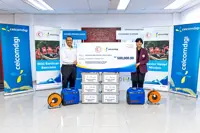
Share option is for taking company out of the rut, giving it new lease of life and expanding its operations beyond fixed-line business
The CEO of TIME Dotcom Bhd
(TdC) Afzal Abdul Rahim has been slowly raising his stake in the company.
But the size of his purchases thus far has been small. However, last week TdC granted him a share option to subscribe to up to 17.22 million new TdC shares or 3% stake at an undisclosed price.
The idea behind this share grant is to reward him.
That is for taking TdC out of the rut, giving it a new lease of life and expanding its operations beyond the fixed-line business.
Besides fixed line, today TdC is also into the data centre business and has equity stakes in a few global submarine cable networks in partnership with players like Google to sell global bandwidth.
“The option is there but it is not free. I have to pay for the shares and I have not figured out a way how to fund the purchase yet. But the proposal is for a scheme that runs for five years. We will figure out something along the way,’’ Afzal says when contacted.
This offer of shares is just for him as he had opted out of the management and staff performance based share grant scheme the company has. Under that scheme, TdC staff are granted shares at no cost, but it is applies only to top performers.
“I did not think the company should give me shares as I could not be a neutral facilitator of the scheme. And I am glad that I voluntarily chose to opt out,’’ he says.
On hindsight he felt that it was the right thing to do from a governance perspective and it also sends the right message to employees.
“If I want shares, I should pay for them,’’ Afzal adds.
Afzal emerged in TdC in October 2008 at a time when the telco’s books were splashed with red ink and the share price was trading at 20 sen. As at end 2007, TdC reported a net loss of RM160mil.
Afzal and his partner Gan Te-Shen bought a 36.24% equity stake in TdC but managed to get a waiver from the Securities Commission on making a mandatory general offer for the rest of the company.
But part of the deal also included a plan for them to raise their stake by 3% and the recent grant could be related to that deal, even though Afzal says the recent 3% grant was just a standard employee share option scheme (Esos) that the TdC board had decided on.
The price Afzal will pay for the new shares will be at a 10% discount to market price after shareholders approve the deal, he adds.
Afzal holds a 75% equity stake in Pulau Kapas Ventures Sdn Bhd, which owns the 36.24% stake in TdC, and Gan holds the remaining 25%.
“So if I am able to raise funds to exercise the option, that is an additional 3% over the next five years,’’ Afzal adds.
TdC sold more DiGi shares
Prior to Afzal’s entry into TdC, the company had transferred its prized 3G spectrum to DiGi.Com Bhd in exchange for a 3.5% block of shares in the latter for RM654mil or RM2.49 a share. Later TdC bought 6.5% stake in DiGi from Telenor ASA to raise its stake to 10%. Then Telenor had to reduce its stake in DiGi to meet the 49% shareholding ruling. To fund the 6.5% equity, TdC took a loan, explains Afzal.
Over the years, TdC has reduced its stake in DiGi and it is said the proceeds had gone into funding TdC business, but Afzal denies this.
“During the 2008 financial crisis, we had to sell the shares to pay off the loan they had earlier taken. After that, there was the share distribution where we rewarded shareholders with the DiGi shares via the dividend-in-spiece scheme. Then on we only had about 3% equity stake in DiGi,’’ he says.
Afzal adds that TdC cashflow turned positive from operations in the second quarter of 2009.
“So none of the proceeds or gains from the DiGi shares went to fund the TdC business. But our shareholders have definitely benefited as we distributed the DiGi shares directly to them,’’ he says.
As for dividends, it was only last year that TdC began the payout, and the trend is likely to continue where it will pay at least 25% of its normalised net profits to shareholders. TdC reported RM174mil in net profit for 2014.
Last week, TdC sold 49.9 million DiGi shares or a 0.64% stake. Funds raised from the sale will be kept by TdC, the first time it has been able to keep the proceeds from the sale of its Digi shares.
The gross proceeds of RM310.9mil will result in a net gain of RM202mil for TdC and see its basic earnings per share increase by about 35 sen.
But over the years the handsome dividends from holding the DiGi shares did flow into TdC’s business.
“DiGi has been a good investment for us, though a passion investment that earns us good dividends. We like the company but we also feel it is right time to monetise our stake. We have been investing heavily in fixed-line broadband and want to fuel our growth even further.
“But there are no plans to sell the remaining stake. We will see what our business requirements are in the future,’’ he adds
“Had we kept the 3G spectrum, we would have made a colossal mess of trying to roll it out. It was the right decision to transfer it to an operator who knew what to do with it.
“A better way to look at our stake in DiGi is somewhat of a safety net. And it also gave us an opportunity to build a great working relationship with DiGI,’’ he adds.
Alliance Research says: “We understand that TdC has actually secured US dollar financing to fund and better match its submarine cable investments which are based in US dollars. Thus, we think the additional cash proceeds from this disposal could potentially be utilised in the near term for its regional expansion and/or consolidation of the data centre market in Malaysia.”
“Nevertheless, we will not be surprised if TdC decides to distribute part of the cash proceeds through a higher dividend payout,’’ the house adds.
That also explains why Afzal is keen to take his business model to the regional front, given the bigger cash hoard.
“We really do like the fixed-line business. As much as the market wrote it off seven years ago when we first got involved, the team has been working hard to grow the business. We believe that a TdC like model of fibre, data centres and global networks will work well in other Asean markets. The challenge is always finding the right partner,’’ he says.
He is keen to expand TdC’s footprint into Thailand, Indonesia, Vietnam and Cambodia but it is going to be a challenge.
“We are interested but it is not easy and it takes a while to get to know people after scanning the market. The partners also need to see the value in what we can bring to the table,’’ he adds.
From purely a fixed-line company, TdC has been transformed into a company that offers fixed line, has data centres and submarine cable connectivity. It has stakes in submarine cables networks such as Unity in partnership with Google and other such as, Asia Pacific Gateway, Asia-Africa-Europe-1 network, and FASTER.
Locally, it would be involved in constructing and developing a new submarine cable system, Sistem Kabel Rakyat 1 Malaysia (SKR1M), since it has a memorandum of understanding with Telekom Malaysia Bhd
.
Already a subscriber? Log in
Get 20% OFF The Star Digital Access
Cancel anytime. Ad-free. Unlimited access with perks.