



There are fears that Socso may not be able to sustain paying out benefits in about two decades. To overcome this, the organisation wants to rehabilitate injured workers to return to work. DEVID RAJAH, WANI MUTHIAH and CECIL FUNG report.
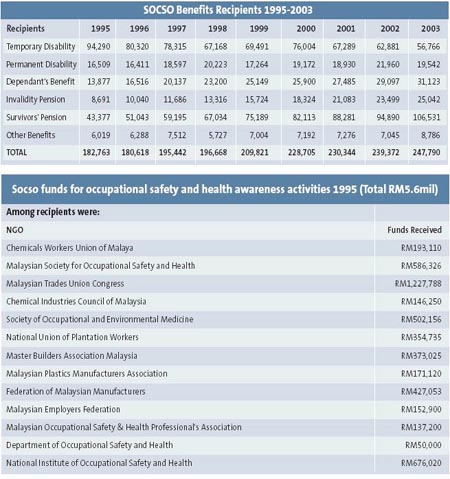
THE statistics are showing a worrying trend – the number of beneficiaries and the amount paid out to injured workers (or benefits expenditure) by the Social Security Organisation (Socso) is set to grow in future.
Last year’s payout amounted to 66% of the RM1.5bil collected from 4.5 million contributors in the country.
Between 1995 and 2003, benefits paid out to injured workers or their dependants increased by 160% but contributions went up only by 70%.
 |
If this current trend continues, Socso’s payout and other expenditure may begin to outstrip its collection.
Socso chief executive officer Datuk Ng Teck said the increase in payouts to injured workers did not pose an immediate problem as its accumulated funds currently stood at more than RM11bil.
“But if we don’t take the necessary steps to reduce work-related accidents and the overall expenditure, there will be cause for concern,” he said.
There is also the possibility that overall benefits and operation expenditure would outstrip the collection and other income within the next 16 to 20 years, he admitted.
“In fact, last year’s investment returns covered our benefits expenditure, but this doesn’t mean the fund will not deplete in the long-run.”
He noted, however, that investment returns from accumulated funds had been encouraging for now because they had been yielding average returns of 7% annually since 1995.
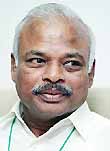 |
Rajasekaran: 'Workers willing to pay more.' |
As a social insurance provider, Socso is required to invest at least 65% of its funds in risk-averse investment portfolios like AA rated bonds (high safety for timely payment of interest and principal) and other fixed income instruments. But it is not allowed to invest more than 30% in equities.
Ng said Socso had taken various steps to reduce accidents and minimise expenditure.
“Our role in creating awareness through campaigns at workplaces is also showing results. The number of work-related accidents dropped by 35% in the past nine years,” he said.
In 1995, there were 114,134 reported cases. The number of cases recorded last year was 73,855.
Over the past nine years, expenditure in organising campaigns to raise public awareness about occupational safety and health increased ten-fold, from RM120,850 in 1995 to RM1,217,647 in 2003.
The upward trend can also be seen in the value of education loans offered to dependants’ children. It increased five-fold from RM6.8mil in 1999 to RM41.4mil in 2003, with the number of students increasing from 777 to 2,243.
Socso is now putting in place a number of schemes, including the “return to work programme”, to avert the scenario of depleted funds. Socso medical and rehabilitation manager Dr Mohammed Azman Aziz Mohammed said the return to work programme would mean additional cost but it would reduce expenditure in the long run.
“We have found that many of those applying for invalidity pension can be sent for the programme so that they can find suitable jobs and remain productive,” he said.
Socso discovered that about 300 invalidity pension beneficiaries were working again, and this is a blatant violation of the Socso Act, he said.
He stressed that the organisation was not trying to deny the rights of insured workers but to help them get back into the job market and feel useful.
While the depletion of funds may be a concern for Socso, the MTUC feels that monthly contributions should be increased as a counter measure.
MTUC secretary-general G. Rajasekaran said it had relayed to Socso that it was willing to increase monthly contributions because the workers were willing to pay more.
“If depletion of money is its main concern, Socso should say so, instead of short changing and cutting corners,” said Rajasekaran, who claimed that the board had ceased to ensure that claimants were duly compensated from the time Socso employed a doctor to scrutinise the board’s decisions two years ago.
“I think doctors in the appellate board used to be more sympathetic but, of late, they have become more restrictive in determining the claimants’ percentage of disability,” he said.
Rajasekaran said the MTUC had received many complaints from its members about the appellate board's reduction of compensation that were originally awarded.
A former union leader, however, is against increasing contributions, saying it would only burden employees and employers.
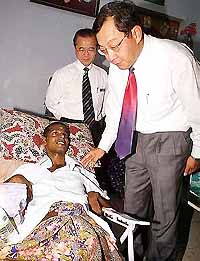 |
ACCIDENT VICTIM: Dr Fong (right) and Ng visiting former lorry driver N. Munusamy, one of the numerous beneficiaries from work-related accidents. |
“Any increase should only be the last option,” he stated. “The organisation should first cut down on wastage, abuses and fraud cases before opting to increasing the quantum of contribution.
“In several parts of the world, such organisations have even collapsed because of fraud and abuses. I hope this will not happen in Malaysia.”
He said Socso should hire more professionals to check on abuses.
Reassuring workers that Socso has their interest at heart, Human Resources Minister Datuk Dr Fong Chan Onn said the organisation had been directed to be as flexible as possible in considering genuine claims while being financially responsible and prudent.
“Within the confines of the law, the Socso Board and management should provide assistance immediately to those in genuine need, and at the same time they must go hard on employers who have not been paying workers’ contributions.
“They must also go after those who are responsible for making fraudulent claims or duping contributors into making such claims,” he said, adding that Socso’s main priority was to look after the social welfare of injured workers.
Dr Fong said one of the ways Socso had increased its contribution base was to raise the monthly wage ceiling for coverage of employees. (This was raised from RM2,000 to RM3,000.)
He said by increasing the wage threshold coverage, Socso would be able to provide coverage to a wider group of employees.
“Socso is also looking at hiring more professionals like doctors and lawyers to better manage the organisation,” he said, adding that it would also look at ways of ensuring medical board doctors carried out their assessments more objectively.
By putting such measures in place, the organisation must make sure that it will not face a depletion in funds in the next 16 to 20 years, as reflected in the worrying trend shown over the past nine years.
Related story:Timely loan helps medical student pursue her dream
Already a subscriber? Log in
Get 20% OFF The Star Digital Access
Cancel anytime. Ad-free. Unlimited access with perks.

