
After becoming the first spacecraft to orbit an asteroid, the NASA probe is now the first to orbit a dwarf planet.
Space probe Dawn has successfully slipped into orbit around Ceres, becoming the first spacecraft to orbit a dwarf planet. “We feel exhilarated,” says lead researcher Chris Russell at the University of California, Los Angeles, in a statement after Dawn radioed back to Earth on March 6.
Located just beyond Mars, Ceres is believed to be a leftover from the formation of the solar system. It’s the second stop on Dawn’s mission to study two of the biggest non-planetary objects in the inner Solar System. Dawn has already completed its 14-month tour of the asteroid Vesta, the largest body in the asteroid belt between Mars and Jupiter.
The probe will now spend about a month re-positioning itself from its initial orbit about 61,000km above Ceres to the first survey altitude of 4,400 km. After that, it will study the dwarf planet for 16 months, descending to as low as 375km above Ceres’ surface to carry out its survey.
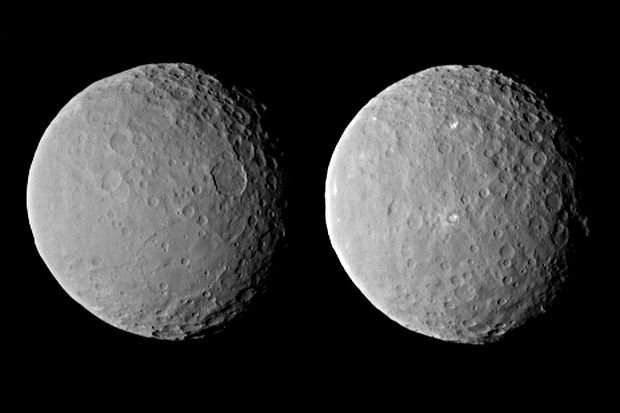
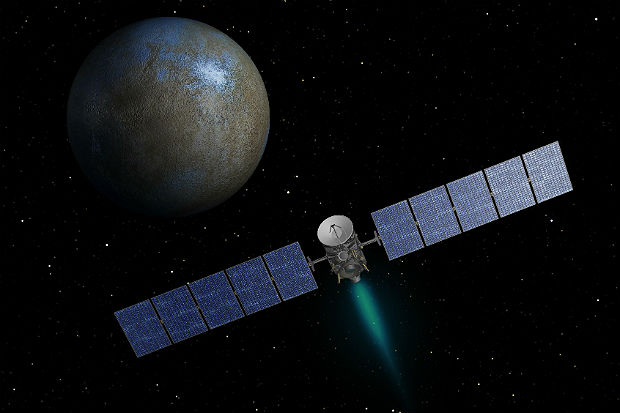
Launched in 2007 and costing NASA about US$473mil (RM1.7bil), Dawn is NASA’s first mission to include stops at more than one extraterrestrial body. In order to do that, Dawn has an ion electric propulsion engine, which requires far less fuel than traditional chemical engines.
Scientists had initially planned for Dawn to fly by Pallas, another dwarf planet, after its stay with Ceres. However, issues with some of Dawn’s onboard equipment have made it impossible, which also means that the probe will be left in perpetual orbit around Ceres after completing its mission in June 2016.
Bright spots
Last month, as Dawn neared Ceres, it relayed images of startlingly bright spots on the surface, which could be patches of subsurface ice exposed after an asteroid or comet impact. They also could be deposits of salt or other minerals.
“These spots were extremely surprising,” says Dawn scientist Carol Raymond of the National Aeronautics and Space Administration’s Jet Propulsion Laboratory in Pasadena, California.
Scientists suspect Ceres may have had an underground ocean early in its history that later froze. Europe’s Herschel telescope last year detected water vapour around Ceres, a clue that impacting bodies may periodically send plumes of watery material shooting into space. Dawn will try to confirm those findings.
Another NASA mission, the New Horizons probe, is scheduled to fly by another dwarf planet, Pluto, in the far reaches of the solar system later this year. Like Ceres, Pluto was once considered a full-fledged planet, but was reclassified after the discovery of similar bodies. – Reuters
Already a subscriber? Log in
Get 20% OFF The Star Digital Access
Cancel anytime. Ad-free. Unlimited access with perks.