MALAYSIA is on track in its fight against corruption in the country, and has charted notable progress.
With as many as 27 initiatives in the Government Transformation Programme (GTP) 1.0 and 18 initiatives in GTP 2.0, National Key Results Area (NKRA) Against Corruption director Datuk Hisham Nordin said the country was on the right path.
“Fighting corruption is like running a marathon. It takes a long time and the finish line is a long distance away,” he said.
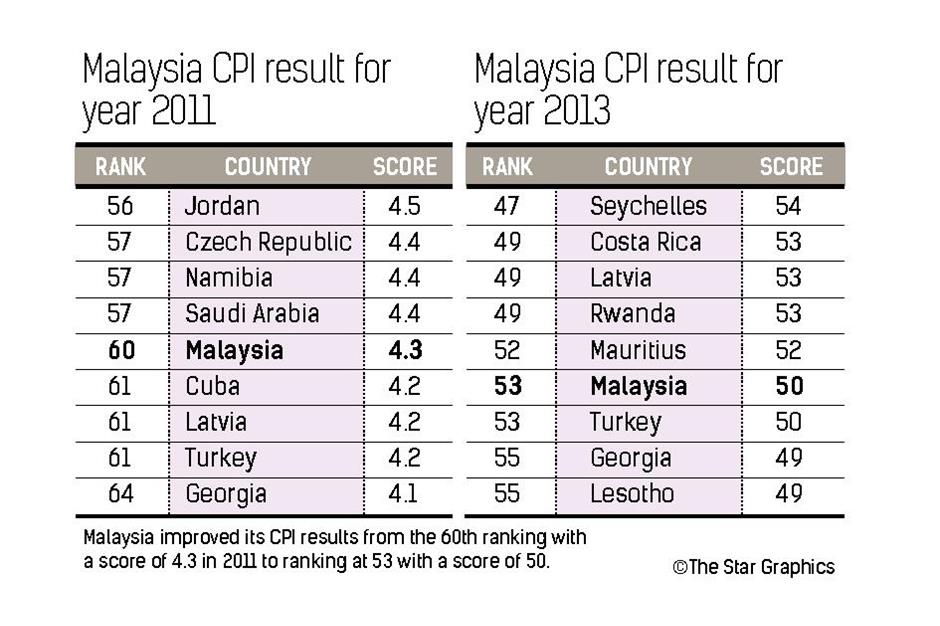
However, he points out that there are encouraging signs along the way as Malaysia’s score on the anti-corruption watchdog Transparency International’s Corruption Perceptions Index (CPI) has improved over the last three years.
“From being placed in 60th spot in the CPI in 2011 with a score of 4.3, we were ranked 53rd among 177 countries in the CPI last year with an improved score of 50,” he said.
A country or territory’s score indicates the perceived level of public sector corruption on a scale of 0 to 100, with 100 means it is perceived as very clean.
Transparency International had previously used a scale of 0 to 10 and updated the methodology of CPI using the new scale in 2012.
Hisham said the numbers indicate that Malaysia is moving towards being “cleaner” where corruption perception is concerned.
Minister in the Prime Minister’s Department Senator Datuk Paul Low Seng Kwan agreed that as long as the scores were not decreasing, it showed that Malaysia was progressive in fighting corruption.
“With many measures taken in the past few years to fight corruption, we are headed in the right direction,” he said.
He admitted that the people’s perception was the biggest challenge as they wanted to see drastic measures.
“They (the people) want to see drastic action and accountability from the Government and civil services.
“Perception cannot be changed overnight.
“It takes time but we are making positive changes this year and there is a slight improvement,” he said, adding that part of his mission was to get Malaysians to be the solution and not the problem.
Working together with NKRA Against Corruption, Low has came up with various anti-graft measures to ensure a cleaner Malaysia, such as setting up the Governance and Integrity Committee (JITU).

The committee comprises 200 chief integrity officers (CIOs) from 700 ministries and government agencies, who have undergone training with the Malaysian Anti-Corruption Commission (MACC) to enhance their skills and understanding of good governance and integrity.
There are more CIOs currently being trained for the committee.
It aims to be an anti-graft monitoring body in the public sector.
“JITU will be responsible for monitoring and reducing abuses, mismanagement and irregularities in the public sector,” said Low.
He said the ministry was looking for a sustainable solution to fight corruption, instead of an ad hoc solution.
He disclosed that JITU would monitor activities within each ministry and agency from top to bottom. from upper to lower-level management.
“Each ministry will also be monitored in its implementation of the Key Performance Indicator (KPI) and the ministries will have to achieve the KPI,” he added.
JITU is expected to bring a substantive change to the government institutions and aimed at weeding out corruption among civil servants.
Low said he decided to set up JITU because each ministry was different and one policy for all was not going to work.
“JITU will implement different initiatives in each ministry, based on the study that they have done,” he said.
According to Hisham, the CIOs are secretaries-general of the ministries.
“Fighting corruption has to start from within and this joint committee will look into the whole structure,” he said.
GTP 2.0 started last year and Hisham noted that one area lacking in the transformation programme was public support and education.
“With the assistance of MACC, Anti-Corruption Secretariats have been established in 20 public universities and 27 teacher training institutions nationwide.
“In addition, elements of anti-corruption and noble values have been incorporated in the secondary school syllabus.” he said.
NKRA Anti-Corruption has also taken the initiative to train members of Parliament and state assemblymen.
The MACC and the Malaysian Institute of Integrity (IIM) will be conducting seminars on integrity, procurement and auditing requirements for Members of Parliament (MPs).
These seminars are meant to provide the MPs with an overview of the dos and don’ts for politicians.
Hisham said that MACC had come a long way since its establishment in 2010.
“We realised the necessity to strengthen the prevention division of MACC.
“We are also looking into various sectors independently and non-government bodies, government-linked companies and private sectors to help us move forward in the prevention side. This will put us on a better path,” he said.
He also said that in an effort to be more transparent, MACC was now using the Video Interview Room (VIR) to conduct interviews with witnesses.
“Everything will be recorded in the VIR and the recording can be used during trials. This will create a sense of confidence among the public in our juridiciary system,” he added.
One of the success stories of NKRA Anti-Corruption is completing almost 75% corruption trials in 2012.
Hisham said there were almost 700 backlog cases in 2009.
“We conducted a study and found that corruption trials were taking too long to be completed.
“On average, the trials take 8.5 years to conclude and some trials stretch to almost 15 years,” he said.
He highlighted that based on past trend, the longer a trial dragged on, the conviction rate decreased.
“Longer trials have about 15% conviction rate. However, we noticed that shorter trials have a higher conviction rate, at almost 75%,” he said.
He then decided to focus on clearing up the backlog of cases.
“It was easier said than done. The infrastructure is available but the judges have to be equipped with the full knowledge of how corruption trials are conducted,” he said.
He also saw to changes in the ranks of judges who presided over the trials, as prior to 2012 the judges appointed to hear the cases were mostly in junior positions.
“We requested to have judges with 15 years of experience and above.
“At the same time, we strengthened the prosecution team and enforced speedy trials to work efficiently,” he said.
“The judge will chair a pre-trial conference and it is agreed that the trial should not go on for longer than one year,” he said, adding that the accused would usually plead guilty during the pre-trial conference if they knew that they could not win the case.
Thanks to this overhaul, MACC finished their backlog cases in 2012 and their conviction rate rose from 54% in 2009 to 82% this year.
Another measure that has helped with fighting corruption in the country is the implementation of the Whistleblower Protection Act 2010.
Malaysia’s Whistleblower Protection Act 2010 came into force on Dec 15, 2010, and is part of the GTP to eliminate corruption.
Under the Act, individuals who expose corrupt practices in the public and private sectors are promised confidentiality and immunity from criminal or civil charges.
The Act has led to an increase in the number of corruption complaints received by MACC.
There are currently 96 individuals whose identities are protected under the Act.
Hisham said the Government hoped to table a Bill in Parliament that will amend the MACC Act to make companies responsible for their employee’s corrupt practices, unless the companies could prove that had have taken adequate measures to prevent it.
At the moment only individuals can be charged for corrupt practices, even if the wrongdoings are committed on behalf of the companies.
The Bill known as Corporate Liability Provision is meant to nudge companies into strengthening their internal processes to combat corruption.
The amendments will be tabled under the Government Transformation Programme’s National Key Results Area (NKRA) on corruption.
“We are hoping that the law will come into force by the end of this year,” said Hisham.
Already a subscriber? Log in
Get 20% OFF The Star Digital Access
Cancel anytime. Ad-free. Unlimited access with perks.