
They qualify for Asean Collective Investment Schemes
KUALA LUMPUR: A total of 11 funds from Malaysia, Singapore and Thailand have been approved by the respective regulators as qualifying Asean Collective Investment Schemes (Asean CIS) under the respective frameworks.
These funds, once approved by the “host” regulators, would enable their offering in the said countries without having to go through stringent or duplication of processes. Of the 11 funds, five are from Malaysia and Singapore each, while the remainder is from Thailand.
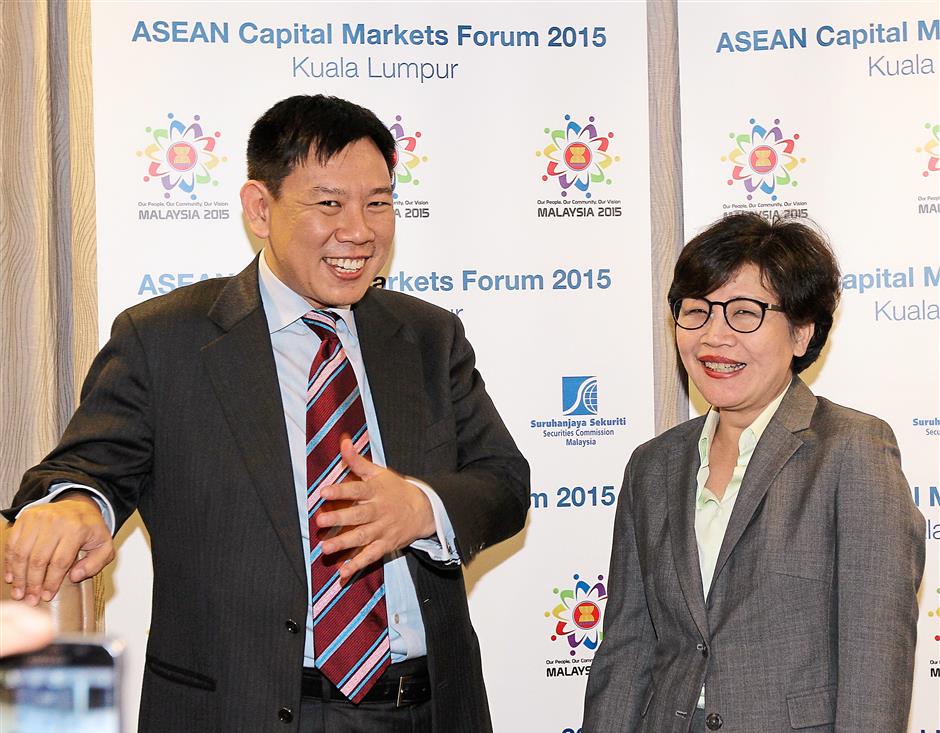
“The initiative is to make CIS an asset class in itself. The idea is that the funds that are offered in one Asean jurisdiction should be all right to sell in another, with minimum regulatory obstacles. Without it, it is not possible at all to sell, say, Malaysian funds in Thailand or vice-versa because they only permit funds that are created and offered by fund-management companies that are a resident of that country,” Tipsuda Thavaramara, Thailand Securities Exchange and Commission assistant secretary-general, told StarBiz in an interview.
Securities Commission executive director for corporate finance and investments Eugene Wong said that of the five Malaysian funds, four have already been recognised by the Monetary Authority of Singapore.
“Malaysia is in the process of recognising one of the Singapore-qualified CIS,” he told StarBiz.
Malaysia together with Singapore and Thailand had signed a memorandum of understanding in March this year to establish the Streamlined Review Framework for the Asean Common Prospectus, which could expedite the review and approval process for cross-border initial public offerings.
Thavaramara said the condition under the framework is that for a fund to be sold under this scheme, it has to be accepted by the home regulator and can be sold in the home jurisdiction first.
“In order words, you can’t have a Thai fund that is not sold in Thailand selling in Malaysia. They don‘t accept that yet. They want some degree of skin in the game,” she said.
In 2009, one of the objectives under the Asean Capital Markets Forum (ACMF) plan was to support the objective of freer flow of capital, mainly because the bulk of savings in the Asean region was being “recycled” elsewhere rather than within the region.
“You may find people who have money in Asean going through a private banker investing in an US fund that maybe comes back as an Asean infrastructure fund. Or, you will find that people actually don’t have the money to invest directly in say 10 shares in every country because they need a pooling vehicle to do so,” said Wong.
In the past, there was no direct access to foreign mutual funds. Instead, it was through a local feeder fund.
Requirements for a fund to get through the approval process include the fund operator having a five-year minimum track record, as well as assets under management of at least US$500mil.
“You don’t need to be a regional player to play the regional game. It could be a local partner who is also a standalone,” said Thavaramara.
The Asean CIS framework is an initiative undertaken by the ACMF to encourage intra-regional investment flows and transactions.
The framework, adopted by Malaysia, Singapore and Thailand so far, allows fund managers operating in a member jurisdiction to offer CIS, such as mutual funds, constituted and authorised in that jurisdiction to retail investors in other member jurisdictions under a streamlined authorisation process.
To be a part of the Asean CIS, jurisdictions would have to be willing to amend their laws a little, said Thavaramara.
“If a qualifying fund comes from another country, and they say they are qualified, then you have to speed up the approval process, although technically, you have the authority to reject. For some jurisdictions, it might amount to some giving up of some authority to explicitly say that they will rely on another jurisdiction’s work,” she said.
She added that the exercise the participating jurisdictions had to undergo to come up with the regime resulted in a better understanding of their own process and other jurisdictions’ processes.
Wong said it was encouraging that now Vietnam and Indonesia had signed on as signatories.
He said to ease communication and selling of the approved funds, the fund management companies would appoint a local distributor and representative in the host country. “So there is some control there because the local guys won’t missell. Once you are recognised by the home regulator, the host regulator will approve you in the same time as it would a domestic fund.”
He added that the mutual fund represented a very big growth market in Asean. Malaysia, Singapore and Thailand have a market penetration rate of 25.4%, 4.2% and 24.1%, respectively. Meanwhile, Indonesia and the Philippines have a 5.2% and 7.1% penetration rate.
Already a subscriber? Log in
Get 20% OFF The Star Digital Access
Cancel anytime. Ad-free. Unlimited access with perks.