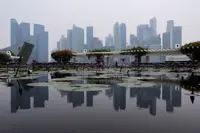
WHEN we think of large buildings, especially high-rises, we rarely consider just how much energy is needed to keep these buildings running.
In Malaysia, large and high-rise buildings account for almost 40% to 50% of energy consumption and 30% of greenhouse-gas emissions. Left unchecked, this could put further stress on our already strained environment.
But changing the way buildings are designed, built and run will make them more energy-efficient and can have a significant impact on energy policies, notes architect Von Kok Leong, who is with the Green Building Index (GBI), a group that promotes sustainable architecture.
“Green, or sustainable, architecture focuses on increasing the efficiency of resource use while reducing the building’s impact on human health and the environment during its life cycle. This can be done through better siting, design, construction, operation, maintenance, and removal.
“Green Buildings, as these buildings are known, should be designed and operated to reduce the overall impact of the built environment on its surroundings. In order to design, build and operate in a world affected by climate change, the need for scalable solutions applied within the local context is key, which is where GBI comes in,” he explained.
GBI is a green certification rating designed by the Malaysian Institute of Architects (PAM) and the Association of Consulting Engineers Malaysia (ACEM) for Malaysia’s tropical climate and current social, infrastructural and economic development.
A green building is achieved when six key criteria are met — energy-efficiency, indoor environmental quality, sustainable site planning and management, materials and resources as well as water efficiency and innovation.
Von, who is chairman of the GBI Accreditation Panel, said Malaysian architects and developers were increasingly moving towards green buildings.
“Since GBI was first introduced to Malaysia in 2009, there has been a significant increase in projects applying for the certification.
“When it was first introduced, there was only one project certified green, but now we have more than 240 projects certified and a further 597 building projects in the country vying for the certification.
“Part of the reason is the increase of awareness among developers and buyers about the benefits of green buildings such as allowing building owners to command an additional selling price above the market price,” he said.
Since 2009, 88 projects in Kuala Lumpur and 89 in Selangor have been certified.
An additional 162 projects in Kuala Lumpur and 211 in Selangor have applied for the GBI certification.
Von, who was also a member of the Joint LAM-PAM Sustainability Committee that helped establish GBI, said buildings that had been certified by GBI had generated more than 108mil sq ft (gross floor area) of green space in the country.
“These buildings are able to reduce CO2 (carbon dioxide) emissions by 475 tonnes annually,” he said.
Achieving GBI status
For a building project to receive accreditation from GBI, there are several stages and criteria that need to be fulfilled.
In Stage One, applicants complete and submit the GBI Application Form and a registration fee will be set depending on the size of the project. Upon payment of the fees, a GBI Certifier will then be appointed for the project.
Stage Two is where the Design Assessment (DA) is done. During this stage, applicants can submit their project design either directly or through an appointed GBI facilitator.
“Submissions should be done when all key criteria of the design are finalised and preferably before the commencement of construction, to enable the project to be monitored and assessed in its entirety.
“The GBI Certifier will, upon completion, table the assessment report to the accreditation panel to register and award the certification. The provisional GBI DA certification will then be issued with an accompanying GBI score sheet to show the scores achieved,” Von said.
“Once the project is completed, the Completion and Verification Assessment (CVA) will be conducted during Stage Three.
“This is to be done within 12 months of completion or when the building is 50% occupied, whichever is earlier. The final GBI award will be issued by the Accreditation Panel upon completion of this CVA assessment,” he explained.
“We conduct consultations every fortnight for GBI project applicants and those who intend to pursue GBI certification.
“The sessions consist of 30-minute discussions with our panellists relating to technical questions on GBI certification including the three stages of Application and Registration, DA and CVA submission,” he added.
Buildings are awarded GBI Platinum, Gold, Silver or Certified ratings depending on the scores achieved and will have to be re-assessed every three years in order to maintain their GBI rating to ensure they are well-maintained.
Going green
The lure for architects and builders to go green has increased during the past few years in large part due to the falling cost of sustainable materials.
Von said the cost of making a building green was not as much as most people would think.
“Sustainable materials are increasingly easy to come by locally as the demand has grown.
“In fact, greening buildings does not necessarily require high technology,” he said, adding that a return on investment could usually be seen within one to five years.
Von said unlike other countries that had made it mandatory for all buildings to be energy-efficient, in Malaysia it was done on a voluntary basis.
Building materials typically considered to be “green” include lumber from forests that have been certified to a third-party forest standard, a rainwater harvesting system, use of light-emitting diode (LED) lamps, and a landscape area of about 10% to 15% out of their total development area.
“Well-designed buildings also help reduce the amount of waste generated by the occupants by providing on-site solutions such as waste sorting to reduce matter going to landfills.
“Even having 3R bins in and around the building can help in greening the building,” he highlighted.
He said current building bylaws and codes needed to be upgraded to meet higher standards of building performance, which indirectly required the use of greener materials.
“In the long term, the most successful way to drive energy use down is in operations and the behaviour of occupants,” he reiterated.
Already a subscriber? Log in
Get 20% OFF The Star Digital Access
Cancel anytime. Ad-free. Unlimited access with perks.