
David Rosen, a Brooklyn-born entrepreneur who transformed his photo booth business in Japan into Sega Enterprises, the video game giant that dominated arcades, basements and dorm rooms with blockbusters like Mortal Kombat, Sonic The Hedgehog and NHL ’94, died Dec 25 at his home in Los Angeles. He was 95.
His death was confirmed by Annette van Duren, a spokesperson for his family.
During a four-decade career that began in the 1950s with coin-operated machines and culminated with the introduction of cutting-edge home gaming systems, Rosen was a visionary figure who helped shape what is now a US$200bil (RM811.26bil) industry.
“It is eminently clear that computer video games are a sign of the times,” he wrote in Play Meter magazine in 1982. “And by that I mean the games are truly one of the early manifestations of an electronic revolution whose technology will personally touch, on an increasing basis, all of our lives.”
As chair of Sega’s US operation in 1989, Rosen oversaw the introduction of the company’s Genesis gaming console to North America, a product that directly challenged the near-monopoly that Nintendo, its main competitor, had in American homes.
Sega marketed its system to teenagers and young adults who had played Nintendo as children, positioning Genesis as more technologically advanced, with a lineup of grittier, more intense games. In doing so, the company forged the creative and commercial blueprint that turned gaming into a cultural touchstone.
During the 1990s, Genesis was seemingly everywhere: in commercials during the MTV Video Music Awards; on an episode of Roseanne, when the title character’s son, D.J., huffs off to play Genesis at a friend’s house when his parents won’t buy him a Nintendo; and in the 1996 movie Swingers, when Trent, played by Vince Vaughn, makes Wayne Gretzky’s head bleed in a popular hockey game.
Players would greet each other by shouting, “Sega!” parroting the signature ending of the company’s commercials.
“Everything that Sega was able to do in the ’90s was built on the foundation that Rosen built,” Ken Horowitz, the author of Playing At The Next Level: A History Of American Sega Games (2016), said in an interview. “The industry would not have become as big a thing as it is today if not for him.”
Rosen took a circuitous path to gaming eminence.
In the late 1940s, while stationed in Japan with the US Air Force, he became enamored with the country’s culture, especially its art. After his discharge in 1952, he moved to New York and started a business selling portraits by Japanese painters. It wasn’t exactly a success.
In 1954, Rosen moved to Tokyo, where he noticed a booming market in photo identification cards for school and work.
After learning that shops took about three days to process photos, he thought he could shorten the wait to mere seconds by importing photo booths like the ones he had seen in American amusement parks.
He started a company, Rosen Enterprises, which installed hundreds of the machines around Japan – in movie theatres, restaurants and stores.
“There were different times when people would go through school applications and whatnot, and it was not unusual at those times of the year for the lines to get into the booth to be an hour, hour and a half,” he said in an interview with gaming journalist Steven L. Kent for the book The Ultimate History Of Video Games.
In the late 1950s, when the typical workweek in Japan shrunk from six or seven days to five and leisure time exploded, Rosen began thinking of ways to enter the entertainment market.
“The popular entertainment at that point in time in Japan was pachinko, dance studios, bars and cabarets,” he said in an interview with Next Generation magazine. “None of these were something I wanted to get involved in, so I thought, ‘Gee, coin-operated games’.”
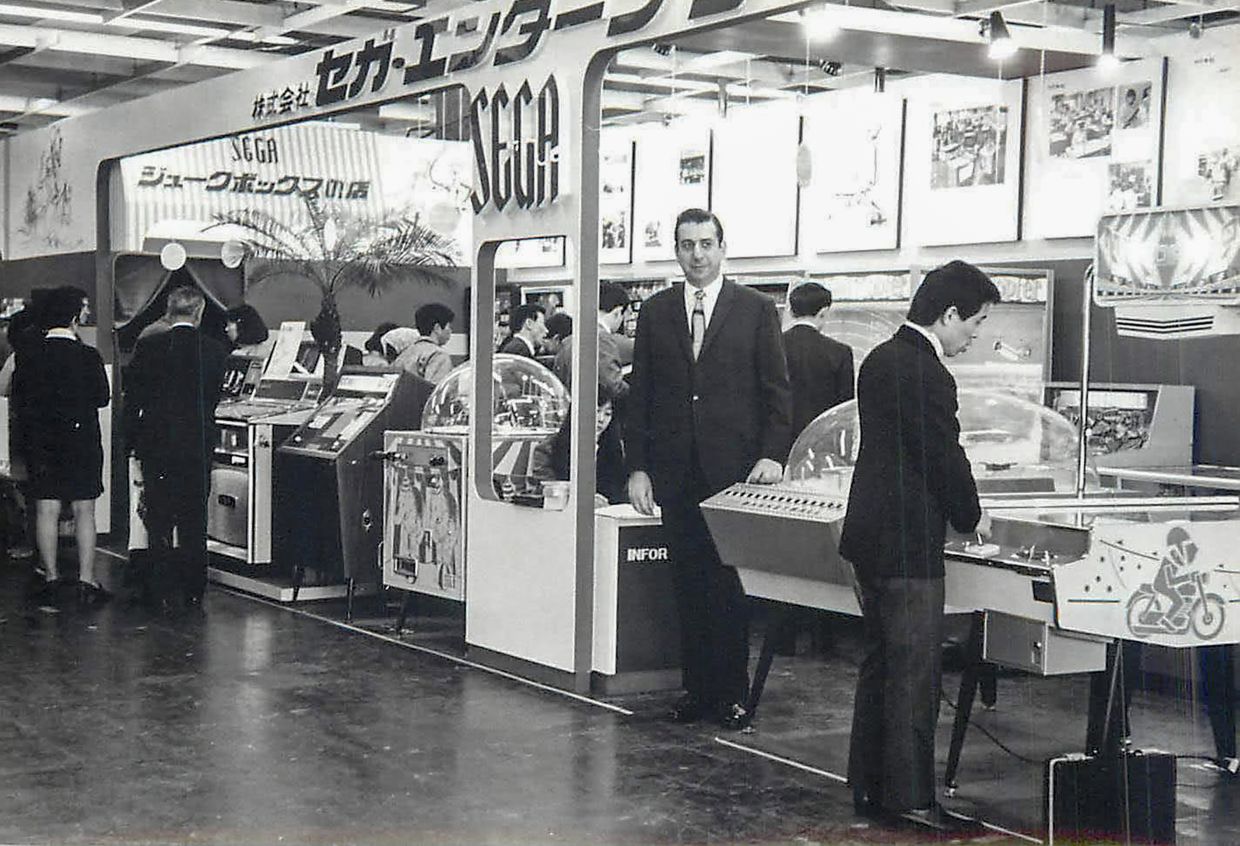
Pinball machines, mechanical claws and shooting galleries had become popular arcade games in the United States but were virtually nonexistent in Japan. Rosen cut deals with US distributors to import older arcade games that were gathering dust in warehouses, then installed them in the same locations as his photo booths.
The games, especially the shooting ones, were an immediate hit. Before long, several Japan-based competitors emerged. The biggest was Service Games, a jukebox manufacturer that had transformed into an arcade operator. In 1965, Service Games and Rosen Enterprises merged, becoming Sega Enterprises.
The newly formed company quickly released its own games, beginning with Periscope, a submarine simulator designed by Rosen, in which players fired projectiles at cardboard ships. The game was a huge hit, and Sega exported it to the United States.
In 1972, Atari released the video game Pong. Sega imported it to Japan. Soon, the company was making its own video games – first for arcades and eventually for its home consoles, starting with the SG-1000 in 1983.
To Rosen, gaming represented an entirely new category of entertainment.
“Activities such as television, movies, sporting events and records or the radio all have a valid place in our society, yet all these forms of entertainment lack an important factor in satisfying a fundamental need,” Rosen wrote in Play Meter. “That need is active participation, which is, of course, what computer video games are all about.”
David Rosen was born in Brooklyn, New York, on Jan. 22, 1930, to Samuel and Fay (Sacks) Rosen. His father was an importer and also owned a chocolate factory.
After joining the Air Force when he was 18, Rosen was stationed throughout Asia, serving as a writer for Armed Forces Radio. He also worked in the finance office on a military base.
He married Masako Fujisaki in 1954. She died last year. His family declined to provide information about his survivors.
Rosen stayed with Sega through several mergers. He retired in 1996 as the company was in the early stages of losing battles against Sony, which boasted the PlayStation console, and then Microsoft, with Xbox.
“Sega just didn’t have the financial resources to battle with these bigger companies, which could afford huge losses until their machines became profitable,” Horowitz said. “Sony and Microsoft just had endless supplies of cash.”
Sega is now part of Sega Sammy Holdings Inc, a Japan-based entertainment conglomerate. In addition to making its own games, the company purchased Rovio, the developer of Angry Birds, in 2023. This year, Sega will celebrate the 35th anniversary of Sonic The Hedgehog.
Late in his career, Rosen marveled at how far he had come.
“When I was a youngster, I went to Coney Island,” he said in The Ultimate History of Video Games. “Like everybody else in New York City, I played the games in the penny arcades. That was really my total knowledge of the business.” – ©2026 The New York Times Company
This article originally appeared in The New York Times.