




Chinese AI start-up DeepWisdom, which has launched its Atoms multi-agent application, wants to make life easier for solo entrepreneurs by deploying AI agents to serve in different roles, in what may be a glimpse of the future of work.
“We want everyone to be able to realise their ideas at very low cost,” Alex Wu Chenglin, founder and CEO of DeepWisdom, said in an interview with the Post. “Each person can become one of the building blocks of society.”
Previously known as MGX, Atoms allows users to build products such as websites, apps and games simply by describing their ideas in natural language.
Behind the scenes, a virtual team of AI agents steps in, acting as team leader, engineer, product manager, data analyst, architect, deep researcher and even search engine optimisation specialist. The system, powered largely by open-source AI models including Alibaba Group Holding’s Qwen and DeepSeek, aims to deliver a finished product without the user writing a single line of code.
DeepWisdom, backed by Ant Group, Cathay Capital, Jinqiu Capital and Baidu Ventures, is pitching Atoms as the next step beyond “vibe coding”, a term popularised by OpenAI co-founder Andrej Karpathy to describe coding done with prompts based on intuition. Ant is the fintech affiliate of Alibaba, which owns the Post.
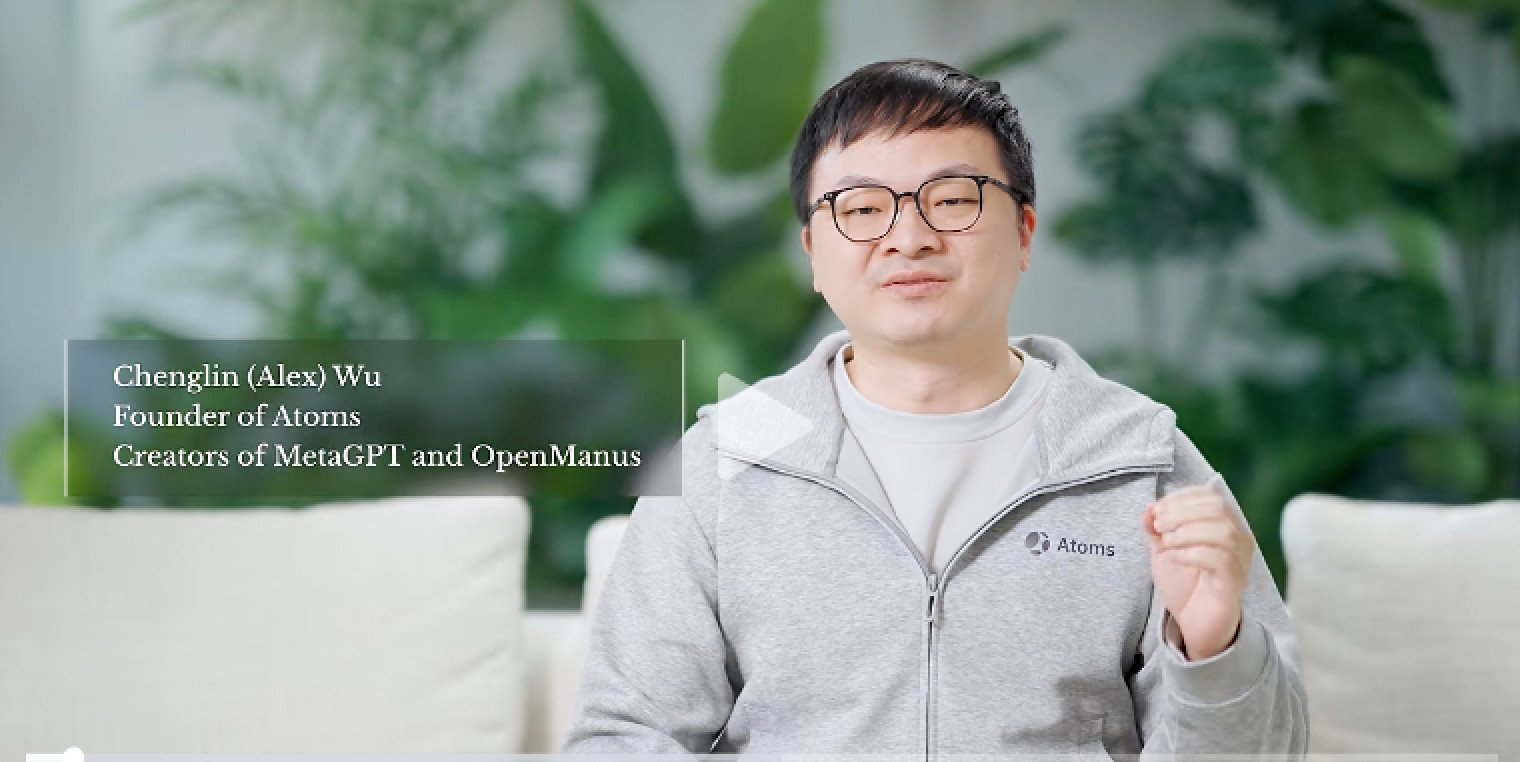
Wu called this next phase “vibe business”, where AI agents do not just help write code but effectively serve as employees who execute tasks end to end. The Atoms website showcases a library of templates designed to help users prompt and coordinate these agents.
“The human world is built on a series of accidental ideas,” Wu said. “When random ideas combine, they can create enormous value. With Atoms, turning an idea into something real becomes much easier.”
Currently, DeepWisdom employs about 100 people and expects that number to double by April next year.
Atoms is launching amid a global surge of interest in so-called AI agents – systems designed to carry out tasks autonomously, rather than simply answering questions in a chat window. Major AI model developers such as Anthropic, OpenAI, Google and Alibaba are all pushing agent-style features, while start-ups including Cursor and Windsurf have gained traction for their coding-focused tools.
More general-purpose platforms like Replit, Lovable, Genspark and Manus are also competing in the space. Compared with traditional chatbots, these products consume far more “tokens” as they attempt to finish multi-step workflows.
Founded in 2019, DeepWisdom raised 220 million yuan (US$31 million) in the first half of last year from investors, but has not disclosed its valuation. In comparison, Replit is nearing a funding round that would roughly triple its valuation to about US$9 billion, Bloomberg reported. Meanwhile, Chinese-founded AI agent start-up Manus is being acquired by Facebook owner Meta Platforms, although Beijing is reviewing the deal for compliance with its own export controls.
Wu, 36, who graduated from Xiamen University with a degree in computer science, previously worked at Huawei Technologies and Tencent Holdings, particularly on their early AI projects. At DeepWisdom, he has initiated several open-source projects that have gained wide recognition in the developer community, including a multi-agent framework called MetaGPT.
The team also released OpenManus, an open-source alternative to Manus, which was replicated by developers on the same day it launched.
Beyond commercial products, Wu also leads an organisation called Foundation Agents, which brings together researchers from top universities for collaboration and tracking of cutting-edge developments in AI research.
Within the first month of its launch in February 2025, Atoms – then still branded as MGX – attracted 500,000 registered users globally and reached an annual recurring revenue of US$1 million, according to the company.
By September last year, MGX was seeing 1.2 million monthly visits and generated more than 10,000 applications per day. Its users are geographically dispersed, with paying users from more than 100 countries. The company is eyeing overseas expansion, including in the US.
Atoms currently generates income through subscriptions and by selling credits needed by users to run tasks. Wu said the commercial potential of applications built on the platform could also become a potential future revenue stream for DeepWisdom.
“In the future, silicon-based labour [AI and robots] will be scaled infinitely, while carbon-based labour [human beings] becomes less important,” Wu said, describing the idea as “silicon scaling”.
In his view, the history of software was essentially humans programming silicon through all kinds of coding languages, which may no longer be necessary. “Silicon will optimise silicon,” he said, triggering an explosion in productivity. “Human ideas and trust will matter more.” – South China Morning Post


