




In Wufeng Tujia autonomous county, Hubei province, the rugged beauty of central China masks the region’s long-standing isolation. Its steep terrain and dense forests have long hindered transport, stifling growth and keeping communities cut off both physically and economically.
But a new force is now reshaping the landscape – with dynamite, drilling rigs and lines of code.
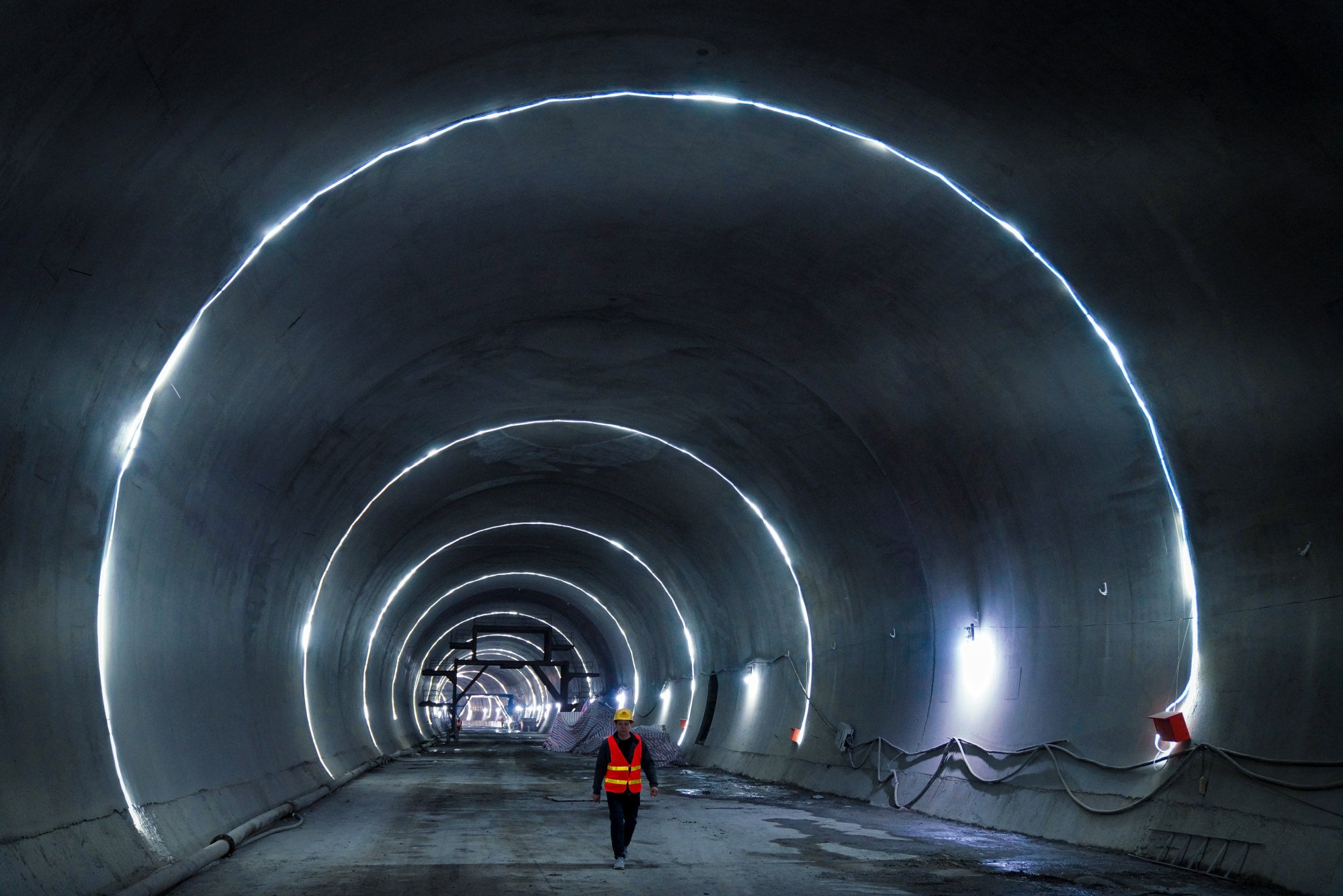
The Yangcun Tunnel in Wufeng is part of a high-speed rail line designed to bring 350km/h (217mph) trains into one of China’s most geologically complex regions. It represents the world’s first high-speed railway tunnel whose construction method was mainly determined by an artificial intelligence (AI) system – before being executed by human engineers and workers.
This milestone could mark a pivotal moment for the global AI race.
The tunnel cuts through the heart of Wufeng, a region shaped by hundreds of millions of years of geological upheaval. The area sits within the Wuling Mountain range, characterised by karst landscapes, deep fractures, fault zones, underground rivers and highly variable rock formations.
Wufeng is known to host over 120 recorded geological relics, including caves, sinkholes and stone spires – testaments to its volatile subterranean world.
Digging a tunnel here is a huge challenge, according to the AI project team led by Wu Jiaming, senior engineer with the China Railway Siyuan Survey and Design Group. Workers could encounter a cavity, water pocket or loose shale. Traditional design methods rely heavily on the experience of individual engineers – but experience does not always work across hundreds of tunnel segments.
One misjudged section could lead to collapses, flooding or catastrophic delays.
Until now, choosing the right excavation method – whether full-face blasting, bench cutting or the cautious CD (centre diaphragm) method – was considered one of the most critical decisions in tunnel engineering, reserved for veteran experts.
But in the case of Yangcun Tunnel, that decision was made by a machine.
The AI system behind the breakthrough, developed jointly by researchers from China Railway Siyuan, the National & Local Joint Engineering Research Centre of Underwater Tunnelling Technology, and the China University of Geosciences (Wuhan), is a deep learning model trained on a vast archive of historical tunnel designs.
The team compiled a database of 1,700 tunnel construction sections from 251 high-speed rail tunnels across China – data collected over decades of relentless infrastructure expansion. Each entry included 19 key factors: rock type, groundwater levels, fault lines, burial depth, tunnel alignment, proximity to entrances and more.
And this is just a fraction of the data available in China.
“By the end of 2024, China had put into operation a total of 18,997 railway tunnels, including 4,917 high-speed railway tunnels,” Wu and his colleagues wrote in a peer-reviewed paper published in the journal Railway Standard Design on November 5.
“Through decades of tunnel construction, China has accumulated vast and valuable historical design data as well as rich practical experience.”
This data advantage allowed the team to train a multi-scale convolutional neural network enhanced with attention mechanisms (ACmix) and a specialised loss function (Focal Loss) to handle rare but dangerous conditions. The result was an AI that not just recognised patterns but also understood them.
When fed real-time geological data from Yangcun Tunnel’s planned path, the AI did not give a single answer. Instead, it segmented the tunnel into hundreds of sections, each receiving a customised construction recommendation – full-face method here, three-step method there or CD method in a high-risk zone.
The model achieved an 89.41 per cent accuracy rate in predicting optimal construction methods – outperforming traditional machine learning models like Random Forest and SVM (Support Vector Machine) by nearly 3 percentage points. Crucially, it improved predictions for rare but dangerous scenarios – such as CD method zones – from near-zero to 64 per cent accuracy after integrating Focal Loss.
The United States has no operating high-speed rail lines running at 350km/h. Amtrak’s Acela mostly tops out at 240km/h and covers just 740km (460 miles).
China has launched a series of megaprojects in recent years, including the Sichuan-Tibet Railway and the Yarlung Tsangpo dam on Tibet’s longest river, expected to be three times more powerful than the Three Gorges dam. These projects demand innovation at scale – creating both the need and the resources for AI adoption.
Unlike many Western firms that treat AI as a separate “tech experiment”, Chinese engineering firms are integrating AI directly into design workflows, according to some industrial reports.
For the Yangcun project, the AI-generated plan was reviewed and approved by senior engineers – then fully implemented in construction. The tunnel’s building information modelling system now carries the AI’s method recommendations as embedded metadata, guiding workers and machines in real time, according to Wu’s team.
The significance of the Yangcun Tunnel extends beyond one mountain pass. It shows that AI can now make high-stakes engineering decisions once considered too complex or risky for automation.
This shift could speed up infrastructure development worldwide – especially in developing nations facing similar terrain challenges, according to the researchers.
China is industrialising AI on a large scale for critical sectors like construction, transport and energy.
Some Chinese construction companies use AI and Internet of Things (IoT) sensors to monitor workers, predict delays and optimise equipment usage in real time.
AI is also embedded throughout China’s ongoing high-speed rail expansion, including automated tunnel boring machine control, using the technology to adjust pressure and speed based on geological feedback, intelligent scheduling of construction phases using generative AI models, and defect detection in tracks and tunnels via AI-powered image recognition.
China is also building a large number of smart dams, where AI and automated machines are used throughout the design, construction and operation phases. – South China Morning Post



